


If you prefer to always view the website in English, please click here.
{{content.phone.title}}
{{content.phone.text}}
{{content.phone.phoneText}}
{{content.form.title}}
{{content.form.text}}
{{content.form.success.title}}
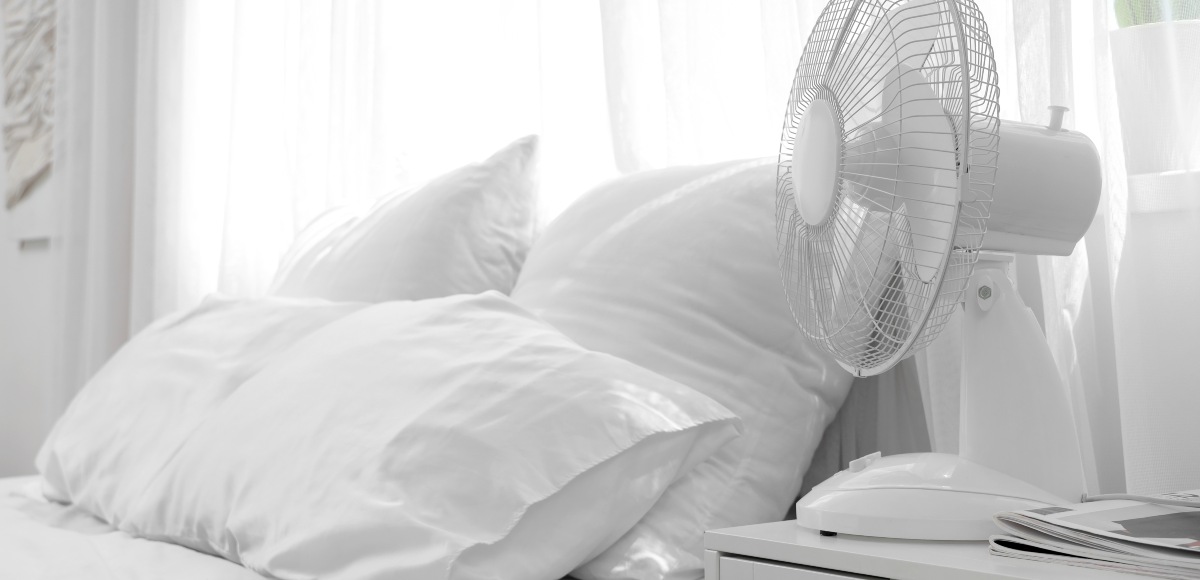
The name might sound evocative and even romantic, but tropical nights have become one of the most dreaded summer weather phenomena in Spain. With night-time temperatures that make it impossible to sleep, these are days when our air conditioning and fans don't get a rest either.
Have you ever wondered which one cools you down more? Which uses more energy, a fan or air conditioning? Are there any tricks to stop tropical nights from sending your electricity bill sky-high? Read on for answers to these questions and a few top tips to help keep your bill in check.
What is a tropical night and why does it make it harder to sleep?
When temperatures fail to drop below 20°C throughout the night, it is classed as a tropical night. The term refers to certain tropical regions of the planet where it is normal for the heat to remain constant 24 hours a day.
The direct effect of this phenomenon is that we find it harder to sleep: our bodies need an environment of 20°C or less to enter the deep sleep phases (physical relaxation and REM sleep) necessary for good mental and emotional health.
If these phases are disrupted, the consequences are well known: frequent waking, accumulated fatigue, irritability, poor concentration and memory, and even respiratory and cardiovascular risks in severe cases.
Alerts for tropical nights have increased in recent years. What's more, they are now competing with two even more extreme weather anomalies. One is equatorial (or torrid) nights, where temperatures consistently stay above 25°C. The other, becoming more common and dangerous every summer, is the so-called hellish night, where the thermometer refuses to drop below 30°C.
The bottom line is that getting a good night's sleep comes at a price: cooling our homes. Whether using air conditioning, fans, or other methods, beating the heat means using more energy and, ultimately, facing a higher electricity bill at the end of the summer. Tracking this usage can help you plan your cooling strategy.
The formula for calculating how much it costs to stay cool at night
To figure out exactly how much getting to sleep on a tropical night will cost you, just do a simple calculation based on your device's power rating:
- Divide the power rating (shown in watts or W on the specifications) by 1,000. This gives you the electricity consumed per hour (in kWh).
- Multiply this by the number of hours the device is on during the night to cool the room.
- Finally, multiply that result by your electricity tariff's kWh price.
This means that if you use a 1,000 W air conditioning unit for 2 hours before bed, you will use 2 kWh (one per hour). At a price of €0.109/kWh (like Endesa's Conecta Luz Tariff), your electricity cost per night is roughly €20 cents.
However, not all cooling methods use the same amount of power. Since they are used differently, it is worth looking at them one by one.
How much does it cost to leave a fan on all night?
Compared to an air conditioning unit, a fan uses considerably less electricity per hour. However, you need to bear two things in mind:
- Unlike air conditioning, a fan doesn't actually lower the room temperature; it just makes you feel cooler.
- The cooling effect stops as soon as you turn it off, so you will need to leave it running all night.
Furthermore, there is a huge variety of fans available – from pedestal to desk and ceiling models – with different features that also affect their energy use, such as remote controls, speed settings, noise reduction, oscillation options, blade size, or built-in lights.
As a rough guide, here is a comparison of how much different fans cost to run all night:
|
Power |
Hours of use |
Cost per night |
|
|---|---|---|---|
|
Desk fan |
30 W – 45 W |
8 h |
€0.026 – €0.039 |
|
Pedestal fan |
40 W – 55 W |
8 h |
€0.035 – €0.048 |
|
Ceiling fan |
50 W – 70 W |
8 h |
€0.044 – €0.061 |
Calculations based on the price of €0.109/kWh for Endesa's Conecta Luz Tariff.
How much it costs to beat tropical nights with air conditioning
There is a massive difference in energy use between fans and air conditioning. This remains true even when factoring in an AC unit's ability to genuinely lower the ambient temperature, cooling the room down quickly for the whole night.
While energy efficiency varies wildly between models, comparing the previous table with this estimate for 2 hours of air con use paints a clear picture:
|
Power |
Hours of use |
Cost per night |
|
|---|---|---|---|
|
A/C para ≤10 m2 |
900 W – 1.000 W |
2 h |
€0.20 – €0.22 |
|
A/C para ≤ 20 m2 |
1.500 W – 2.000 W |
2 h |
€0.33 – €0.44 |
|
A/C para > 30 m2 |
3.000 W – 3.500 W |
2 h |
€0.65 – €0.76 |
Calculations based on the price of €0.109/kWh for Endesa's Conecta Luz Tariff.
In short, having a genuinely cool room when you go to sleep can cost up to 10 times more with air conditioning than with a fan. Because of this, when simply moving the air isn't enough, you need to use your air con as efficiently as possible.
How to use sleep, eco, or fan modes to save on night-time cooling
Using your air conditioning's sleep, eco, or fan settings at the right time can help lower your consumption.
Sleep mode adapts the air con so the room doesn't get too cold, nudging the temperature up a couple of degrees after the first few hours. It also runs at a lower speed, reducing motor noise so you aren't disturbed. This reduces the strain on the compressor and fans, meaning it uses less energy than running at normal power all night.
Eco mode, meanwhile, automatically adjusts both temperature and power based on the room's conditions. This feature is especially handy if you leave the air con on for long periods, potentially saving up to 30% on electricity depending on the model. However, it isn't ideal if you need to cool a room down quickly.
Finally, fan mode cuts the air con's energy use down to roughly that of a standard fan. It circulates the air using the unit's internal fans without engaging the energy-hungry compressor, making it a great option if the room is already at a comfortable sleeping temperature.
When to use a fan and when to turn on the air conditioning
As we have seen, there is a huge difference in running costs. The more you rely on a fan, the less you will pay for air conditioning.
It is true that fans don't lower the temperature. But they do cool you down: the breeze accelerates the evaporation of sweat, lowering body heat and reducing the 'feels like' temperature by 3°C to 5°C.
As long as tropical nights don't cross into equatorial territory (above 25°C), a fan – especially a ceiling fan – is often more than enough to help you sleep.
However, on hotter nights, or if your bedroom has trapped the daytime heat, turning on the air conditioning is a better idea.
Tropical night tricks: how to lower the cost before bed
People often make a classic mistake on sweltering nights: waiting until bedtime to start cooling the room.
If you cool the room down beforehand, you get two main benefits:
- You won't waste the first few hours of the night tossing and turning while you wait for the temperature to drop.
- You will use significantly less air conditioning.
One trick is to keep the room protected during the day. Air it out first thing in the morning to catch what might be the only cool breeze of the day. Keep windows closed and blinds down when it is hottest outside, especially if the sun hits the facade directly. Leave the bedroom door open so it can benefit from any cool air you generate in the rest of the house.
You can combine all these tricks with turning the air con on an hour before bed. Once the room is cool, you can turn the unit off as you get into bed and sleep comfortably with just a fan.
Other ways to beat the heat while you sleep
In recent years, cooling innovations have kept pace with climate change.
Today, alongside traditional ACs and fans, there are some great alternatives for cooling and protecting smaller rooms:
- Bedside fans, powered by the USB ports increasingly built into alarm clocks, provide a gentle breeze over the bed while using barely any energy.
- Blackout curtains, made from layered fabrics and materials, do a brilliant job of maintaining the indoor temperature and stopping cold air from escaping through windows and frames.
- Evaporative coolers are perfect for hot, dry climates. They cool the air using only cold water, making them much cheaper to buy and run than traditional air conditioning units.
FAQs about cooling and tropical nights
What is the difference in cost between sleeping with a fan and air conditioning?
Air conditioning can use up to 10 times more energy than a fan, so it is always best to stick to a fan if it keeps you cool enough.
Is it unhealthy to leave the air conditioning on overnight?
In some cases, yes. Because our body's awareness drops while we sleep, we don't always notice if the room gets too cold. This can lead to generally mild issues, typically affecting the respiratory tract.
Which air conditioning mode is best: eco, sleep, or fan?
It depends on what you need. Eco mode offers the best energy savings over the whole night, though it takes a little longer to cool the room. Sleep mode gradually adjusts the output over several hours to save energy and stop you from freezing. Fan mode just circulates the air without cooling it, saving electricity when it is not too hot.
What is the difference between tropical, equatorial, and hellish nights?
On tropical nights, the temperature doesn't drop below 20°C (the minimum for a restful sleep). On equatorial nights, it stays above 25°C. And on 'hellish' nights, it doesn't dip below 30°C.
What is the best temperature for air conditioning at night?
It is best to set your air conditioning between 24°C and 26°C. The ideal ambient temperature for your body and brain to rest is around 20°C. However, since sweating naturally lowers your 'feels like' temperature by several degrees, it is a bad idea to set the air con below 24°C.
Take a minute to find the product that best suits you:
{{firstStep.title}}
Take a minute to find the product that best suits you:
{{title}}
{{content.phone.title}}
{{content.phone.text}}
{{content.phone.phoneText}}
{{content.form.title}}
{{content.form.text}}
{{content.form.success.title}}
You don't need to adapt to Endesa's tariffs because they adapt to you. If you go to our catalogue you can compare the different tariffs for yourself. Or if you prefer, you can answer a few questions and we will take care of comparing all the different electricity and gas tariffs and then make a customised recommendation.
Take a minute to find the product that best suits you:
{{title}}
{{content.phone.title}}
{{content.phone.text}}
{{content.phone.phoneText}}
{{content.form.title}}
{{content.form.text}}
{{content.form.success.title}}
You don't need to adapt to Endesa's tariffs because they adapt to you. If you go to our catalogue you can compare the different tariffs for yourself. Or if you prefer, you can answer a few questions and we will take care of comparing all the different electricity and gas tariffs and then make a customised recommendation.
Comparison of Electricity and Gas Tariffs
You don't need to adapt to Endesa's tariffs because they adapt to you. If you go to our catalogue you can compare the different tariffs for yourself. Or if you prefer, you can answer a few questions and we will take care of comparing all the different electricity and gas tariffs and then make a customised recommendation.
Do you want to see all our offers?
Spend a minute to find the product which best adapts to you:
{{firstStep.title}}
Spend a minute to find the product which best adapts to you:
{{title}}
{{content.phone.title}}
{{content.phone.text}}
{{content.phone.phoneText}}
{{content.form.title}}
{{content.form.text}}
{{content.form.success.title}}
Spend a minute to find the product which best adapts to you:
{{title}}
{{content.phone.title}}
{{content.phone.text}}
{{content.phone.phoneText}}
{{content.form.title}}
{{content.form.text}}