


If you prefer to always view the website in English, please click here.
{{content.phone.title}}
{{content.phone.text}}
{{content.phone.phoneText}}
{{content.form.title}}
{{content.form.text}}
{{content.form.success.title}}
Fan vs air conditioning in 2026: consumption, cost, and when to choose each one
When summer arrives, keeping the house cool without your electricity bill skyrocketing becomes a priority. And with it comes a very common question: which consumes more, a fan or an air conditioner?
The answer is simple: a fan uses much less electricity, while air conditioning offers greater comfort when the heat is intense. However, the option that uses the least energy is not always the most suitable. The size of the property, insulation, outside temperature, and usage time also influence the choice.
In this guide, we compare the consumption, hourly cost, and advantages of each system to help you keep your home cool this summer while using only the energy you need.
If you also want to reduce consumption during the hottest months, you can check out our guide to saving energy in summer.
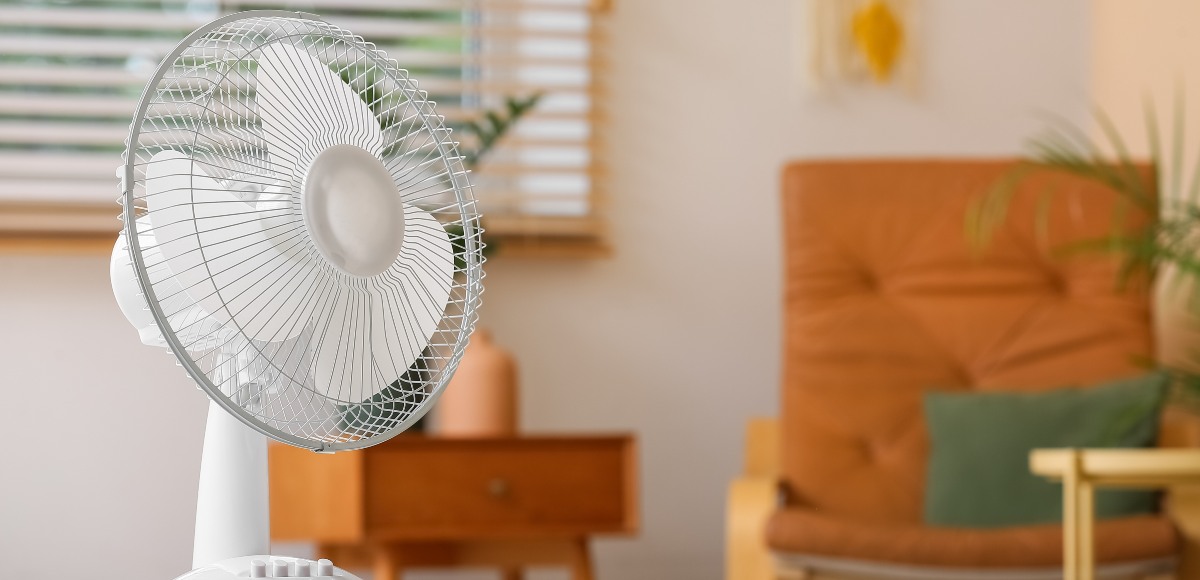
Quick difference: a fan moves the air, air conditioning cools it
Although they are often used for the same purpose, fans and air conditioners do not work in the same way. For this precise reason, their electricity consumption is also very different.
A fan does not cool the room. What it does is move the air to help sweat evaporate and generate a feeling of coolness on the skin. Therefore, it is most effective when there are people in the room, and its electricity consumption is very low.
In contrast, air conditioning actually lowers the temperature of the room. To achieve this, it extracts heat from inside the home and expels it outside through a refrigeration circuit. This process requires more energy, but it also allows you to maintain a pleasant temperature even during a heatwave.
These are the main differences:
- A fan cools people down, but it does not lower the room temperature.
- Air conditioning cools the air, thus improving comfort throughout the room.
- A fan consumes much less, while air conditioning offers better performance when it is very hot.
So, does this mean a fan is always the best option? Not necessarily. To answer that question, it is best to first compare how much each device consumes.
Comparison table: consumption and cost per hour in 2026
The consumption of a fan or an air conditioner depends on its power, the efficiency of the device, and the hours of use. As a reference, this is the approximate running cost of the most common household models.
|
Device |
Approximate power output |
Consumption per hour |
Cost per hour* |
|---|---|---|---|
|
Ceiling fan |
20–40 W |
0.02–0.04 kWh |
Under €0.01 |
|
Pedestal fan |
45–70 W |
0.05–0.07 kWh |
€0.01–€0.02 |
|
Split inverter air conditioner |
700–1,200 W |
0.7–1.2 kWh |
€0.18–€0.30 |
|
Portable air conditioner |
900–1,400 W |
0.9–1.4 kWh |
€0.23–€0.35 |
*Indicative calculations based on an electricity price of €0.25/kWh.
The difference in consumption is significant, but it should not be your only deciding factor. If you are looking to cool a room during a heatwave, an efficient air conditioner will still be the most effective option.
How much does a fan consume per hour and per month?
A fan is one of the most efficient systems for cooling a home in summer.
Most household models consume between 20 and 70 W, so their impact on the electricity bill is very small.
For example, a 40 W ceiling fan used for eight hours a day would consume approximately:
- Daily consumption: 0.32 kWh.
- Monthly consumption: 9.6 kWh.
- Approximate monthly cost: €2.40 (at a price of €0.25/kWh).
Models with a DC motor are even more efficient and quieter. However, remember that it does not cool the air, but rather improves the feeling of coolness by keeping the air moving. If the temperature is very high, it may not be enough on its own.
How much does air conditioning consume per hour and per month?
Air conditioning consumes more than a fan, but it also offers a higher level of comfort by reducing the room temperature.
Consumption will depend on the power of the device, its energy efficiency, the selected temperature, and your home's insulation. As a reference, a split system with inverter technology typically consumes between 0.7 and 1.5 kWh per hour.
For example, if a unit consumes an average of 1 kWh per hour and runs for eight hours a day, the cost would be approximately:
- 8 kWh per day.
- 240 kWh per month.
- Around €60 per month, based on an electricity price of €0.25/kWh.
If your unit is a few years old, upgrading to a more efficient model can help you reduce consumption. Discover Endesa's climate control solutions.
How to calculate the real cost based on your electricity tariff
Calculating how much it costs to use a fan or an air conditioner is very easy. You just need to apply this formula:
Consumption (kWh) × price per kWh = cost
With this calculation, you can easily estimate how much it costs to run any electrical appliance.
For example, if your air conditioner consumes 1 kWh and the price of electricity is €0.20/kWh, using it for one hour will cost approximately €0.20.
If you want to know the price you pay for electricity and choose the option that best suits your habits, you can check Endesa's electricity catalogue.
When to choose a fan and when to choose air conditioning
The best option depends on the temperature and how you plan to use each device.
A fan is a good option if:
- The temperature is moderate.
- You just want to take the edge off the heat.
- You are looking to minimise electricity consumption.
Air conditioning is more advisable when:
- The temperature exceeds 30°C.
- You need to cool a room down.
- You are going to spend several hours in the same room.
In many cases, the decision is not about choosing one or the other, but about using each system at the right time.
The best trick: using a fan and air conditioning together
Although it might seem counterintuitive, combining both devices can help you use less energy.
The fan distributes the cold air around the room better, meaning you can set the air conditioning between 24 and 26°C without losing comfort.
Besides improving comfort, this combination can help you to:
- Enhance the feeling of coolness.
- Reduce the strain on the air conditioner.
- Save energy during the summer months.
If you want to keep improving your home's efficiency, you might also be interested in our guide on the 10 tips to save electricity at home.
What temperature to set the air conditioning to in order to spend less
Choosing the right temperature is one of the factors that most influences consumption. To enjoy a good level of comfort without driving up your bill, it is recommended to set the air conditioning between 24 and 26°C.
Lowering the temperature below this range will not cool the room down any faster, but it will increase electricity consumption.
As well as setting the thermostat correctly, these habits can help you save:
- Keep doors and windows closed while the unit is running.
- Lower the blinds during the sunniest hours.
- Clean the filters frequently to maintain the unit's performance.
- Use the ECO mode or the timer whenever possible.
If you want to delve deeper into this topic, check out our guide on the ideal air conditioning temperature in summer.
Mistakes that cause consumption to soar in summer
Some habits can cause consumption to increase without you even noticing.
Most are easy to avoid and can make a difference to your electricity bill. The most common ones are:
- Setting the air conditioning to a temperature that is too low.
- Leaving doors or windows open while it is running.
- Not cleaning the filters regularly.
- Cooling empty rooms.
- Not taking advantage of natural ventilation during the night.
Avoiding these little mistakes can help you reduce consumption and keep your home cool for longer.
The best option for your home: bedroom, living room, working from home, or at night
Not all rooms have the same needs. Choosing the right system for each situation can help you improve comfort and optimise consumption.
Bedroom: if the heat is moderate, a fan is usually enough to sleep comfortably. On particularly hot nights, you can use the air conditioning before going to bed and then just keep the fan on.
Living room: as this is a larger room with more activity, air conditioning usually offers better results during the middle of the day.
Working from home: if you spend many hours in front of the computer, a fan may be enough on mild days. When temperatures are very high, combining both systems can provide greater comfort without increasing consumption too much.
At night: if you use air conditioning to sleep, activate the night mode or set a timer. This will help you avoid unnecessary consumption once the room has reached the desired temperature.
FAQs about fans, air conditioning, and your electricity bill
Which consumes less, a fan or an air conditioner?
A fan consumes much less electricity. However, air conditioning is the best option when you need to lower the room temperature.
Is it better to leave the air conditioning on all day?
No. The most efficient approach is to maintain a stable temperature while the house is occupied, and turn the unit off when nobody is home for an extended period.
Do ceiling fans use a lot of energy?
No. They are one of the most efficient systems for cooling a home, and models with a DC motor, in particular, have very low consumption.
Does using a fan alongside air conditioning help you save?
Yes. The fan improves the distribution of cold air and allows you to set the air conditioning to a higher temperature without losing comfort.
Which option is best for saving money?
If the heat is not extreme, a fan will always be the most economical alternative. When temperatures are very high, combining a fan and air conditioning usually offers the best balance between comfort and consumption.
Choosing between a fan and an air conditioner is not just about comparing their consumption. The outside temperature, your home's insulation, and how you plan to use each device also play a role.
With efficient consumption habits and an electricity tariff adapted to your needs, it is possible to keep your home cool during the summer without your electricity bill going through the roof.
Take a minute to find the product that best suits you:
{{firstStep.title}}
Take a minute to find the product that best suits you:
{{title}}
{{content.phone.title}}
{{content.phone.text}}
{{content.phone.phoneText}}
{{content.form.title}}
{{content.form.text}}
{{content.form.success.title}}
You don't need to adapt to Endesa's tariffs because they adapt to you. If you go to our catalogue you can compare the different tariffs for yourself. Or if you prefer, you can answer a few questions and we will take care of comparing all the different electricity and gas tariffs and then make a customised recommendation.
Take a minute to find the product that best suits you:
{{title}}
{{content.phone.title}}
{{content.phone.text}}
{{content.phone.phoneText}}
{{content.form.title}}
{{content.form.text}}
{{content.form.success.title}}
You don't need to adapt to Endesa's tariffs because they adapt to you. If you go to our catalogue you can compare the different tariffs for yourself. Or if you prefer, you can answer a few questions and we will take care of comparing all the different electricity and gas tariffs and then make a customised recommendation.
Comparison of Electricity and Gas Tariffs
You don't need to adapt to Endesa's tariffs because they adapt to you. If you go to our catalogue you can compare the different tariffs for yourself. Or if you prefer, you can answer a few questions and we will take care of comparing all the different electricity and gas tariffs and then make a customised recommendation.
Do you want to see all our offers?
Spend a minute to find the product which best adapts to you:
{{firstStep.title}}
Spend a minute to find the product which best adapts to you:
{{title}}
{{content.phone.title}}
{{content.phone.text}}
{{content.phone.phoneText}}
{{content.form.title}}
{{content.form.text}}
{{content.form.success.title}}
Spend a minute to find the product which best adapts to you:
{{title}}
{{content.phone.title}}
{{content.phone.text}}
{{content.phone.phoneText}}
{{content.form.title}}
{{content.form.text}}