


If you prefer to view the website always in english, click here.
{{content.phone.title}}
{{content.phone.text}}
{{content.phone.phoneText}}
{{content.form.title}}
{{content.form.text}}
{{content.form.success.title}}
Endesa charging point map 2026: over 7,100 locations across Spain for travelling in August
August is synonymous with travelling. And with enjoying the planning of each trip, especially if you're doing it with an electric car: when to charge the battery, where to stop, and what to do to avoid waits or unforeseen events. Discover here how to use the Endesa charging point map, the interactive solution to manage your journeys with complete peace of mind.
Where to find Endesa charging points: more than 7,100 locations in Spain
Wherever you go, Endesa already has more than 7,100 charging points waiting on your route throughout Spain. A network ready to give you more choices this summer, covering motorways, cities, coastal areas, and all kinds of tourist destinations. And with more than 1,000 ultra-fast charging points.
To have them always at hand and plan each route safely, all locations are updated on the free Endesa On Your Way app. An application where, in addition, you can reserve the charging points you are interested in, pay from your mobile, or take advantage of the savings from Endesa's electric vehicle tariffs.
How to use the Endesa charging point map
Once you have installed the Endesa On Your Way app, managing your routes and charging stops on the map is very easy:
1. Search for the location you are interested in
The map will show you the closest charging points to each location you select: your destination, intermediate stops on your journey, rest areas, or any other location you want to explore.
2. Find charging points near you
If you are already on the move, the charging point map will accompany you throughout the journey. The application continuously cross-references your vehicle's position with the nearest alternatives, anticipating your needs so you can decide whether to charge or continue the journey.
3. Filter by power and connector type
If you only use one type of connector, or if you want charging stops not to interfere with the pace of your journey, the Endesa charging point map will only show you the options that match your selection.
4. Check availability and price
The price of charging is not the same at all public charging stations and, moreover, customer demand can vary greatly from one day and time to another. Therefore, especially during the busiest times in August, it will be useful to check both aspects to ensure a charge without surprises.
5. Book and manage your charge
Another great advantage of planning your journey from the map is the possibility of booking a charging point up to 15 minutes in advance, thus avoiding unnecessary waits when you arrive. In addition, you will be able to manage the entire charging process from the application, as well as pay directly with your linked payment method.
The information you need about each charging point
Having everything under control on every journey helps you enjoy every kilometre more. That's why the Endesa charging point map offers you complete information to choose where to stop, point by point:
- Charging speed (power): semi-fast, fast, or ultra-fast.
- Type of connector you need: Type 2, CCS Combo 2, Schuko, or others.
- Status of each charger at the station: available or in use.
- Price: cost per kWh or per minute of charging, depending on the power and connector.
- Booking: possibility of booking a charger for the time of your arrival.
How to plan your electric car journey to optimise your charging stops
On long summer journeys, or on those wonderful days on the road with no plans, your electric car's battery will demand a little more attention. Besides having an updated charging point map, there are some tips that will help you leave all worries behind:
- Before setting off, confirm your car's actual range. Don't forget that the weight of luggage and passengers, weather conditions, potential traffic jams, or using the air conditioning are factors that increase consumption.
- Start the journey with a fully charged battery. Take advantage of the night before to charge to 100% on slow charge, as it is considerably cheaper than the fast or ultra-fast charging at public points.
- Use the final minutes of charging at your starting point to pre-cool the vehicle. This will reduce one of the main battery drains during the journey: the air conditioning.
- Locate a few alternative charging points for each stage of the journey and, if possible, reserve the one you are most interested in. In summer, it is more common for stations to be occupied, so it pays to plan ahead.
- Avoid charging during peak hours in tourist areas. Also, during peak holiday getaway and return periods, try to avoid typical meal break times.
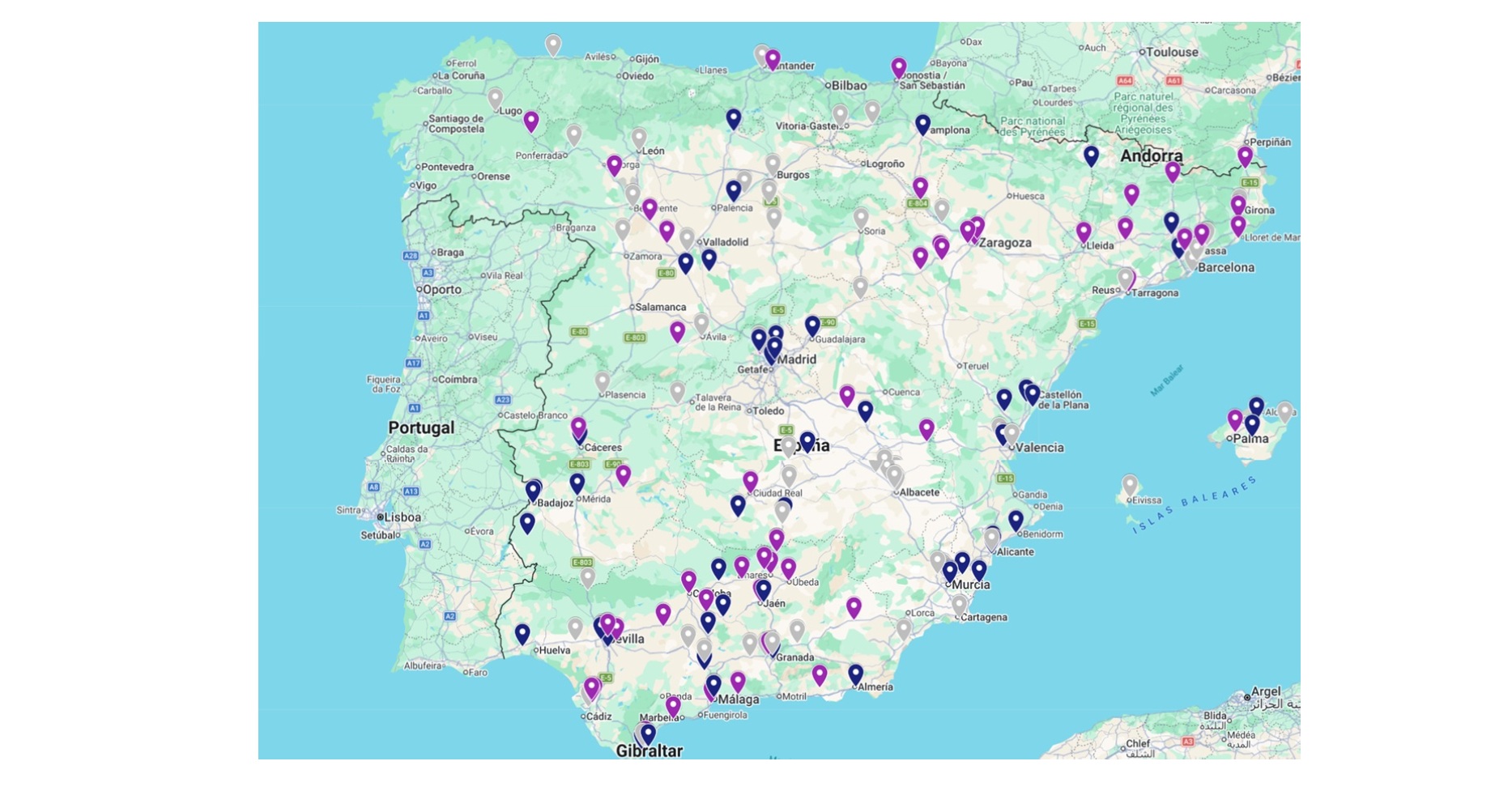
Charging points on the main summer holiday routes in Spain
From the sea to the mountains, and from the tranquillity of a village to the biggest parties and festivals, with the Endesa charging point map you will have the energy you need to refuel on our main summer routes:
Catalonia and Costa Brava
The Costa Brava is one of the most spectacular vantage points over the Mediterranean Sea and, to enjoy it, one of the areas with the most charging stations on the Endesa network.
Centred around the AP-7 motorway, Catalonia sees its traffic multiply in August, driven both by tourism from the peninsula and because it serves as the entry point for many French tourists. As a result, its territory accumulates a high volume of charging stops in the final kilometres of the journey.
If you want to arrive with your electric car in good shape, it is highly recommended to plan your charge in detail when approaching Tarragona, Barcelona, or Girona, booking a charging point whenever possible.
Comunidad Valenciana and Murcia
Continuing south, the arteries of the AP-7 and the A-7 run through the Levante from north to south, connecting Castellón, Valencia, Alicante, and Murcia.
These are two autonomous communities that also host a significant number of charging points, many of them fast charging, to serve the influx of holidaymakers on the Costa Blanca and the Costa Cálida, including destinations such as Benidorm, Gandía, the Mar Menor, or Cartagena.
Andalusia and Costa del Sol
The descent from central and northern Spain towards the southeast of Andalusia is another of the usual routes in August, in search of the cool waters of the Atlantic where they meet the Mediterranean Sea.
Málaga, Cádiz, and Huelva, with highly visited towns in August such as Marbella, Estepona, or Conil, are the scene of a large movement of vehicles every day, served by the A-7 and A-49 motorways. This makes selecting both main and alternative charging points a good idea to enjoy your journeys with greater peace of mind.
Galicia and the Cantabrian Coast
The cooler climate of the Galician coast, Asturias, Cantabria, and the Basque Country multiplies the arrival of tourists year after year. The Cantabrian coast distributes its charging points covering destinations that have the A-8 motorway as their main connecting thread, with a significant presence from Vigo to Bilbao or San Sebastián, passing through A Coruña, Oviedo, and Santander.
These are destinations that invite you to explore landscapes and places along secondary roads, where you will have to offset the lower density of charging stations with better planning of charging stops for your electric car.
Pyrenees
Another great escape from the August heat is the Pyrenees, which continues to see growth in the number of charging points at the most important access routes and tourist hubs such as Huesca, Jaca, Vielha, or La Seu d'Urgell.
In this case, whether you have chosen the Aragonese, Navarre, or Catalan Pyrenees, it will be almost essential to fully charge your vehicle's battery before starting each journey, to venture worry-free into less-travelled areas or travel long distances along its winding mountain roads.
Balearic and Canary Islands
The Spanish islands attract millions of holidaymakers every summer and, apart from those who transport their vehicle by ferry, a large number of them rent a car at their destination.
The boom in electric mobility is also impacting these rental services and has been accompanied by the installation of more charging points. However, touring any island in the Balearics or the Canaries involves knowing the location of these points well to plan your charging: bear in mind that the majority are concentrated in the most touristy areas like Palma, Ibiza, Las Palmas de Gran Canaria, or Santa Cruz de Tenerife.
Which charger to choose during your journeys
On the Endesa charging point map, you will find all the information about each station, and one of the most notable features is the power of the chargers it includes. Choosing yours will depend, above all, on the time you want to spend at your stops:
- Slow or semi-fast charging: with a power of up to 22 kW, these types of chargers are the most economical, making them ideal when you stop for several hours to eat or stay overnight.
- Fast charging: between 50 kW and 150 kW, they allow you to recharge 80% of the battery in about half an hour. A good option for stopping to have a coffee or make a purchase midway through the journey.
- Ultra-fast charging: when there is no time to lose, choosing a charging point with ultra-fast chargers is the most advisable option. With a power exceeding 150 kW, your electric car will be ready in 10 to 20 minutes.
As a general rule, the different speeds of the chargers are directly related to their location: ultra-fast chargers, which are fewer in number, are usually found on main motorways, while fast or semi-fast chargers are more common on secondary roads, at hotels, rest areas, and tourist destinations.
FAQs about electric car charging points
Where can I view the Endesa charging point map?
The best way to always carry the charging point map with you is to download the On Your Way app, where you can also manage on-route charger reservations, the charging process, and payment.
Do other charging stations besides Endesa's appear on the charging point map?
Yes. In addition to the more than 7,100 locations of its own charging points, the map keeps track of around 14,000 public points in Spain and more than 70,000 throughout Europe.
How much do the Endesa On Your Way app and the charging point map cost?
The On Your Way app, which includes the updated charging point map, is completely free, both for Endesa customers and non-customers.
What should I do if I arrive at a charging point and it is out of order or occupied?
If you find a broken charger, you can report the incident from the On Your Way application to see if it can be resolved right away. To prepare for these situations, as well as the possibility of finding the chargers occupied upon arrival, it is important to have marked several options for alternative charging points on the map.
How much does it cost to charge an electric car at an Endesa charging point?
Charging prices vary depending on the charging speed you select, and also on any potential electric car tariffs you may have contracted with your provider. As a general rule, the cost is higher for faster charges and lower for slower ones.
How do you know if your vehicle can be charged at an Endesa charging station?
Check if your vehicle's battery characteristics are compatible with the technical specifications of the charging point you select on the map. For years, virtually all cars sold in Europe have been compatible with the CCS connector, the most common at charging stations, although most Endesa points offer you more options.
Take a minute to find the product that best suits you:
{{firstStep.title}}
Take a minute to find the product that best suits you:
{{title}}
You don't need to adapt to Endesa's tariffs because they adapt to you. If you go to our catalogue you can compare the different tariffs for yourself. Or if you prefer, you can answer a few questions and we will take care of comparing all the different electricity and gas tariffs and then make a customised recommendation.
Take a minute to find the product that best suits you:
{{title}}
You don't need to adapt to Endesa's tariffs because they adapt to you. If you go to our catalogue you can compare the different tariffs for yourself. Or if you prefer, you can answer a few questions and we will take care of comparing all the different electricity and gas tariffs and then make a customised recommendation.
Comparison of Electricity and Gas Tariffs
You don't need to adapt to Endesa's tariffs because they adapt to you. If you go to our catalogue you can compare the different tariffs for yourself. Or if you prefer, you can answer a few questions and we will take care of comparing all the different electricity and gas tariffs and then make a customised recommendation.
Do you want to see all our offers?
Spend a minute to find the product which best adapts to you:
{{firstStep.title}}
Spend a minute to find the product which best adapts to you:
{{title}}
{{content.phone.title}}
{{content.phone.text}}
{{content.phone.phoneText}}
{{content.form.title}}
{{content.form.text}}
{{content.form.success.title}}
Spend a minute to find the product which best adapts to you:
{{title}}
{{content.phone.title}}
{{content.phone.text}}
{{content.phone.phoneText}}
{{content.form.title}}
{{content.form.text}}