


If you prefer to always view the website in English, please click here.
Travelling by electric car at Easter 2026: routes, charging points, and costs
Travelling during Easter Week – or Semana Santa – is considered a deep-rooted tradition in Spain, and more and more people are choosing to do it in an electric car. However, covering long distances requires some planning. Along your route, you’ll need to take into account the vehicle’s real-world range and which charging points are available during the Easter period. Another key factor is the cost of charging on the road, especially during such a high-traffic period. In this article, we’ll help you plan your trip efficiently to avoid surprises and make your holiday the best possible experience.
Easter 2026 dates and why they matter for your trip
In 2026, the Easter holidays will fall between 29 March and 5 April. During this window, public holidays and weekends see significant traffic peaks, meaning roads can be more congested and charging points may face higher-than-usual demand. Deciding which days you’ll be travelling is key, as it allows you to plan ahead and time your stops more effectively, ensuring a smooth and stress-free journey.
How to plan an electric car route for Easter
To plan your Easter trip in an electric car, you need to consider several factors.
How much range do I actually need?
While the most efficient EV models boast ranges of around 500 km, in practice it may be lower, especially on motorways. That’s why it’s advisable to factor in a 15–25% safety margin when planning a trip, as the actual distance you can travel before recharging will be lower than the manufacturer’s stated range.
Plan stops with backup options
On long journeys, it’s never a good idea to rely on a single charging point, so it’s best to have nearby alternatives in case your first choice is unavailable. We also recommend using fast chargers, which significantly cut down on waiting times. Remember: there’s no need to charge to 100% every time – charging to 80% is usually enough. This makes the trip more comfortable and efficient, as it allows you to use charging stops to rest or take care of other things.
Charging point map: recommended tools and how to use them
Knowing where and how to charge your car is key when planning a trip, especially during periods like Easter. Apps like Endesa’s On Your Way or the endesaxway.com website allow you to locate a network of charging stations with more than 6,300 charging points, over 900 of which offer ultra-fast charging and 40% offer fast charging. These are located along main travel corridors to make long-distance travel easier. This way, you can easily plan entire routes, check availability, and reserve charging points when needed.
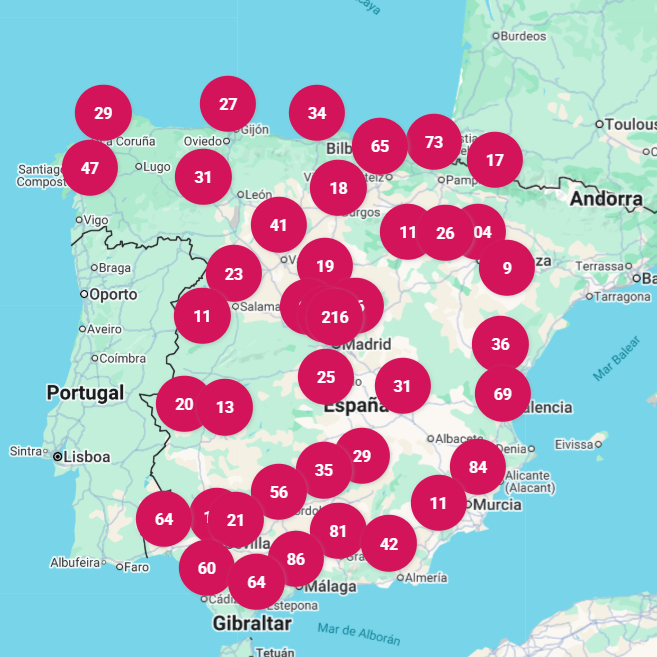
Electromaps is another useful planner. It will help you find charging points and filter them by connector type, power output, and operational status. For long-distance travel, we recommend focusing on CCS connectors with a minimum power output of 50 kW. Always double-check that the charging point is operational and ensure there are nearby alternatives in case something goes wrong. Moreover, it's always a good idea to check other drivers’ reviews to avoid unpleasant surprises.
Typical Easter 2026 routes (travel corridors) and charging strategy
In Spain, the charging network has been significantly strengthened, especially along major travel corridors. According to MITECO, 99% of the mainland Spain now has access to a charging point within 50 km.
Madrid ↔ Andalusia (A-4)
This is one of the busiest routes. The strategy here is to prioritise direct current (DC) or fast charging at intermediate service areas (such as Valdepeñas or Bailén). Always have a backup plan in nearby towns off the motorway in case the main stations are overcrowded.
Madrid ↔ Valencia / Costa Blanca (A-3 / AP-7)
On this route, the golden rule is to charge before you reach the tourist hotspots. Charging stations in destinations such as Denia, Jávea, or Benidorm tend to be in high demand during Easter. Charge to 80% at intermediate stops along the A-3 to arrive at your destination with a comfortable margin.
Barcelona ↔ Costa Brava / Tarragona
For shorter but busy trips, the key is AC charging at your destination. Look for hotels or public car parks with 11 or 22 kW chargers so you can ‘charge while you sleep’ or while exploring the city, leaving DC points free for drivers in transit.
Northern Spain ↔ Madrid / Basque Country / Cantabria
Here, weather conditions and elevation changes (such as the Somosierra mountain pass) play a key role. Cold temperatures and long uphill stretches increase battery consumption. Plan your stops in advance and avoid pushing your range too far if the forecast from the Spanish met office (AEMET) predicts low temperatures or heavy rain.
Choosing the right charger on the road: AC vs DC and connector types
Not all plugs are created equal, and knowing how to tell them apart will save you time:
Rapid and Ultra-rapid chargers (DC – Direct Current): These are the ones you’ll find at service stations and rest areas. Power outputs typically range from 50 kW up to 350 kW. The standard connector is the CCS Type 2. Use them to charge from 10% to 80% in 20–40 minutes.
Fast chargers (AC – Alternating Current): Commonly found in hotels, shopping centres, and car parks. Power outputs range from 7 kW to 22 kW, and they typically use the Mennekes (Type 2) connector. They’re ideal for longer charging sessions when the car will be parked for several hours.
How much it costs to travel by electric car during Easter
The cost per 100 km for an electric car varies significantly depending on where and how you charge. To keep your budget in check, consider these three scenarios:
Scenario A – Charging mostly at home
This is the most affordable option. If you leave home with a full battery (after charging overnight on off-peak EV tariffs), the first 300–400 km will cost very little. Making the most of a home charger such as a Waybox is the foundation of a low-cost trip.
Scenario B – Mixed home + public charging
This is the most realistic scenario for an Easter getaway. You start with a full charge from home and then stop for one or two rapid charges on the road. The average cost balances out and remains significantly lower than fossil fuels, especially if you use subscriptions or loyalty plans offered by charging apps.
Scenario C – Trip based solely on rapid charging (DC)
If you don’t have a home charger or you’re taking a long multi-day trip relying only on ultra-rapid charging stations, the cost per 100 km will be higher. Even so, the efficiency of electric motors often offsets this, and you can always look for pay-as-you-go deals or temporary passes in apps like On Your Way.
Easter tips: queues, timing, and avoiding surprises
Avoid peak times: Just like traffic jams, chargers have peak hours. Try to charge early in the morning or during typical lunch hours (when many drivers have already finished their charging session).
Avoid pushing your battery too far: Arriving at a charger with less than 10% battery is risky during busy travel periods. If the charging point is occupied or out of service, you won’t have enough range to reach your backup option.
Have your apps ready: Before setting off, make sure you’ve installed and set up the main operators’ apps (REVE, Ruta-e, Endesa, etc.), with your payment methods already validated.
Check traffic updates (DGT and the Official State Gazette (BOE)): Stay informed about special traffic operations. Occasionally, restrictions on heavy vehicles can improve the flow toward service areas where chargers are located.
Quick checklist before you leave
Before you hit the road, go through these essentials:
Software: Update your car’s software and navigation maps.
Tyres: Check the tyre pressure, since low pressure increases consumption and reduces range.
Cables: Don’t forget your Type 2 (Mennekes) cable for destination charging at hotels or public buildings.
Apps: Have at least 2–3 apps installed, logged in, and linked to a credit card.
Route: Make sure you have a clear Plan A and Plan B for charging on each leg of your journey.
Travelling by electric car this Easter 2026 isn’t just an eco-friendly option but also a more relaxed and tech-forward way to discover Spain.
Take a minute to find the product that best suits you:
{{firstStep.title}}
Take a minute to find the product that best suits you:
{{title}}
{{content.phone.title}}
{{content.phone.text}}
{{content.phone.phoneText}}
{{content.form.title}}
{{content.form.text}}
{{content.form.success.title}}
You don't need to adapt to Endesa's tariffs because they adapt to you. If you go to our catalogue you can compare the different tariffs for yourself. Or if you prefer, you can answer a few questions and we will take care of comparing all the different electricity and gas tariffs and then make a customised recommendation.
Take a minute to find the product that best suits you:
{{title}}
{{content.phone.title}}
{{content.phone.text}}
{{content.phone.phoneText}}
{{content.form.title}}
{{content.form.text}}
{{content.form.success.title}}
You don't need to adapt to Endesa's tariffs because they adapt to you. If you go to our catalogue you can compare the different tariffs for yourself. Or if you prefer, you can answer a few questions and we will take care of comparing all the different electricity and gas tariffs and then make a customised recommendation.
Comparison of Electricity and Gas Tariffs
You don't need to adapt to Endesa's tariffs because they adapt to you. If you go to our catalogue you can compare the different tariffs for yourself. Or if you prefer, you can answer a few questions and we will take care of comparing all the different electricity and gas tariffs and then make a customised recommendation.
Do you want to see all our offers?
Spend a minute to find the product which best adapts to you:
{{firstStep.title}}
Spend a minute to find the product which best adapts to you:
{{title}}
{{content.phone.title}}
{{content.phone.text}}
{{content.phone.phoneText}}
{{content.form.title}}
{{content.form.text}}
{{content.form.success.title}}
Spend a minute to find the product which best adapts to you:
{{title}}
{{content.phone.title}}
{{content.phone.text}}
{{content.phone.phoneText}}
{{content.form.title}}
{{content.form.text}}