


If you prefer to always view the website in English, please click here.
Types of electric car chargers: a complete guide
Electric mobility is growing rapidly, and more and more drivers are considering making the leap to an electric vehicle. One of the first questions that arises when taking this step is what type of charger to use and how to charge an electric car efficiently.
Today there are different types of chargers for electric cars. They differ mainly in their charging speed, the type of connector, and where they are installed or used – factors that directly influence charging time and convenience of use.
Knowing these differences is key to choosing the option that best adapts to your driving habits, where you usually park, and your daily needs.
In this guide, we explain how charging an electric car works, what types of chargers exist, and which one might be the most suitable for you.
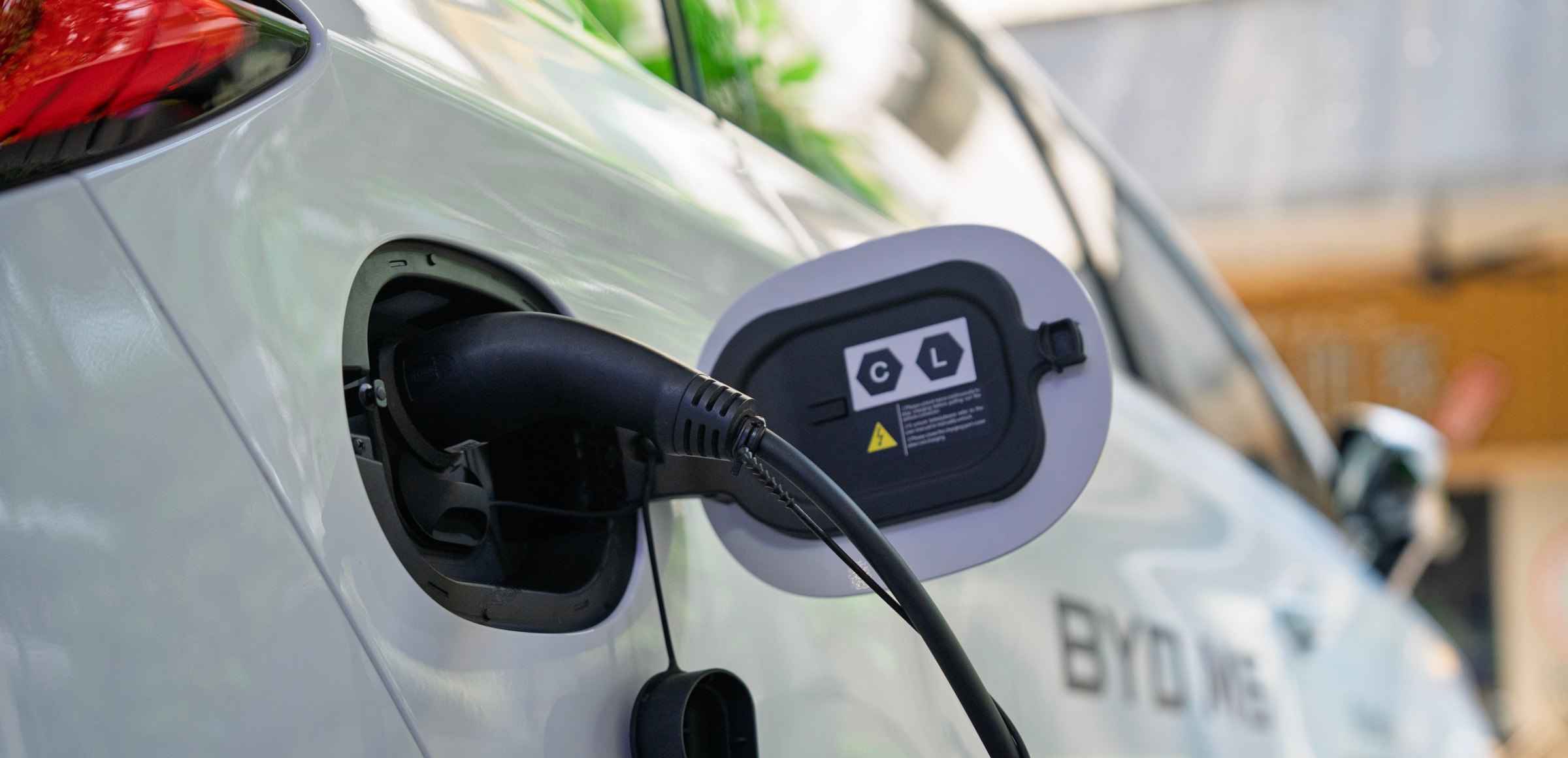
How to charge an electric car: the basics
Charging an electric car is a very simple process. It basically consists of b
That charging point can be found in various places: at home, in the shared garage in a block of flats, in a public car park, or at charging stations located in cities and on motorways.
On a technical level, there are two main forms of charging:
Alternating current (AC): the most common in homes, businesses, and car parks. The car transforms the electricity into direct current using its internal onboard charger.
Direct current (DC): the conversion is done directly at the charging point, which allows for higher power outputs and reduces charging times.
Depending on the available power and the vehicle model, the time needed to complete a charge can vary quite a bit: from several hours when charging at home to less than half an hour at high-power stations.
Types of chargers by charging speed
One of the most common ways to classify electric car chargers is by the speed at which they can recharge the battery. That is, the time the vehicle needs to recover energy.
Slow charging (2.3–3.7 kW)
Slow charging is the most basic way to charge an electric car. It is usually done via standard domestic plugs or low-power chargers.
Approximate charging time: between 8 and 20 hours.
Typical use: occasional charging or vehicles with small batteries.
Can be done using standard domestic plugs.
Although it is a possible option, it is not usually the most practical for day-to-day use. Charging times are long, and domestic electrical wiring is not always designed for this continuous use.
That is why many users choose to install a domestic Waybox for their electric car, which offers greater safety and more efficient charging.
Semi-rapid charging (7.4–22 kW AC)
Semi-rapid charging is currently the most common option in homes, businesses, and public car parks:
Approximate charging time: between 3 and 8 hours.
Allows you to fully charge the vehicle overnight.
Very common in private garages, residents' associations, and car parks.
In most cases, this charging is done using a wallbox, a device specifically designed for electric vehicles that improves the safety of the installation and allows for better energy consumption management.
Rapid charging (50–150 kW DC)
Rapid charging is found primarily at public charging stations and EV forecourts, designed to reduce waiting times during journeys.
Allows charging up to 80% of the battery in about 20–40 minutes.
Designed for occasional charging away from home.
Widely used during trips or long journeys.
In Spain, there are already thousands of public charging points distributed throughout the territory. You can check the available network on the Endesa X Way charging point map.
Ultra-rapid charging (150–350+ kW DC)
Ultra-rapid charging represents the most advanced technology currently available in public charging infrastructures:
Allows you to recover a large part of the battery in just 10–20 minutes in compatible vehicles.
Designed for short stops during long trips.
Common installations on motorways and road networks.
The goal of these chargers is to minimise waiting times and bring the charging experience increasingly closer to that of traditional refuelling.
Types of chargers by connector type
In addition to charging speed, charging points also differ by the type of connector they use – a key element to ensure compatibility between the electric vehicle and the charger.
There are currently several standards on the market, although in Europe some have consolidated as the most common.
Type 1 (less common in Europe)
The Type 1 connector was one of the first standards used in electric vehicles:
Found mostly on older electric models.
Used primarily in vehicles from Asia and the United States.
Designed for alternating current (AC) charging.
Today, its presence in Europe is increasingly shrinking, as it has been progressively replaced by more widespread connectors such as Type 2 or CCS.
Type 2 (European standard and mandatory for AC)
Type 2 is the European standard for alternating current charging.
Compatible with most electric cars sold in Europe.
Allows for power outputs of up to 22 kW in AC.
It is the standard connector at domestic and public charging points.
For this reason, most wallboxes and domestic chargers use this connector.
CCS Combo 2 (standard for rapid DC charging)
The CCS Combo 2 system is the European standard for rapid charging in direct current.
Compatible with most modern electric vehicles.
Allows for very high power outputs, even exceeding 350 kW.
Used at fast and ultra-rapid charging stations.
CHAdeMO (phasing out in Europe)
The CHAdeMO system was one of the first fast-charging standards.
Widely used by some Japanese manufacturers.
Allows fast charging in direct current.
Its use is declining in Europe in favour of the CCS standard.
Standard domestic plug (Schuko) (for occasional use only)
A conventional domestic plug can be used with a specific cable, although it is not the recommended option for regular use.
Very low power output (approx. 2.3 kW).
Very long charging times.
Not designed for frequent vehicle charging.
Therefore, it should only be used occasionally.
Types of chargers by where they are used
Chargers can also be classified according to where they are installed or used.
Domestic chargers (wallbox)
Domestic chargers or wallboxes are installed in detached houses or private garages and are the most convenient option for those who park their car at home daily.
They allow the vehicle to be charged overnight, so by morning it is always ready to use. Furthermore, they offer greater safety than a conventional plug.
Many models also allow you to schedule charging times or monitor consumption, which helps to optimise energy expenditure.
Communal chargers (shared garages)
In buildings with a communal garage, it is also possible to install charging points. In Spain, regulations allow you to do this simply by notifying the homeowners’ association, which has greatly facilitated the adoption of electric cars.
These systems usually include individual consumption metering, shared power management, and structures prepared for multiple users, so that neighbours can charge their vehicles in an organised manner.
Public charging points
Public charging points are available in car parks, shopping centres, hotels, offices, or service stations.
They are a very useful solution for those who do not have their own garage or for topping up the car while carrying out everyday activities.
EV forecourts and motorway chargers
EV forecourts are designed especially for long journeys and are usually located on motorways and major A-roads.
They offer fast or ultra-rapid charging, allowing you to recover a significant portion of the battery in a short time.
To locate nearby chargers or easily plan routes, you can use tools like Endesa's On Your Way app, designed to facilitate charging both in the city and on the road.
Download the On Your Way app and discover the smartest way to charge your electric car.
Download the Enel On Your Way App
Download the app for free and start charging your electric car now.


What type of charger you need depending on your situation
Choosing the right charger depends mostly on how you use your electric car and where you usually charge it.
If you charge mostly at home: a 7.4–11 kW wallbox allows you to charge the vehicle overnight and take advantage of cheaper off-peak tariffs.
If you don't have a private garage: you will rely on public charging points and EV forecourts.
If you take long trips: look for vehicles compatible with fast or ultra-rapid charging.
If your car has a small battery: it can be charged with moderate-power chargers.
Charging times by charger type
The time needed to charge an electric car depends primarily on three factors: battery capacity, charging point power output, and the maximum power the vehicle accepts. As a rough guide, times are usually:
Slow charging: Between 8 and 20 hours.
Semi-rapid charging: Between 3 and 8 hours.
Rapid charging: Between 20 and 40 minutes up to 80%.
Ultra-rapid charging: Between 10 and 20 minutes up to 80%.
Cost of charging by charger type
The cost of charging an electric car can vary depending on where the charging takes place. In general terms:
Charging at home is usually the most economical option, especially with time-of-use tariffs.
Public AC charging points have a mid-range cost.
Fast or ultra-rapid chargers are usually more expensive due to the power and infrastructure required.
Even so, in most cases, the cost per kilometre is still lower than that of a combustion engine vehicle.
Common mistakes when choosing a charger
Choosing an electric car charger may seem simple, but it is common to overlook some important aspects that can affect the usability or efficiency of the charge. Some of the most frequent mistakes are:
Not considering the property's electrical capacity.
Choosing a charger with more power than the vehicle can accept.
Using standard domestic plugs on a regular basis.
Not anticipating future needs or the availability of the public charging network.
Therefore, before deciding which charger to install or use, it is wise to analyse how the vehicle is used, where it will normally be charged, and what needs might arise in the future. With that information, it will be much easier to find the charging solution that best adapts to each case.
Take a minute to find the product that best suits you:
{{firstStep.title}}
Take a minute to find the product that best suits you:
{{title}}
{{content.phone.title}}
{{content.phone.text}}
{{content.phone.phoneText}}
{{content.form.title}}
{{content.form.text}}
{{content.form.success.title}}
You don't need to adapt to Endesa's tariffs because they adapt to you. If you go to our catalogue you can compare the different tariffs for yourself. Or if you prefer, you can answer a few questions and we will take care of comparing all the different electricity and gas tariffs and then make a customised recommendation.
Take a minute to find the product that best suits you:
{{title}}
{{content.phone.title}}
{{content.phone.text}}
{{content.phone.phoneText}}
{{content.form.title}}
{{content.form.text}}
{{content.form.success.title}}
You don't need to adapt to Endesa's tariffs because they adapt to you. If you go to our catalogue you can compare the different tariffs for yourself. Or if you prefer, you can answer a few questions and we will take care of comparing all the different electricity and gas tariffs and then make a customised recommendation.
Comparison of Electricity and Gas Tariffs
You don't need to adapt to Endesa's tariffs because they adapt to you. If you go to our catalogue you can compare the different tariffs for yourself. Or if you prefer, you can answer a few questions and we will take care of comparing all the different electricity and gas tariffs and then make a customised recommendation.
Do you want to see all our offers?
Spend a minute to find the product which best adapts to you:
{{firstStep.title}}
Spend a minute to find the product which best adapts to you:
{{title}}
{{content.phone.title}}
{{content.phone.text}}
{{content.phone.phoneText}}
{{content.form.title}}
{{content.form.text}}
{{content.form.success.title}}
Spend a minute to find the product which best adapts to you:
{{title}}
{{content.phone.title}}
{{content.phone.text}}
{{content.phone.phoneText}}
{{content.form.title}}
{{content.form.text}}