


If you prefer to always view the website in English, please click here.
Before buying a TV for the great festival of football: how it will impact your bill
If you have a real passion for football, this summer you will want to get home, turn on the TV, and feel like your living room has transformed into the stadium stands. However, have you ever wondered how much it will cost to enjoy all those matches?
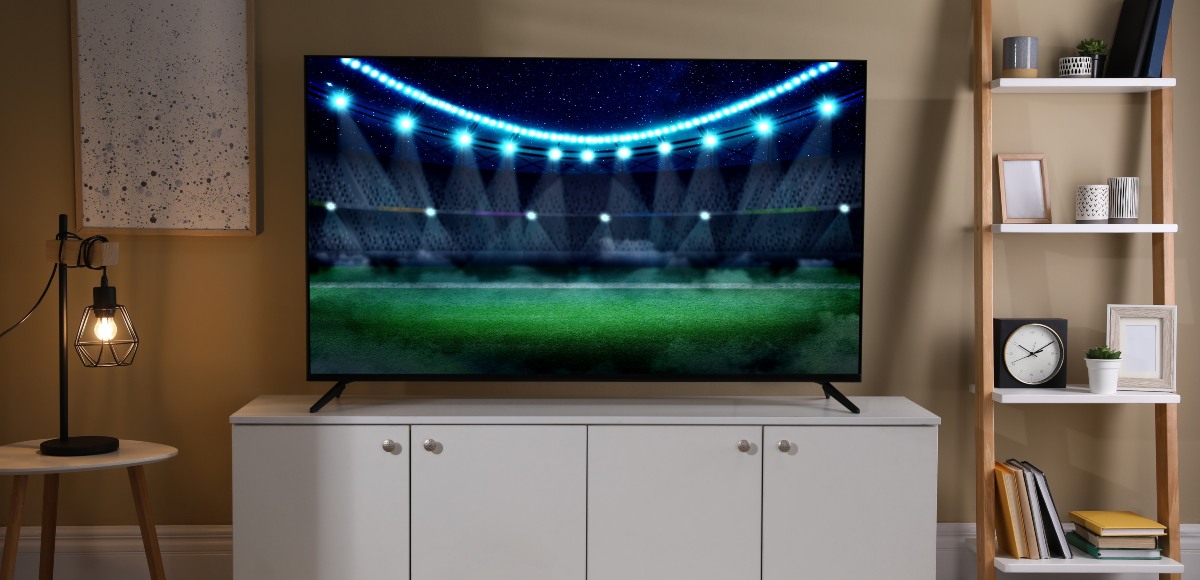
Most users focus primarily on the screen size. But often, the technology matters more than the size. For example, a 65" OLED can use less energy than an old 55" LCD, so before buying, you need to check the annual consumption in kWh shown on the energy label. Below, we will look at some of the specific details you should consider to help you make a better choice.
How much energy 55, 65, and 75-inch TVs use a year
The TV is one of the appliances that accounts for a large chunk of household consumption, representing approximately 12.2% of the total. If you are considering an upgrade to enjoy the upcoming festival of football, the impact on your bill will depend on a combination of technology and screen size.
Here is a comparison estimating the annual cost of a TV based on manufacturer data:
|
Technology |
Size |
Annual consumption |
Annual cost* |
|---|---|---|---|
|
LED |
55 |
87 kWh |
€9.87 |
|
65” |
90 kWh |
€10.21 |
|
|
75” |
115 kWh |
€13.05 |
|
|
OLED |
55” |
105 kWh |
€11.91 |
|
65” |
118 kWh |
€13.39 |
|
|
75” |
155 kWh |
€17.59 |
|
|
QLED |
55” |
87 kWh |
€9.87 |
|
65” |
117 kWh |
€13.27 |
|
|
75” |
114 kWh |
€12.93 |
* Annual cost calculated using an electricity price of €0.1135/kWh (Luz Fija 24h Online tariff – May 2026).
The TV energy label: how to read it in 30 seconds
The energy label classifies different appliances according to their energy efficiency. Since 2021, the system has been adjusted to show clearer information. The three details it includes that you need to check are:
- Energy class (A–G): the colour scale where A (green) is the most efficient and G (red) is the least.
- Consumption in use (kWh/1000 h): indicates the energy demand for every 1,000 hours of use, distinguishing between standard dynamic range (SDR) and high dynamic range (HDR).
- Estimated annual consumption: although the label highlights kWh/1000 h, the annual figure is calculated based on standard usage of 4 hours a day. The shop is obliged to display this information both in-store and online.
To delve deeper, you can learn more about how to read your TV's energy label in Endesa's detailed guide.
OLED vs. QLED vs. standard LED: the consumption difference they don't explain in the shop
The widespread use of LED in TVs offers significant savings, especially with ever-larger screens. The difference between the three types of screens lies in how they generate light:
- Standard LED: uses a backlight that stays on constantly.
- QLED: is essentially an LED enhanced with quantum dots for better colour and brightness.
- OLED: turns off dark pixels individually, eliminating consumption in those areas of the picture.
The key point is that an OLED's consumption depends radically on what you are watching. It is highly efficient for films with dark scenes, but can exceed the consumption of a QLED when viewing web pages or content with bright backgrounds.
On the other hand, we know that LED TVs consume 25% less than older LCDs, and up to 40% less than plasma TVs.
When does a more efficient TV pay for itself? The calculation nobody does
Many buyers doubt whether it is worth paying more for a TV with a better energy rating. By dividing the price difference between the two models by the annual saving on your bill, you will know how many years it will take to recoup the investment. That is:
Price difference between models / Annual savings on bill = Years to recoup cost
For example, if a Class B TV costs €30 more than a Class D model, but only saves 20 kWh a year (around €2.27), it will take you 13.2 years to make your money back.
This reveals that the financial savings alone rarely justify the extra cost. The real argument for choosing a model with a better energy label isn't the electricity bill, but what that rating indirectly indicates: greater durability, better visual comfort, and more refined technology that prevents unnecessary long-term costs.
The picture mode nobody uses that saves the most electricity
In shops, TVs are set to maximum brightness ('Vivid' mode) to grab the buyer's attention, which skyrockets consumption. When you get home, turning on 'Cinema' or 'Calibrated' mode reduces brightness by 30% to 50% with the exact same picture quality.
It is highly recommended to turn down the TV's brightness as soon as you get home, setting it to 60% or even half, to protect your eyes and noticeably reduce your bill.
What actually matters more than efficiency: room size, viewing distance, and HDR
Another practical formula to help you find your perfect TV to enjoy the great festival of football gives you the ideal screen size based on viewing distance:
Distance (cm) / 3.81 = Ideal size in inches
|
Viewing distance |
Ideal size |
|
2,1 m |
55” |
|
2,5 m |
65” |
|
2,9 m |
75” |
Furthermore, you should also bear in mind that HDR (High Dynamic Range) mode can double or triple the power demand in watts (W) compared to standard mode (SDR).
For total peace of mind, you can check your TV's impact on your monthly bill via the Endesa Customer Area and identify if your consumption spikes coincide with the matches.
FAQs
Is it worth paying more for a Class A TV if I use it a lot?
In 2026, Class A TVs are very rare and come with a high premium. For heavy use (more than 6 hours a day), a latest-generation Class B is a balanced choice between purchase cost and efficiency.
Does OLED consume more or less than QLED?
It really depends on the content. OLEDs are especially efficient for content with lots of dark scenes thanks to their ability to turn off pixels. For football, where the screen is mostly a bright green pitch, the difference narrows.
How much does a 75-inch TV cost to run per year?
It depends on the technology, screen size, and your electricity tariff. A 75" TV watched for 4 hours a day can add an estimated €13 to €18 a year to your bill.
Does a bigger TV always mean higher consumption?
Not necessarily. A 65" Class B OLED can consume less than an old 55" Class D LCD. The panel technology and energy class currently carry more weight than physical size.
Take a minute to find the product that best suits you:
{{firstStep.title}}
Take a minute to find the product that best suits you:
{{title}}
{{content.phone.title}}
{{content.phone.text}}
{{content.phone.phoneText}}
{{content.form.title}}
{{content.form.text}}
{{content.form.success.title}}
You don't need to adapt to Endesa's tariffs because they adapt to you. If you go to our catalogue you can compare the different tariffs for yourself. Or if you prefer, you can answer a few questions and we will take care of comparing all the different electricity and gas tariffs and then make a customised recommendation.
Take a minute to find the product that best suits you:
{{title}}
{{content.phone.title}}
{{content.phone.text}}
{{content.phone.phoneText}}
{{content.form.title}}
{{content.form.text}}
{{content.form.success.title}}
You don't need to adapt to Endesa's tariffs because they adapt to you. If you go to our catalogue you can compare the different tariffs for yourself. Or if you prefer, you can answer a few questions and we will take care of comparing all the different electricity and gas tariffs and then make a customised recommendation.
Comparison of Electricity and Gas Tariffs
You don't need to adapt to Endesa's tariffs because they adapt to you. If you go to our catalogue you can compare the different tariffs for yourself. Or if you prefer, you can answer a few questions and we will take care of comparing all the different electricity and gas tariffs and then make a customised recommendation.
Do you want to see all our offers?
Spend a minute to find the product which best adapts to you:
{{firstStep.title}}
Spend a minute to find the product which best adapts to you:
{{title}}
{{content.phone.title}}
{{content.phone.text}}
{{content.phone.phoneText}}
{{content.form.title}}
{{content.form.text}}
{{content.form.success.title}}
Spend a minute to find the product which best adapts to you:
{{title}}
{{content.phone.title}}
{{content.phone.text}}
{{content.phone.phoneText}}
{{content.form.title}}
{{content.form.text}}