


If you prefer to always view the website in English, please click here.
{{content.phone.title}}
{{content.phone.text}}
{{content.phone.phoneText}}
{{content.form.title}}
{{content.form.text}}
{{content.form.success.title}}
IAQ at home: how to know if the air you breathe is really healthy
Indoor Air Quality (IAQ) has become a pillar of health and energy efficiency at home. When people talk about air quality, references are usually made to traffic-filled streets, smog and outdoor pollution. However, according to data from the World Health Organisation (WHO) and the Spanish Ministry of Health, indoor air can be between two and five times more contaminated than outdoor air.
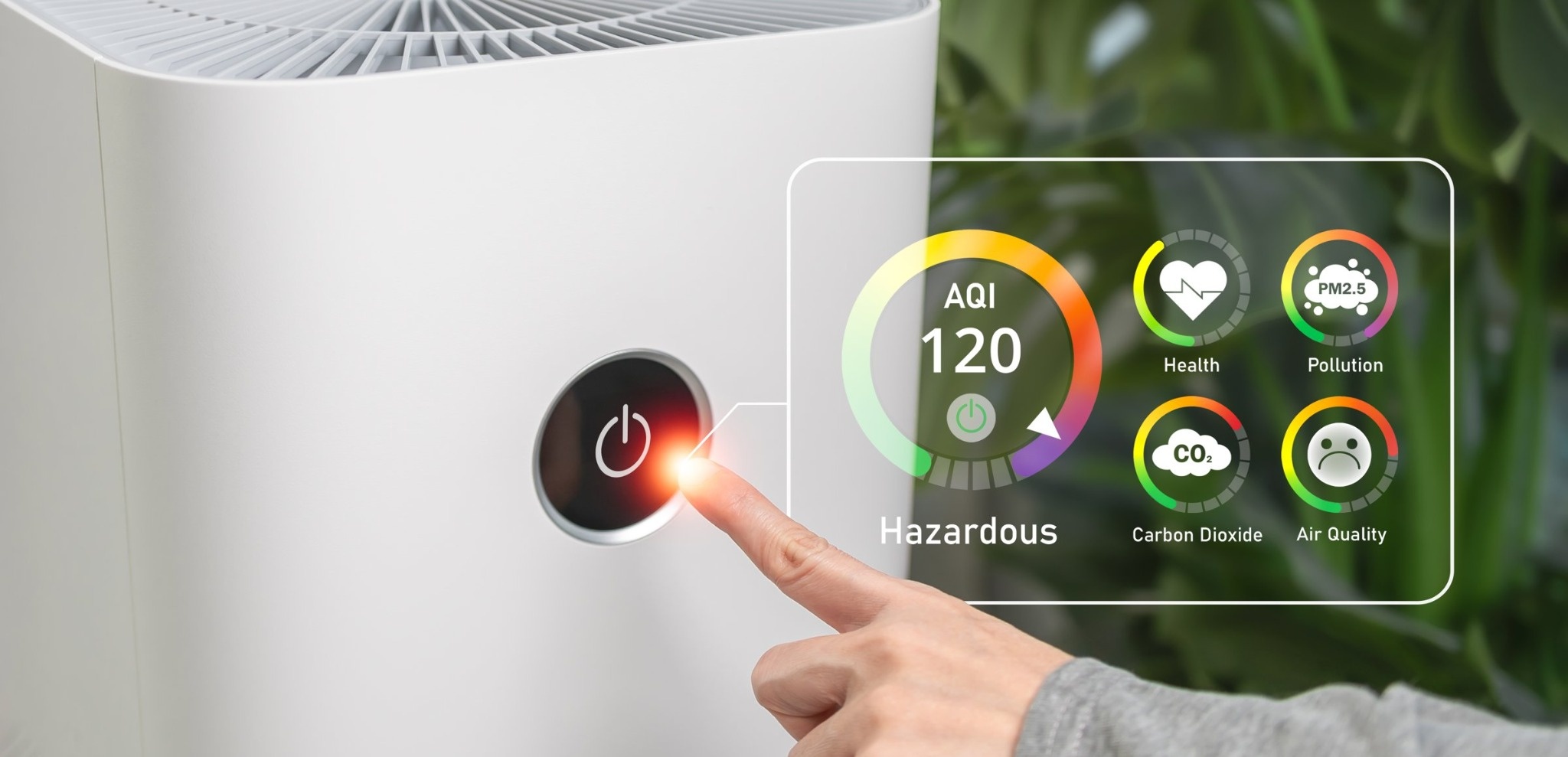
Someone with a standard daily routine, whose day-to-day life is spent between home, the office or teleworking, the gym, the supermarket, shops, etc., usually spends more than 80% of their time in enclosed spaces. Therefore, indoor air quality (IAQ) represents a key factor for health, comfort and energy consumption in the home.
In Spain, there are official standards and guides that clarify what 'good air' means and how to maintain it without electricity bill costs skyrocketing. At Endesa, we explain what this is all about and how to achieve it.
What is IAQ? Explained without jargon
IAQ is the quality of the air you breathe inside your home; it indicates how 'clean and suitable' the indoor air is. This depends on several factors: how much ventilation there is, the pollutants present, how many particles and gases accumulate (PM, VOCs, formaldehyde, radon), whether the temperature and humidity are within comfortable ranges, and daily activities such as cooking, cleaning or even breathing.
Having good IAQ translates into air with sufficient oxygen, few pollutants and adequate thermal conditions. Conversely, poor IAQ can cause immediate discomfort and health problems in the medium and long term.
Why is indoor air quality becoming such a hot topic?
Because, as we mentioned previously, people spend around 80% of their time in indoor spaces. Following the pandemic, internal ventilation gained significant importance due to its role in reducing respiratory risks.
In Spain, the Regulation of Thermal Installations in Buildings (RITE) reinforces hygiene and the rational use of energy in ventilation and air conditioning systems, aligned with energy efficiency standards in the construction sector. Furthermore, modern homes are increasingly airtight to improve energy efficiency, as promoted by regulations such as the Technical Building Code (CTE). However, this measure to reduce heat loss also hinders the natural renewal of air. All of this has placed IAQ at the centre of the debate on health and energy.
Clear signs that the air in your home is not good
You do not need to be an expert in health or the environment to detect an indoor air quality problem. Some common signs or everyday clues are:
- Frequent headaches, irritated eyes or throat, a feeling of tiredness for no apparent reason, or 'stuffy' air when there are several people and little ventilation (high CO₂). The National Institute for Safety and Health at Work (INSST) considers these signs to be practical indicators, and links them to insufficient ventilation or elevated levels of indoor pollutants.
- Condensation on windows, a smell of damp or the appearance of mould may be related to high humidity and poor ventilation.
- Persistent odours in the indoor space for several hours or days after cooking or a cleaning session.
The values that really matter in your home
- CO₂: among the most relevant indicators, CO₂ stands out; it is not toxic at domestic levels, but it is an excellent marker of ventilation. Values below 800 ppm (parts per million) indicate acceptable air; above 1,200 ppm, renewal is usually insufficient.
- Relative humidity: relative humidity also matters, and should be maintained between 40% and 60% to minimise mould and dryness.
- Particles (PM₂.₅): attention must also be paid to the presence of fine particles (PM₂.₅) from kitchens, candles or heating systems. The lower, the better. We recommend using an extractor hood with an external outlet, and filtration when necessary.
- Radon: keep the annual average <300 Bq/m³. You can check the map on the Nuclear Safety Council (CSN) website to see if you live in a potential risk zone.
Why can poor ventilation make you spend more on heating?
Ventilating your home doesn't mean opening the windows for hours in the middle of winter. This would cause heat loss, force heating systems to work harder, and send electricity or gas consumption soaring.
The IDAE recommends short and intense ventilation in winter (5 to 10 minutes with cross-ventilation), just before turning on the heating, to renew the air with minimal heat loss. This alternative is better than keeping windows ajar for a long time, because the air is renewed without cooling down the walls and furniture.
How to improve the air at home without spiking your bill?
Small actions have a big impact, which is why we tell you which ones you can put into practice:
Measure and control
We recommend using meters for CO₂, temperature and humidity. These will serve as a guide to know the IAQ, to know when to open the windows, or if you need to apply permanent measures to maintain pure indoor air.
Ventilate strategically
Brief cross-ventilation (morning and night) at the right times, and localised extraction in the kitchen using the hood, as well as in bathrooms, are strategic ways to maintain a controlled flow of air inside the house. In this way, the air is renewed where the most pollutants are generated. In more efficient homes, mechanical ventilation systems with heat recovery allow air to be renewed while minimising energy consumption.
Seal sources and filter
Avoid using highly volatile products, opt for low-VOC paints and products, and if particulate matter (PM) levels are high, you can install HEPA purifiers. It is essential to keep air conditioning or heat pump filters clean, as well as controlling humidity (keep it between 40% and 60%). If you notice areas with mould, use a dehumidifier and check for thermal bridges.
Put these alternatives into practice and you will see how your efficiency increases and the expenditure on your bill is reduced. If you want to verify this, use Endesa's free energy information and advice service, infoEnergía, with which you can check and compare your energy efficiency.
CO₂ sensors and air quality: what they measure and if they are worth it
CO₂ is not toxic at standard domestic levels, but it indicates whether ventilation is sufficient and efficient. For this reason, installing sensors is recommended, as they allow you to measure CO₂, humidity, temperature and, in some cases, particles and volatile organic compounds. Undoubtedly, they are an ideal tool for better managing ventilation and reducing respiratory risks.
In a home, a well-calibrated non-dispersive infrared sensor (NDIR) will help you make better decisions. For example, knowing if it is necessary to ventilate and how, as well as adjusting climate control habits.
It is important to note that these sensors do not replace assessment by a certified professional. They are simply a resource that will allow you to avoid unnecessary ventilation, which will translate into savings and greater comfort inside the home.
IAQ and energy efficiency: the balance that hardly anyone explains
Ventilating just enough and in a controlled manner is key to living in an efficient, but also healthy, home. Having good IAQ will reduce health problems, improve well-being and optimise energy use at home. For this reason, energy efficiency and IAQ must always go hand in hand.
The true balance between the two lies in combining insulation, effective systems and well-controlled ventilation. In new or refurbished homes, controlled mechanical ventilation (CMV) systems with heat recovery allow air to be renewed while maintaining indoor heat, aligning health and savings.
Breathing well at home is not just a question of ventilating adequately. It also implies understanding IAQ, monitoring essential indicators and measuring what is important (CO₂, humidity, radon, etc.). Furthermore, it involves relying on solutions that allow you to save energy and prevent you from paying more on your electricity bill.
Indoor air quality is neither a luxury nor a secondary concern; it is a key piece of comfort, health and energy consumption in the household. Looking after the air at home is also a responsible way of managing energy.
Take a minute to find the product that best suits you:
{{firstStep.title}}
Take a minute to find the product that best suits you:
{{title}}
You don't need to adapt to Endesa's tariffs because they adapt to you. If you go to our catalogue you can compare the different tariffs for yourself. Or if you prefer, you can answer a few questions and we will take care of comparing all the different electricity and gas tariffs and then make a customised recommendation.
Take a minute to find the product that best suits you:
{{title}}
You don't need to adapt to Endesa's tariffs because they adapt to you. If you go to our catalogue you can compare the different tariffs for yourself. Or if you prefer, you can answer a few questions and we will take care of comparing all the different electricity and gas tariffs and then make a customised recommendation.
Comparison of Electricity and Gas Tariffs
You don't need to adapt to Endesa's tariffs because they adapt to you. If you go to our catalogue you can compare the different tariffs for yourself. Or if you prefer, you can answer a few questions and we will take care of comparing all the different electricity and gas tariffs and then make a customised recommendation.
Do you want to see all our offers?
Spend a minute to find the product which best adapts to you:
{{firstStep.title}}
Spend a minute to find the product which best adapts to you:
{{title}}
{{content.phone.title}}
{{content.phone.text}}
{{content.phone.phoneText}}
{{content.form.title}}
{{content.form.text}}
{{content.form.success.title}}
Spend a minute to find the product which best adapts to you:
{{title}}
{{content.phone.title}}
{{content.phone.text}}
{{content.phone.phoneText}}
{{content.form.title}}
{{content.form.text}}