


If you prefer to always view the website in English, please click here.
San Fermín festival: how much electricity does Pamplona consume during its nine days of partying?
The 2026 San Fermín festival is about to begin, with 9 days of celebrations that will fill the streets of Pamplona with energy. But exactly how much energy are we talking about? Join us as we look at how electricity consumption surges during one of Spain’s most important festivals.
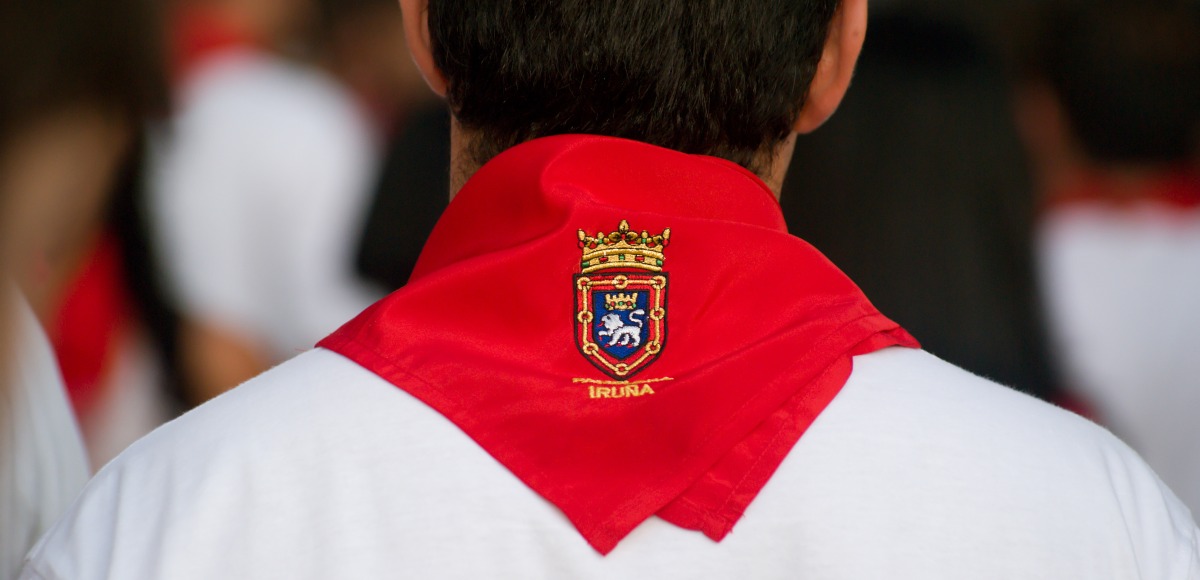
At midday on 6 July, not a minute before or a minute after, the chupinazo (opening rocket) fired from the balcony of the City Hall will announce the start of San Fermín 2026.
The party will have already kicked off hours earlier with the traditional almuercico (mid-morning snack), and indeed, months in advance, when the peñas (festival societies) gather throughout the year to celebrate their particular first of January, second of February, third of March, or fourth of April.
But on that day, at that exact time, everything truly begins. And until 14 July, more than 400,000 people will put the electricity demand required to keep the capital of Navarre in the global spotlight to the test.
Peña members, runners, and festival-goers: energy for 424,000 people, day and night
Along with the Feria de Abril in Seville, the Malaga Fair in August, and the Fallas in Valencia, Pamplona's Sanfermines are one of the year's best-attended festivals in Spain. Its international appeal means that during its nine days and nights, the city's population doubles. And with so many hours to enjoy and so little time set aside for resting, it's only natural that electricity consumption multiplies too.
Hotels, restaurants, bars, nightclubs, concerts, family celebrations, street lighting, the illumination of landmark sites, and the airport, train, and bus stations running at peak capacity all add up to a consumption level that is as intense as it is difficult to calculate exactly.
And if we add the fact that the festival takes place in the middle of July, any time spent at home or indoors will also mean an extra charge on the bill due to the use of air conditioning systems.
But the important thing – as has been the case since its first edition in 1591 – is that each of the more than 400,000 people who will enjoy Pamplona during this festival will do so knowing they have all the energy they need in a city that, as the occasion demands, has no intention of sleeping either.
The three big consumers of San Fermín: hospitality, lighting, and event infrastructure
Bearing in mind that Navarre is a region renowned worldwide for its fine food and drink, it's easy to imagine that the hospitality sector is one of the main contributors to the electricity bill during its biggest festival.
According to the Pamplona City Council website, the city has 960 bars and restaurants. It also boasts the street with the most bars in the world, San Nicolás. Furthermore, the National Statistics Institute has registered 46 hotel establishments in a municipality covering just over 25 square kilometres.
But tourist accommodation and catering are not the only ones putting up 'no vacancies' signs during the San Fermín festival. As night falls, numerous open-air dances, concerts, and music festivals kick off, competing with the charangas (brass bands) roaming the streets. This is when the spotlights come on to illuminate the fun for tens of thousands of people, from Sound Fermín in the Plaza de los Fueros to the concert in the Plaza del Castillo, or the open-air dances in the Plaza de la Cruz and Antoniutti Park.
Finally, commemorative lighting plays its own role in the Sanfermines and, consequently, in the electricity demand during these days. This is especially attractive to all those visitors who, besides the partying, bull runs, and matador costumes, want to discover a Pamplona that also dresses its most iconic monuments and spaces in light. Thus, thousands of bulbs and streetlights adorn the old town, the Plaza del Castillo, the fairground area, and Carlos III Avenue every year, bathing them in red and white until dawn.
How much electricity does Pamplona consume without the Sanfermines?
From the 'Pobre de mí' song that marks the end of these Sanfermines, until the 'Riau-riau' waltz on 6 July 2027 that kicks off the next ones, Pamplona will return to normal as a city recognised worldwide for its commitment to sustainability and energy efficiency.
Already awarded the title of Sustainable City in 2014 by the Environmental Forum Foundation and the Ministry of Agriculture, Food and Environment, the municipality has an ambitious plan in place to be among the first European capitals to achieve net-zero emissions before 2050.
Among the goals related to this energy transition are:
- Reducing its consumption by 64% compared to 2005.
- Covering at least 37% of that consumption with renewable sources.
- Meeting the challenge of Zero Energy Poverty.
Today, the Navarre region has already exceeded some of these goals. According to Red Eléctrica, the province had an electricity demand of 4,874 GWh during 2025, compared to its own generation of 7,327 GWh. And it achieved this with 64.5% of renewables in its installed capacity, supplying 5.5% of all wind energy in Spain.
What sustainability and energy efficiency measures are implemented during the San Fermín festival?
Even taking into account the impact that the San Fermín festival has on consumption in the sectors most closely linked to the celebration, statistics unanimously show that the city's energy demand remains relatively stable during these dates.
Why? The reason is very simple: during the festivities, a large part of the city's industrial activity comes to a halt. And this more than compensates for the spike in demand that this week might represent in the overall total.
However, the Sanfermines are also part of the sustainability and energy efficiency goals that Pamplona has set for itself as part of its Energy Transition and Climate Change Strategy.
The PAMPLONA SF365 Tourism Sustainability Plan sets out a programme of actions to measure and reduce the event's carbon footprint, particularly due to the large influx of vehicles into the city. Promoting public transport and cycling through the centre, providing access to drinking water to reduce packaging consumption, reinforcing waste collection points, and deploying technological tools to optimise energy consumption and City Council services are just some of the ideas making up this plan, which is aimed at improving the quality of the festival in terms of its sustainability, too.
FAQs about the energy impact of the Sanfermines
Does the San Fermín festival cause electricity prices to rise in July?
No. Although electricity consumption in the city of Pamplona increases during the festival, its impact on national demand is negligible. Since the base price of electricity is set for the whole country, taking into account generation capacity and total energy demand, your bill will not be affected in this regard.
What is the carbon footprint of the Sanfermines?
According to data provided by the Pamplona City Council, the 2025 San Fermín festival generated a carbon footprint of 11.8 tonnes of CO2 equivalent, 98.62% of which was linked to transport emissions from external visitors, with flights arriving and departing being particularly significant.
How much water does Pamplona consume during San Fermín?
During the San Fermín festival, the flow of water consumed increases, with an average of 1,230 litres per second in 2025. The largest amount is used for street cleaning operations, which means peak demand coincides with the filling of the street-washing lorries after the massive chupinazo in the City Hall square.
Which energy tariff is ideal for the hospitality sector during the festival?
In general, for a bar or restaurant whose activity stretches day and night across the 9 days of an event like San Fermín, a combined electricity and gas tariff with a stable 24-hour price could be highly suitable. This option helps cover the establishment's two main energy sources, including the kitchen, without worrying about the price of electricity varying during different time bands.
How many electric car chargers are there in the city of Pamplona?
The Pamplona City Council has its own network of 67 charging points, spread across 24 stations. Added to these are several EV charging stations, shopping centres, and other spaces, reaching a total of 102 electric vehicle charging points in the city.
Take a minute to find the product that best suits you:
{{firstStep.title}}
Take a minute to find the product that best suits you:
{{title}}
{{content.phone.title}}
{{content.phone.text}}
{{content.phone.phoneText}}
{{content.form.title}}
{{content.form.text}}
{{content.form.success.title}}
You don't need to adapt to Endesa's tariffs because they adapt to you. If you go to our catalogue you can compare the different tariffs for yourself. Or if you prefer, you can answer a few questions and we will take care of comparing all the different electricity and gas tariffs and then make a customised recommendation.
Take a minute to find the product that best suits you:
{{title}}
{{content.phone.title}}
{{content.phone.text}}
{{content.phone.phoneText}}
{{content.form.title}}
{{content.form.text}}
{{content.form.success.title}}
You don't need to adapt to Endesa's tariffs because they adapt to you. If you go to our catalogue you can compare the different tariffs for yourself. Or if you prefer, you can answer a few questions and we will take care of comparing all the different electricity and gas tariffs and then make a customised recommendation.
Comparison of Electricity and Gas Tariffs
You don't need to adapt to Endesa's tariffs because they adapt to you. If you go to our catalogue you can compare the different tariffs for yourself. Or if you prefer, you can answer a few questions and we will take care of comparing all the different electricity and gas tariffs and then make a customised recommendation.
Do you want to see all our offers?
Spend a minute to find the product which best adapts to you:
{{firstStep.title}}
Spend a minute to find the product which best adapts to you:
{{title}}
{{content.phone.title}}
{{content.phone.text}}
{{content.phone.phoneText}}
{{content.form.title}}
{{content.form.text}}
{{content.form.success.title}}
Spend a minute to find the product which best adapts to you:
{{title}}
{{content.phone.title}}
{{content.phone.text}}
{{content.phone.phoneText}}
{{content.form.title}}
{{content.form.text}}