


If you prefer to view the website always in english, click here.
{{content.phone.title}}
{{content.phone.text}}
{{content.phone.phoneText}}
{{content.form.title}}
{{content.form.text}}
{{content.form.success.title}}
Average electricity consumption for two people: tariff comparison and money-saving tips
To know how much electricity is consumed on average in a home with two people, it is essential to rely on official data and representative studies. According to the IDAE (Institute for the Diversification and Saving of Energy), the average annual consumption of a household in Spain is around 3,500 kWh, but this can vary depending on the size of the dwelling, lifestyle, the type of electrical equipment in it, and usage habits.
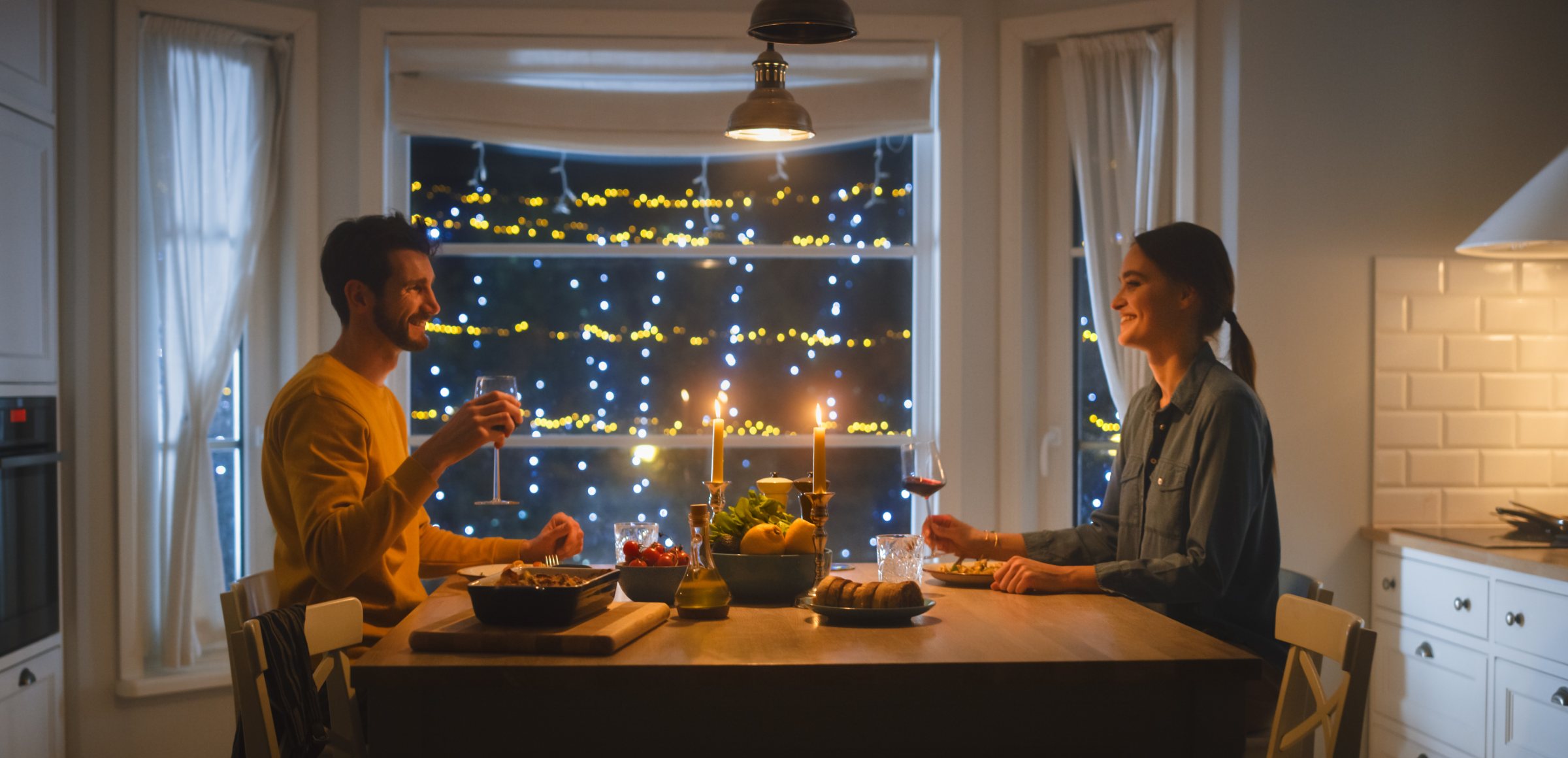
For small households where one or two people live, some official references place regular consumption between 1,800 and 2,500 kWh per year, but only when the use of basic appliances is optimised. Consumption can increase if an electric boiler or heavy air conditioning usage is included.
The regulated PVPC tariff (Voluntary Price for the Small Consumer) publishes dynamic hourly prices and, for a couple of years now, has partially integrated futures markets to reduce volatility (it can be contracted for up to 10 kW of power). In the free market, you can opt for 24-hour fixed-price tariffs or tariffs with time-of-use discrimination, taking advantage of their stable conditions and promotions. Thanks to time-of-use discrimination, if you adapt your domestic consumption to off-peak hours, you can pay less per kWh.
In short, to save money in a two-person household, it is advisable to adjust actual consumption to the contract. For example, if you consume little, do not use electric heating all the time, have efficient appliances, and have good usage habits, you could clearly benefit from tariffs with time-of-use discrimination and moderate power capacity.
How much two people consume on average in a home
Knowing the energy consumption of two people is not an exact science, but it is possible to get close to a range by taking data from average households and adjusting them according to size.
In a standard flat with efficient appliances, frequent use of the kitchen, washing machine, dishwasher and lighting, and without switching on electric heating continuously, a realistic range could be a demand of 2,000 to 2,700 kWh per year. Domestic consumption is concentrated in electrical appliances (55%) and lighting (12%), followed by the kitchen (9%) and Domestic Hot Water or DHW (7.5%).
The best way to know what you are spending is to review the bills from the last few months and, in accordance with your usage habits, adjust the contracted power and tariff:
Check your bill
Your monthly receipt indicates the number of kilowatt-hours (kWh) consumed in that period. If you have a smart meter, many energy retailers give you access to daily or hourly usage consumption, which helps to identify peaks or unusual consumption. In addition, the bill shows tolls and regulated charges, meter rental, and taxes.
After analysing this data, you will be able to calculate your monthly and annual consumption and compare it with official averages. This information will be essential to know if you have the right tariff and contracted power for a two-person household.
Adjust your contracted power and tariff
Adapting the power you have contracted to your consumption habits will prevent you from paying too much for the fixed term (standing charge) of your bill, as well as avoiding power cuts due to excess demand. In low voltage (2.0TD access tariff) there is time discrimination for energy (peak, shoulder, off-peak) and two periods for power (peak, off-peak).
For a flat where two people live, where there is no high simultaneous consumption (without many high-power appliances running in parallel), contracting a moderate power capacity is usually sufficient. Standard power capacity typically ranges between 3.45 and 4.6 kW, which is sufficient if you use the fridge, washing machine, and small appliances at the same time, and in a controlled manner.
Comparison of electricity tariffs for two people living together
In 2025, several 24-hour fixed prices on the free market may result in a lower average cost than the PVPC when there are peaks, but suitability will depend on your schedules and the current promotions you can take advantage of. At Endesa, we have several options that could suit you very well:
- One Luz (24h fixed price): a stable price all day long, with no minimum contract period; recommended if your consumption is spread out and you prefer predictability.
- One Luz 3 Periodos: three prices (peak, shoulder, and off-peak) for those who concentrate their consumption at night or during weekends.
These are just some of the Endesa tariffs, but perhaps your consumption habits are better suited to others you can find in our Electricity Catalogue.
Tips to reduce consumption for both of you
It is important to adopt consumption habits so that spending does not skyrocket or get out of control:
- Take advantage of off-peak hours (night, weekends, and public holidays) to use the washing machine, dishwasher, tumble dryer, or electric cooker (if you have contracted a time-of-use tariff or PVPC).
- Avoid standby or 'phantom consumption' by disconnecting devices that are not in use or that consume energy in 'sleep' mode. Using power strips with a switch also helps (standby mode accounts for around 6.6% of domestic consumption).
- Replace bulbs with LED lighting, and old appliances with efficient class ones (A/B), as the use of these devices and lighting represents a significant part of domestic consumption. Lighting accounts for 11% to 12% of energy demand, while appliances represent approximately 55% of the expense.
- Adjust the contracted power, as every unnecessary kW adds a monthly fixed cost. Also, regulate heating or air conditioning. If the home has electric climate control, moderate and controlled use (efficient temperature, thermostats, good insulation) will significantly reduce electricity spending.
Monitoring your consumption, checking your bill month by month and comparing it with previous periods, will allow you to detect unexpected increases and regain control.
When to change tariff if you share a flat with someone else
Changing your tariff can be a 'lifesaver' and a very strategic decision. Having the right one isn't fixed for life, because your habits or personal situation can change. That is why it is ideal to review it periodically and take action depending on different situations:
- If your consumption is concentrated in the afternoon/evening and weekends, a tariff with three periods can help you save compared to the 24h fixed price.
- If you need stability and do not want to check the price daily, then a fixed-price tariff is convenient.
- If you experience lifestyle changes (working from home, intensive use of appliances, buying an air conditioner or an electric boiler), it is important to review power and modality. The CNMC (National Commission on Markets and Competition) offers online tools to see your demanded power and avoid excesses.
In general, reviewing the bill, analysing actual consumption, and comparing different tariffs every 6 to 12 months is a very good practice.
How much do two people living together pay on average for electricity per month?
Calculating this will depend on the final consumption, the habits of both people, the location of the home, and the tariff you have contracted. Some estimates from official bodies indicate that for houses where 1 to 2 people live, the monthly bill usually ranges from €45 to €70 (approximately), provided moderate consumption has been maintained and a tariff appropriate to this type of household has been contracted.
If a moderate demand of about 200 to 250 kWh per month is considered, and an average price close to €0.24/kWh (indicative average value in Spain), the cost for consumption would be about €44 to €60. Adding the fixed power term for a typical contract (for example 4.6 kW), the total monthly consumption could be in that range, up to €70.
What electrical power is sufficient for two people?
Choosing the ideal contracted power that is appropriate for your consumption habits is key to not overpaying or experiencing power trips. For two people in the same home, it is recommended to contract a power of between 3.45 kW and 4.6 kW, but it will depend on the size of the flat and the appliances used. This contracted power will be sufficient to use basic appliances like the fridge, microwave, television, and washing machine simultaneously, without the risk of the supply being cut.
If your lifestyle involves using several appliances and equipment at once (microwave, ceramic hob, oven, washing machine, dryer, air conditioning, etc.), then it is recommended to raise the contracted power to more than 4.6 kW to avoid those unexpected energy interruptions.
The One Luz tariff is an option that fits two people with spread-out consumption who want to always know what they will pay, without having to adapt their lifestyle or habits to schedules. If you concentrate part of the consumption at night or on weekends, then the One Luz 3 Periodos tariff will be a good alternative.
We recommend you dedicate a few minutes to analysing the electricity bill, and make sure you aren't paying more than necessary.
Take a minute to find the product that best suits you:
{{firstStep.title}}
Take a minute to find the product that best suits you:
{{title}}
You don't need to adapt to Endesa's tariffs because they adapt to you. If you go to our catalogue you can compare the different tariffs for yourself. Or if you prefer, you can answer a few questions and we will take care of comparing all the different electricity and gas tariffs and then make a customised recommendation.
Take a minute to find the product that best suits you:
{{title}}
You don't need to adapt to Endesa's tariffs because they adapt to you. If you go to our catalogue you can compare the different tariffs for yourself. Or if you prefer, you can answer a few questions and we will take care of comparing all the different electricity and gas tariffs and then make a customised recommendation.
Comparison of Electricity and Gas Tariffs
You don't need to adapt to Endesa's tariffs because they adapt to you. If you go to our catalogue you can compare the different tariffs for yourself. Or if you prefer, you can answer a few questions and we will take care of comparing all the different electricity and gas tariffs and then make a customised recommendation.
Do you want to see all our offers?
Spend a minute to find the product which best adapts to you:
{{firstStep.title}}
Spend a minute to find the product which best adapts to you:
{{title}}
{{content.phone.title}}
{{content.phone.text}}
{{content.phone.phoneText}}
{{content.form.title}}
{{content.form.text}}
{{content.form.success.title}}
Spend a minute to find the product which best adapts to you:
{{title}}
{{content.phone.title}}
{{content.phone.text}}
{{content.phone.phoneText}}
{{content.form.title}}
{{content.form.text}}