


If you prefer to view the website always in english, click here.
{{content.phone.title}}
{{content.phone.text}}
{{content.phone.phoneText}}
{{content.form.title}}
{{content.form.text}}
{{content.form.success.title}}
How to detect where a gas leak is coming from: a complete guide for your safety
Gas leaks in the home are not common, but when they occur, it is essential to react quickly and know how to interpret the signs. Identifying where a leak is coming from allows you to act before the problem escalates and prevents major risks such as poisoning, fire or explosions.
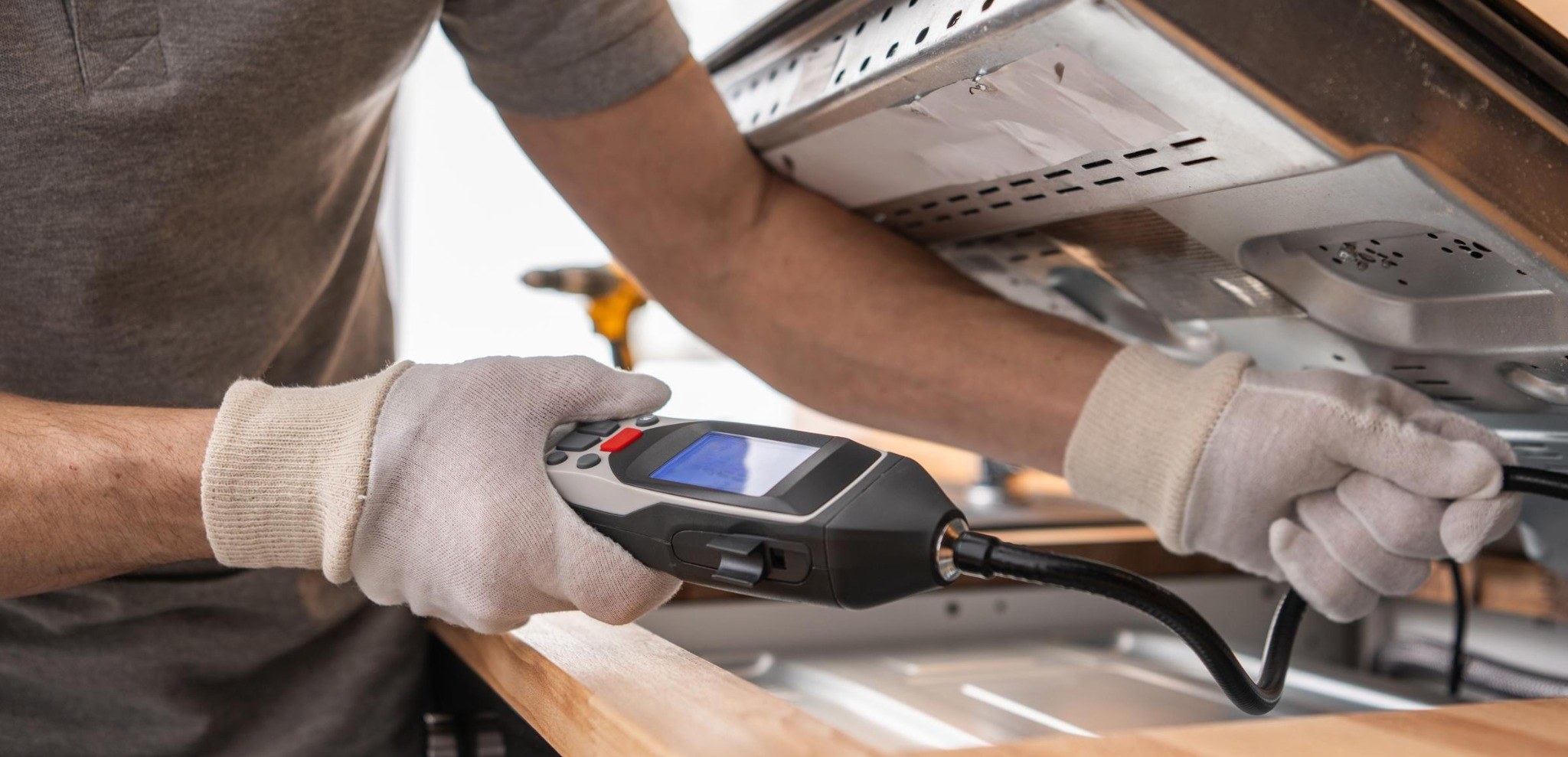
Signs that indicate there may be a gas leak
Before trying to locate where the leak is coming from, the first thing is to ensure that there really is a leak. There are several very recognisable signs that can help you detect it from the very first moment.
Characteristic smell
Natural gas is naturally odourless, which is why an odorant, known as mercaptan, is added to give it that characteristic odour. If you notice a strong, penetrating smell, it is the most obvious sign that there may be a leak.
Unusual noises
A hissing or whistling sound near pipes, control valves or gas appliances is usually a clear sign that gas is escaping through a joint or connection that is not properly sealed.
Unstable or yellow pilot light
In appliances such as cookers, heaters or boilers, the flame can give you important clues. If instead of being crisp blue it appears yellow or orange, it is a sign that combustion is not correct. And if the flame flickers, becomes unstable or goes out easily, it can also indicate a leak or a problem with the gas supply.
Nearby plants turning yellow for no reason
In outdoor installations, a leak can affect the surrounding vegetation. If you notice that plants in a specific area are turning yellow or drying out for no apparent reason, it is a sign that deserves an inspection.
Physical symptoms
Exposure to gas can cause discomfort, such as dizziness, nausea, headaches or an unusual feeling of drowsiness. If these symptoms disappear when you go outside or ventilate the property, it is a warning sign indicating that there could be a leak.
Where can a gas leak come from?
Leaks can occur in several parts of the installation, with some areas being more susceptible than others. Technical guides and maintenance services agree that these are usually the places where problems are most frequently detected.
Pipes and joints
Joints, elbows and connections are areas especially sensitive to wear or defective sealing, so they are usually one of the points where a leak can most easily appear.
Control valves
If a valve is worn or does not close correctly, it can let small amounts of gas escape without it being obvious to the naked eye.
Boiler or water heater
Over time, components such as valves, burners or internal connections can develop faults that lead to a leak.
Gas cooker
Flexible hoses, burners or control knobs can deteriorate or become poorly adjusted, becoming a common point for leaks.
Gas meter
Although less common, a meter that is old, damaged or has been tampered with can also develop leaks that should be checked as soon as possible.
How to detect the source of the leak safely
Once you have verified that gas is indeed present, the next step is to try to identify where the leak is coming from. To do this, you can rely on a series of simple and safe checks, always following the recommendations of industry professionals.
1. Ventilate and ensure there are no sources of ignition.
Before any check, the most important thing is to guarantee that the space is ventilated and free of any element that could cause a spark. To do so:
- Open windows and doors to let fresh air in.
- Do not switch lights or appliances on or off.
- Avoid using mobile phones near the affected area.
These measures are part of all official gas leak response protocols and are essential to minimise risks.
2. Visually check the installation.
A visual inspection can give you clear clues without needing to touch anything. Look out for:
- Worn hoses.
- Loose connections.
- Corrosion on pipes.
- Traces of soot on appliances.
Any anomaly in these points can help you identify where the leak is occurring.
3. Observe the flame of the appliances.
If you suspect the leak may be coming from a burner, a cooker or a boiler, the flame can give you very useful information. Pay attention to:
- Yellowish colour instead of blue.
- Instability or a flickering flame.
- Irregular noise during combustion.
These signs indicate that combustion is not correct and that there could be a leak or a problem with the gas supply.
4. Use gas detectors.
Domestic detectors are a very effective tool for identifying leaks even before the smell is perceptible. Energy safety guides recommend installing them especially in:
- Kitchens.
- Boiler rooms.
- Areas with poor ventilation.
They are affordable, easy to install and offer an early warning that can make the difference.
What you must never do if there is a gas leak
There is a series of actions that is important to avoid completely, as they can increase the risk:
- Do not light matches, candles or cigarettes.
Any spark or open flame can cause ignition.
- Do not operate electrical switches.
Switching a light on or off can generate a spark.
- Do not try to repair the leak yourself.
Attempting to work on the installation without the necessary qualifications can make the situation worse.
- Do not use the lift.
It is safer to use the stairs to avoid electrical risks.
- Do not seal the property hermetically.
Ventilation is key to dispersing accumulated gas.
What to do if you locate the source of the leak
If you have identified the exact point, the most important thing is to act with caution. Specialised technical services insist on following a series of basic steps to guarantee safety:
- Turn off the gas supply at the mains: it is the fastest way to stop the leak.
- Ventilate the property for several minutes: opening doors and windows helps to disperse the accumulated gas.
- Avoid switching electrical appliances on or off: any spark, however small, can be dangerous.
- Do not attempt to repair it yourself: it is important that this is done by a knowledgeable and authorised person.
- Call an authorised engineer or the emergency service if the smell is strong: they have the equipment and preparation necessary to resolve the situation with total safety.
How to prevent future leaks
Prevention is key to avoiding risks. To keep the installation in good condition and minimise the possibility of a leak, it is advisable to follow these safety recommendations:
Periodic maintenance
Professional inspections allow faults to be detected before they become a problem. That is why specialised companies insist on checking boilers, pipes and valves regularly.
Replace old hoses
Flexible hoses have an expiry date and, over time, can deteriorate. Renewing them when appropriate is fundamental to guarantee safe use.
Install gas detectors
They are affordable and very effective devices that offer an early warning of any leak, even before it is perceptible by smell.
Do not tamper with the installation
Any modification or repair must always be carried out by an authorised installer. Interfering with the installation without adequate training can generate unnecessary risks.
The importance of using a professional service
Detecting a leak is only the first step. To guarantee the safety of your home, it is fundamental that the entire installation is in the hands of qualified professionals. Using a specialised maintenance service offers key advantages:
- Periodic inspections. They allow any anomaly to be detected in time and ensure that everything works correctly.
- Safe repairs. Authorised engineers have the training and tools necessary to intervene without risks.
- Support for faults. Having a professional service at your disposal brings peace of mind in unforeseen situations.
- Greater efficiency and peace of mind. A well-maintained installation consumes less, works better and reduces the likelihood of incidents.
The combination of a well-cared-for installation and responsible use is the best way to enjoy a safe, efficient home prepared for any eventuality.
360 Gas Protection: the comprehensive solution for your peace of mind
For those seeking complete protection against faults, leaks and installation problems, Endesa's 360 Gas Protection offers a comprehensive service that covers everything from preventive maintenance to urgent assistance.
It includes periodic inspections, repairs carried out by authorised technician and rapid attention to any incident, guaranteeing a safer and more efficient home all year round.
Take a minute to find the product that best suits you:
{{firstStep.title}}
Take a minute to find the product that best suits you:
{{title}}
You don't need to adapt to Endesa's tariffs because they adapt to you. If you go to our catalogue you can compare the different tariffs for yourself. Or if you prefer, you can answer a few questions and we will take care of comparing all the different electricity and gas tariffs and then make a customised recommendation.
Take a minute to find the product that best suits you:
{{title}}
You don't need to adapt to Endesa's tariffs because they adapt to you. If you go to our catalogue you can compare the different tariffs for yourself. Or if you prefer, you can answer a few questions and we will take care of comparing all the different electricity and gas tariffs and then make a customised recommendation.
Comparison of Electricity and Gas Tariffs
You don't need to adapt to Endesa's tariffs because they adapt to you. If you go to our catalogue you can compare the different tariffs for yourself. Or if you prefer, you can answer a few questions and we will take care of comparing all the different electricity and gas tariffs and then make a customised recommendation.
Do you want to see all our offers?
Spend a minute to find the product which best adapts to you:
{{firstStep.title}}
Spend a minute to find the product which best adapts to you:
{{title}}
{{content.phone.title}}
{{content.phone.text}}
{{content.phone.phoneText}}
{{content.form.title}}
{{content.form.text}}
{{content.form.success.title}}
Spend a minute to find the product which best adapts to you:
{{title}}
{{content.phone.title}}
{{content.phone.text}}
{{content.phone.phoneText}}
{{content.form.title}}
{{content.form.text}}