


If you prefer to always view the website in English, please click here.
Power outages: what to do step by step and how to fix them
Why has your power been cut off? A power cut can happen for several reasons, including non-payment or a technical fault. Here’s how to solve it.
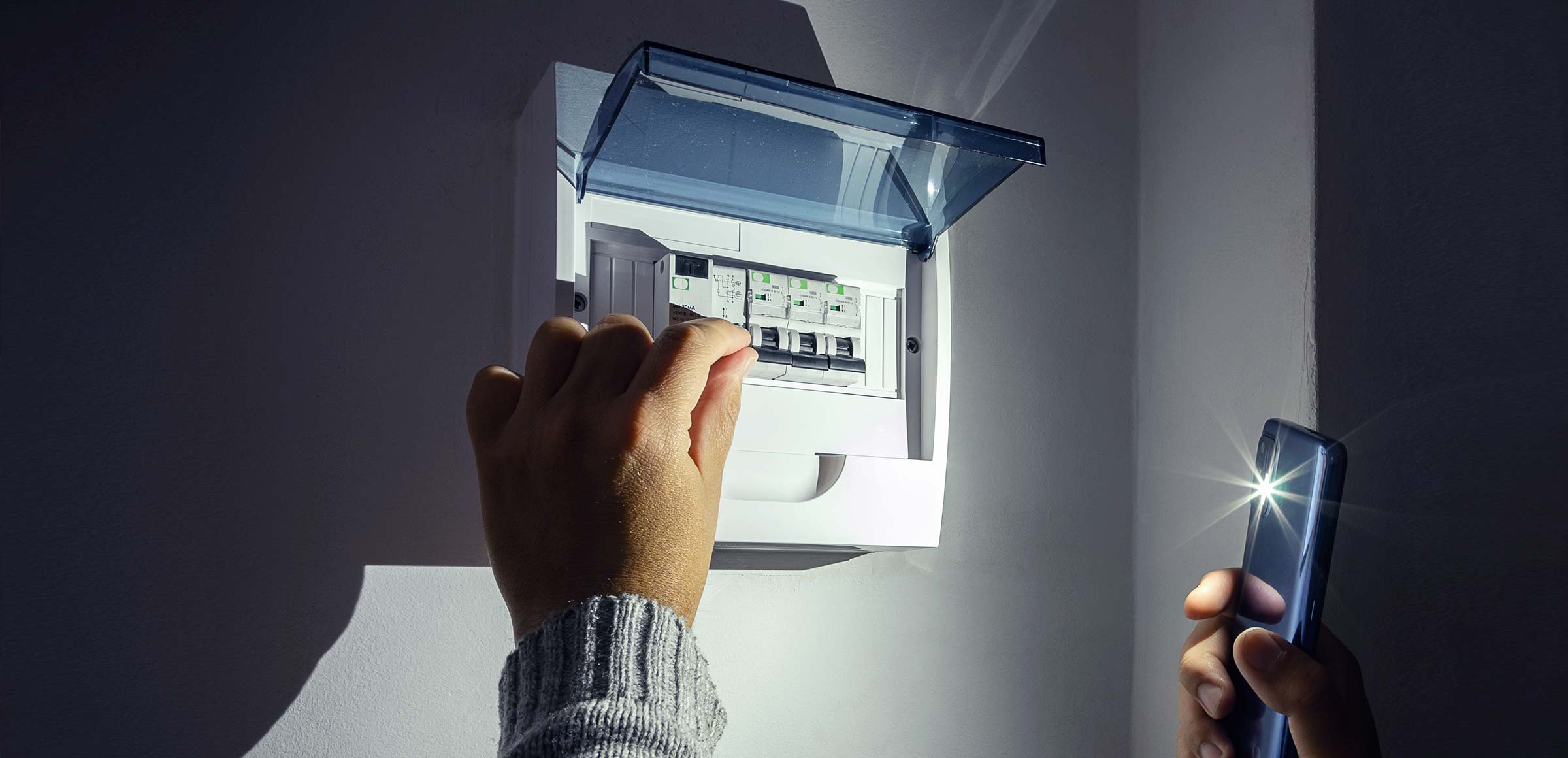
The first thing you should do when the power goes out
The first step is to find out why the electricity supply has been interrupted. If it’s a technical issue, make sure power is restored safely. In other words, if the fault is in your home or building, try to identify the cause if possible and rely on professionals for repairs when necessary.
Here are a few useful tips:
- Always keep torches and spare batteries in an easy-to-reach place.
- Avoid using candles.
- Keep the fridge closed so it stays cold and your food doesn’t spoil.
- Try to unplug appliances that were connected to the mains when the outage occurred.
How to tell if the power outage is only in your home or affects the whole area
To determine the cause of the outage, we recommend the following steps:
To check whether the fault is in your home, try resetting the circuit breakers in your fuse box. If this doesn’t work, the issue may be with your installation or power may have been cut for non-payment.
Check whether your neighbours and common areas in your building have power. If they do, the issue is specific to your home (fault or non-payment). If they don’t, the problem affects the building.
If the outage affects several streets or the whole neighbourhood, it's most likely due to maintenance work by the distribution company or a fault in the grid. Distribution companies are required to inform customers in advance of scheduled outages with at least 24 hours’ notice.
Most common causes of a power outage
The electricity supply in your home or commercial premises may be interrupted for a period of time due to different reasons:
- Power outage due to a fault in your home: There has been an issue with your home’s electrical installation.
- Power outage due to a fault in your building: There has been an issue in the building. You’ll notice because it also affects your neighbours and common areas.
- Scheduled outage by the distribution company: The distribution company is carrying out improvement work and notifies customers in advance.
- Power outage due to a fault in the transmission grid: Grid overloads or severe weather conditions can cause incidents that interrupt the electricity supply.
- Power outage due to non-payment: Failure to pay electricity bills may lead to a supply disconnection.
Electrical overload at home
Excessive simultaneous power use can cause the main breaker to trip, leaving your home without power. This often happens when several high-power appliances are running at the same time.
Insufficient contracted power
If your contracted power doesn’t cover your needs, the supply will be interrupted whenever you exceed the limit. In this case, it’s advisable to review your contract and adjust the contracted power.
Fault in the distribution network
To confirm whether the outage is due to a fault in the network, you can call your local distribution company. If it’s E-distribución, this link provides the phone numbers to call based on your location, 24 hours a day. They will give you information about the outage and the estimated repair time.
Most faults are caused by construction accidents, storms or strong winds, fires, birds, or tree branches damaging high-voltage lines or other components.
Scheduled construction work or maintenance
These types of supply interruptions are common, and they are carried out to upgrade or improve the distribution grid. Customers are notified in advance, including information about the affected areas, the start time of the outage, and its approximate duration. This advance notice allows you to plan for a few hours without electricity.
Storms, high winds, and severe weather
Adverse weather conditions can damage electrical infrastructure and cause power outages.
Illegal connections nearby
Illegal connections can affect grid stability and cause supply interruptions for nearby residents.
Power outage due to non-payment
There are several scenarios that can lead to your electricity being cut for non-payment:
- Not paying your electricity bills. Your supplier must first notify you of the default and their intention to disconnect your supply.
- Making an illegal connection without a contract with a supplier. In this case, no prior notice from your supplier is required.
- Illegally tampering with your electricity meter. As in the previous case, no prior notice will be given.
- Your electrical installation does not meet safety regulations and poses a risk. The supplier is also not required to notify clients in advance in this scenario.
Notices before power outages due to non-payment
If you fail to pay your electricity bill, your supplier will send you a notice after the payment deadline has expired. It is usually delivered by regular post, depending on your supplier and contract.
Once this notice has been sent, if the bill is still unpaid, the supplier will send a formal notice of non-payment, usually by burofax or certified letter. This notice warns that the company intends to disconnect the supply on a specific date. If the bill remains unpaid after receiving this notice, a third registered letter is sent announcing the disconnection, and the supply is then effectively cut off.
The exact timeline depends on the type of market your contract is part of:
- Free market: Payment deadlines from the invoice issue date are specified in your contract. The disconnection deadline is also stated in the contract.
- Voluntary Price for Small Consumers (PVPC): The payment deadline is 20 days from the invoice issue date. Two months must pass after the first notice is received before the supply can be disconnected.
It’s important to remember that there are certain consumers and situations where your electricity cannot be cut off, for example, if you are a beneficiary of the Social Bonus.
How to pay your outstanding bill
We recommend first checking how many bills are unpaid and the total amount due. Then contact your supplier to make payment. At Endesa, you can review and pay any outstanding bills instantly from your Customer Area.
Once the debt is settled, the supplier will take between 5 and 7 days to restore the supply.
Late payment interest on electricity bills
Reconnecting the supply incurs an additional charge, which must be paid on the next bill. The amount is equivalent to double the regular connection fee, approximately €20.
What to do if the problem lies within your home
- Check the fuse box: See whether the main breaker or the residual current device (RCD) has tripped. This often happens due to an overload or a temporary fault in one of your appliances.
- Unplug some devices: If the outage is due to excessive power use, unplug high-consumption appliances (oven, ceramic hob, air conditioner) and then reset the breaker.
- Check sockets and power strips: A faulty outlet or an overloaded power strip can cause the system to trip.
- Check your contracted power: If outages happen frequently, your contracted capacity may be too low for your daily needs.
- Contact a qualified electrician: If the problem persists or you notice unusual smells, sparks, or overheating in the electrical panel, the safest option is to call a professional to avoid risks.
What to do if the power outage is widespread
- Ask your neighbours: If they are also affected, the issue is most likely a grid fault or a scheduled outage.
- Check official channels: Many distribution companies report incidents on their websites or apps.
- Call your local distribution company: If it’s E-distribución, 24-hour hotlines are available depending on your location. They’ll be able to confirm whether it’s a fault, maintenance work, or a scheduled outage, and give you an estimated time for power to be restored.
Who to call if the power goes out
- Distribution company: They are responsible for the electricity grid. You should contact them in the event of faults, widespread outages, or maintenance work.
- Energy supplier/retailer: This is the company you have your electricity contract with. You should contact them if the outage is due to non-payment or administrative issues, or if you have billing questions.
How long does it usually take for the power to come back?
- Faults: The time depends on the severity and location of the issue. Your distribution company will usually provide an estimated timeframe.
- Non-payment: Once the outstanding balance has been paid, supply is typically restored within 5 to 7 days.
- Scheduled maintenance: The duration is specified in the advance notice, usually lasting a few hours.
Which appliances can be damaged by a power outage
Power cuts can affect various appliances, especially those sensitive to voltage fluctuations:
- Fridges and freezers: Loss of cooling can cause food to spoil if the outage lasts too long.
- Computers and TVs: Power surges when electricity is restored can damage internal components.
- Washing machines and dishwashers: If a wash cycle is interrupted, the appliance may get stuck or suffer motor damage.
- Appliances with advanced electronics: Ovens, microwaves, or HVAC systems can also be affected by sudden outages.
To protect your devices, it’s a good idea to use surge-protected power strips or UPS (uninterruptible power supply) systems for sensitive devices like computers.
Can you claim compensation for a power outage due to a fault?
The law outlines certain cases in which power cuts are justified. However, if you experience an unexpected outage without a valid reason, you may claim compensation from your distribution company. You can also file a claim through your home insurance provider, the Consumer Protection Office (in person or online), or the Ministry for the Ecological Transition and Demographic Challenge (MITECO). In addition, you can claim for any potential damage to your appliances through your home insurance.
Depending on where you live, the number of outages, and their duration, you may be entitled to compensation. This table provides further details:
{{content.phone.title}}
{{content.phone.text}}
{{content.phone.phoneText}}
{{content.form.title}}
{{content.form.text}}
{{content.form.success.title}}
|
Location |
No. of power interruptions per year |
Duration of the outage |
|---|---|---|
|
Urban area |
10 | 5 hours |
|
Semi-urban area |
13 | 9 hours |
|
Organised rural area |
16 | 14 hours |
|
Dispersed rural area |
22 | 19 hours |
Take a minute to find the product that best suits you:
{{firstStep.title}}
Take a minute to find the product that best suits you:
{{title}}
{{content.phone.title}}
{{content.phone.text}}
{{content.phone.phoneText}}
{{content.form.title}}
{{content.form.text}}
{{content.form.success.title}}
You don't need to adapt to Endesa's tariffs because they adapt to you. If you go to our catalogue you can compare the different tariffs for yourself. Or if you prefer, you can answer a few questions and we will take care of comparing all the different electricity and gas tariffs and then make a customised recommendation.
Take a minute to find the product that best suits you:
{{title}}
{{content.phone.title}}
{{content.phone.text}}
{{content.phone.phoneText}}
{{content.form.title}}
{{content.form.text}}
{{content.form.success.title}}
You don't need to adapt to Endesa's tariffs because they adapt to you. If you go to our catalogue you can compare the different tariffs for yourself. Or if you prefer, you can answer a few questions and we will take care of comparing all the different electricity and gas tariffs and then make a customised recommendation.
Comparison of Electricity and Gas Tariffs
You don't need to adapt to Endesa's tariffs because they adapt to you. If you go to our catalogue you can compare the different tariffs for yourself. Or if you prefer, you can answer a few questions and we will take care of comparing all the different electricity and gas tariffs and then make a customised recommendation.
Do you want to see all our offers?
Spend a minute to find the product which best adapts to you:
{{firstStep.title}}
Spend a minute to find the product which best adapts to you:
{{title}}
{{content.phone.title}}
{{content.phone.text}}
{{content.phone.phoneText}}
{{content.form.title}}
{{content.form.text}}
{{content.form.success.title}}
Spend a minute to find the product which best adapts to you:
{{title}}
{{content.phone.title}}
{{content.phone.text}}
{{content.phone.phoneText}}
{{content.form.title}}
{{content.form.text}}