


If you prefer to always view the website in English, please click here.
What is grounding, and why is it so important in your home?
Grounding is one of the most important elements of any electrical installation. Although it often goes unnoticed, its role is essential to protect both people and household appliances from potential electric shocks or electrical faults.
What exactly is grounding?
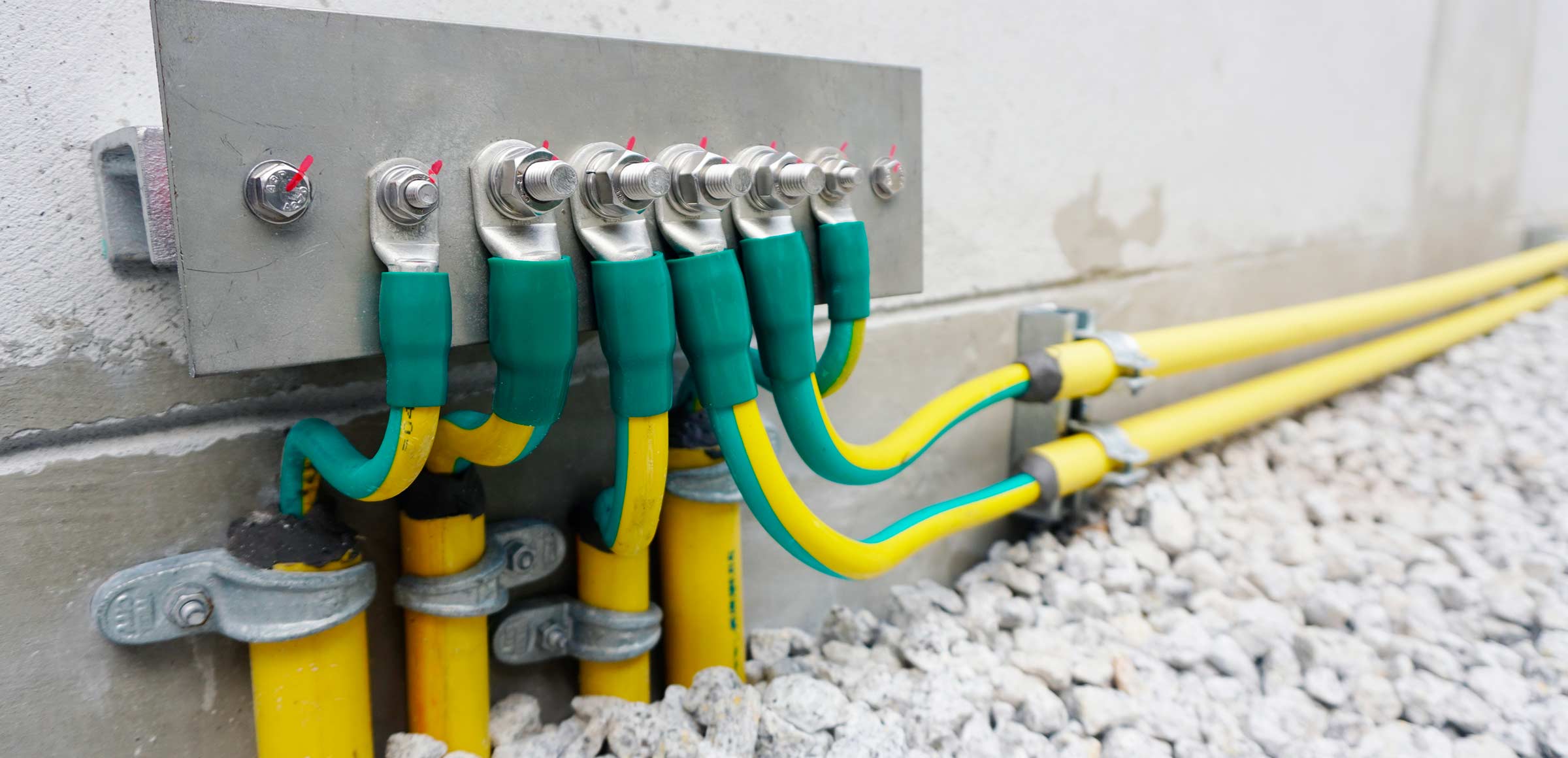
Grounding, also known as earthing, is a safety system that connects your home’s electrical installation to the ground t This cable allows electricity, in the event of a current leak, to be safely diverted into the ground instead of passing through people or electrical devices.
What is grounding used for?
Grounding plays a vital safety role in any electrical installation. Its main purpose is to protect people from electric shocks: when an appliance develops a fault or current leakage, the electricity is redirected straight into the ground, preventing the user from receiving a shock. Even in more extreme situations —such as a power surge caused by a lightning strike— grounding acts as an escape path for electricity, reducing the risk of accidents.
In addition, grounding protects household appliances and electronic equipment from voltage spikes and current leaks, extending their lifespan and ensuring more stable operation. It also prevents metal-cased appliances from building up dangerous voltages on their housing by safely discharging them into the ground and eliminating the risk of contact.
Another key aspect is that grounding supports the proper operation of the RCD or circuit breaker. This device cuts off the power supply when it detects current leakage, while grounding helps ensure that this detection is fast and effective.
Beyond safety, grounding serves a second purpose: it improves electrical signal quality and protects the installation as a whole, ensuring that appliances operate more efficiently. Finally, it helps reduce electromagnetic interference, which is especially useful for audio equipment and sensitive devices where signal quality is critical.
In short, grounding not only protects people and appliances but also ensures the stability of the entire electrical system, making it an essential component of any modern home.
How do earthing connections work?
Earthing connections are easy to identify: earthing connections are found in the form of the third cable or wire of your home installation, your home's power sockets or in your household appliances. They connect conductive materials, such as metal, to earth, diverting the electricity from the conductor to a place where it does not cause damage (such as earth, where it is dispersed). In the case of a household's earthing connection, it must be anchored under earth to prevent damage. This general earthing connection is usually connected to the power sockets to divert the current that could be dispersed from each one.
Earthing connections are easy to recognise, since they have green and yellow cables.
How is an earthing connection installed?
An expert technician must install and handle all earthing connections, due to their complexity and to the associated risks. Keep in mind that some very old homes may not have an earthing connection or this connection may have deteriorated over time. Therefore, it is necessary to inspect your electrical installation at regular intervals.
In addition, you must bear in mind that there are specific laws.
Where is grounding located in a home?
Grounding is present at several key points in the electrical installation:
- On Schuko outlets, where it can be identified by the two metal clips that ensure appliances are properly grounded.
- Housed within the electrical panel, where it is connected to the home’s overall system and distributes protection to all circuits.
- Via the earth rod buried beneath the building, which ensures direct contact with the soil and allows current to dissipate safely in the event of a fault.
Thanks to this connection, the entire installation is protected against electric shocks and power surges.
What elements must be connected to the earthing connection?
The boiler, elevator cables, pipes, concrete walls and other elements must be connected to the earthing connection, i.e., the conductive elements inside a home.
The TV antenna must also be connected to the earthing connection. It is highly exposed to electric shocks caused by lightning, due to its design and place of installation.
Moreover, the lighting arrester must also be connected to the earthing connection, according to its design purpose.
How is the differential switch associated with the earthing connection?
The differential switch is designed to protect your electrical installation against earth leakages to prevent electric shock to people or pets. Therefore, when current is detected between the protection cables of the earthing connection or on the earthing connection's cables of a plug or electrical appliance, these are disconnected automatically.
To do so, measure the input and output amperes: if it detects a difference in voltage, this means that there could be a risk of electricity leakage, so it is triggered and cuts off the electricity.
What are earthed sockets and plugs?
Let us start with power points. In Spain, most sockets have two horizontal holes, into which the electrical device's plug is fitted. You will see two tabs on the top and bottom of the socket: these are earthing connections. They are connected to the general earthing structure under the building.
In the case of plugs, Schuko plugs are used. These types of plugs usually have a metal groove on the top and bottom, into which the socket's tabs fit when the plug is inserted. These grooves are connected to the green and yellow wires mentioned above. The cables are connected to the areas that can be touched by people or pets, and which have conductive materials.
Therefore, electrical appliances featuring a plug with an earthing connection are much safer than those that do not have one.
How to know if your home has grounding
Grounding is an invisible but essential element of any electrical system. Knowing whether your home has proper grounding —and whether it’s working correctly— is key to your safety and that of your appliances. Here are some signs that can help you identify potential issues:
- Risk of electric shocks: if you feel small shocks or tingling when touching a metal appliance, your installation may lack proper grounding, or it may be damaged. This is one of the clearest warning signs.
- Appliances that break down frequently: without grounding, sensitive devices such as washing machines, refrigerators or TVs are more likely to suffer repeated failures. Voltage spikes and current leaks shorten their lifespan and lead to unnecessary expenses.
- Frequent tripping of the RCD: the RCD is designed to cut off power when it detects leakage. If it trips regularly, it may indicate that the grounding system isn’t doing its job and that the installation needs to be checked.
- Power surges and malfunctions in sensitive equipment (computers, routers, TVs): electronic devices are especially vulnerable to voltage fluctuations. If your computer, router or TV shuts down, restarts or malfunctions for no apparent reason, it’s worth checking the condition of your grounding.
What to do if you suspect your grounding isn’t working
- Contact a licensed electrician: only a qualified professional can verify whether the grounding system is correctly installed and functioning properly.
- Don’t try to fix it yourself: grounding requires technical expertise, as working with electricity always involves risks.
- Upgrade your installation if it’s outdated: if your home lacks grounding or if it’s in poor condition, the best option is to upgrade the installation to meet current regulations and improve safety.
What maintenance do earthing connections require?
The maintenance intervals and requirements are established in the corresponding laws. However, it is important to check your installation more often in some cases. It is essential to ensure that there is contact between the electrode and earth. Due to its nature or in the event of high temperatures, it can dry out or crack, which will lessen the degree of contact and thus reduce the resistivity of earth. Specific products can be used to prevent this phenomenon from occurring, which should always be applied by an expert, since acids or salts can rust and damage the earthing connection's materials.
The technicians will choose the best location for the earthing rods (the element in direct contact with earth), at the most suitable distance from the surface (depending on the type of weather in the area and type of building) and at a safety distance from river basins, wells, lakes, pipes, groundwater, power stations, power cables, etc.
All in all, earthing protects your home against electric shocks and is an essential part of your electrical installation and appliances. Ensuring your home is protected will allow you to enjoy day to day safely.
{{content.phone.title}}
{{content.phone.text}}
{{content.phone.phoneText}}
{{content.form.title}}
{{content.form.text}}
{{content.form.success.title}}
Take a minute to find the product that best suits you:
{{firstStep.title}}
Take a minute to find the product that best suits you:
{{title}}
{{content.phone.title}}
{{content.phone.text}}
{{content.phone.phoneText}}
{{content.form.title}}
{{content.form.text}}
{{content.form.success.title}}
You don't need to adapt to Endesa's tariffs because they adapt to you. If you go to our catalogue you can compare the different tariffs for yourself. Or if you prefer, you can answer a few questions and we will take care of comparing all the different electricity and gas tariffs and then make a customised recommendation.
Take a minute to find the product that best suits you:
{{title}}
{{content.phone.title}}
{{content.phone.text}}
{{content.phone.phoneText}}
{{content.form.title}}
{{content.form.text}}
{{content.form.success.title}}
You don't need to adapt to Endesa's tariffs because they adapt to you. If you go to our catalogue you can compare the different tariffs for yourself. Or if you prefer, you can answer a few questions and we will take care of comparing all the different electricity and gas tariffs and then make a customised recommendation.
Comparison of Electricity and Gas Tariffs
You don't need to adapt to Endesa's tariffs because they adapt to you. If you go to our catalogue you can compare the different tariffs for yourself. Or if you prefer, you can answer a few questions and we will take care of comparing all the different electricity and gas tariffs and then make a customised recommendation.
Do you want to see all our offers?
Spend a minute to find the product which best adapts to you:
{{firstStep.title}}
Spend a minute to find the product which best adapts to you:
{{title}}
{{content.phone.title}}
{{content.phone.text}}
{{content.phone.phoneText}}
{{content.form.title}}
{{content.form.text}}
{{content.form.success.title}}
Spend a minute to find the product which best adapts to you:
{{title}}
{{content.phone.title}}
{{content.phone.text}}
{{content.phone.phoneText}}
{{content.form.title}}
{{content.form.text}}