


If you prefer to view the website always in english, click here.
{{content.phone.title}}
{{content.phone.text}}
{{content.phone.phoneText}}
{{content.form.title}}
{{content.form.text}}
{{content.form.success.title}}
Flexible solar panels: what are they, and why are they revolutionising solar energy?
Flexible solar panels are ultra-lightweight, adaptable photovoltaic modules that can be installed on curved or moving surfaces such as caravans and boats. Moreover, they can also be used on buildings. They offer efficiency levels similar to rigid panels, thanks to their easy installation and high versatility, although their initial cost is slightly higher.
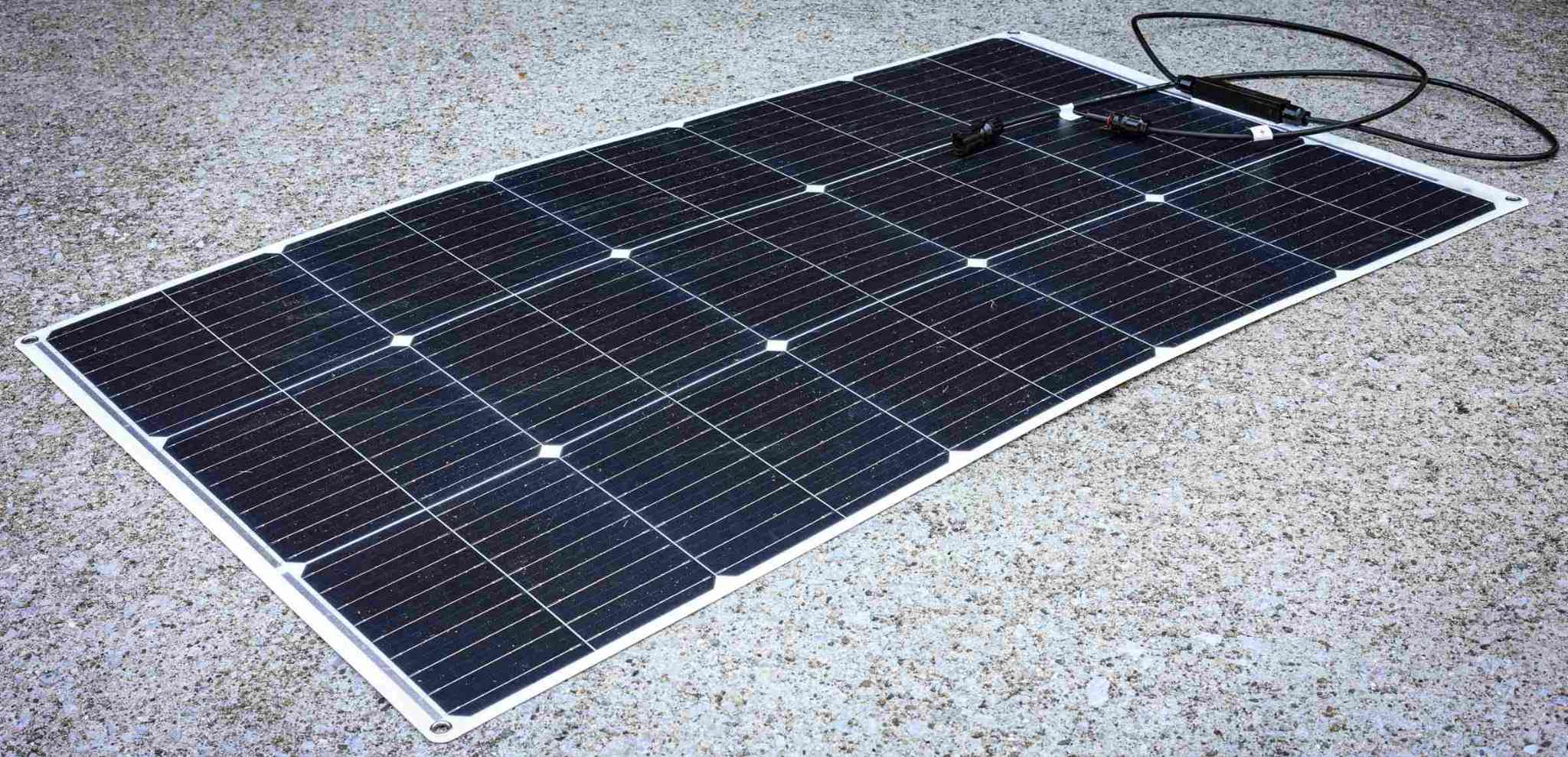
Solar energy continues to transform the way we generate electricity. If just a few years ago rigid panels were the only option, today flexible solar panels have become an innovative alternative for those looking for adaptable, lightweight and efficient solutions. But what exactly are they —and what advantages do they offer over traditional models? Let’s find out!
What are flexible solar panels?
Flexible solar panels are photovoltaic modules designed to adapt to curved or irregular surfaces. Unlike rigid panels, which require robust structures and flat spaces, these panels are made from ultra-thin silicon sheets —up to 300 times thinner than those of a conventional panel— combined with advanced polymers. This composition allows them to bend up to about 30 degrees without compromising performance.
They also do away with metal frames and glass, making them lightweight, easy to transport and simple to install. As mentioned earlier, their thickness is just a few millimetres, allowing them to blend discreetly into caravan roofs, boats or curved façades. In other words, they make solar self-consumption possible in places where installing solar panels was previously unfeasible.
Key technical features of flexible solar panels
Flexibility
As their name suggests, flexible solar panels are the perfect solution for surfaces that challenge traditional installations. Thanks to their adaptable design, they can be installed on curved roofs, caravans, boats, awnings or even unique architectural structures. This feature opens the door to projects where solar energy was previously difficult or impossible to implement.
Lightweight design
Weighing between 2 and 4 kg per panel, installation is much easier. They don’t require heavy metal structures or additional reinforcements, which means lower costs and greater convenience. Their light weight also makes them ideal for transport and installation in mobile spaces, such as camper vans or boats.
Resistance
These panels are designed to perform under demanding conditions. Their IP65–IP68 certification ensures protection against dust and moisture, while their tolerance for extreme temperatures —from -40 °C to 85 °C— makes them a reliable option in both cold climates and very hot areas. Perfect for anyone looking for solar energy without worrying about the environment.
Efficiency
Despite being flexible and lightweight, they don’t sacrifice performance. The most advanced models reach up to 22% efficiency, approaching the level of conventional rigid panels. This means you can generate a significant amount of energy even in limited spaces or non-traditional installations.
Durability
Innovation goes hand-in-hand with durability. These panels have an estimated lifespan of 15 to 20 years, provided that high-quality materials and suitable coatings are used. As a result, they represent an investment that guarantees clean energy for many years.
Types of flexible solar panels
Not all flexible panels are the same. Depending on the number of layers and materials used, there are three main categories:
- Single-layer plastic panels: the most affordable option, but also the least durable. Their lifespan may be under one year if exposed to continuous sunlight.
- Multi-layer plastic panels (EVA, PET, ETFE): offer greater durability and protection against solar radiation and moisture.
- Thermoplastic rubber–reinforced panels: the highest-quality option, combining multiple layers and materials to increase resistance and extend lifespan.
Advantages over traditional panels
- Easy installation: no complex structures required; they can be attached using special adhesives or lightweight fasteners.
- High versatility: ideal for mobile projects (caravans, boats) or temporary installations at events and in remote areas.
- Easy portability: their light weight makes them easy to transport and install.
- Resistance to impacts and vibrations: perfect for applications in motion.
- Better performance in adverse conditions: their thin-film design captures diffuse light more efficiently on cloudy days.
Most common applications of flexible solar panels
Caravans and camper vans
For those who love the freedom of travelling without relying on the power grid, flexible solar panels are the perfect solution. They are easy to install on the roof of a caravan and provide clean energy to power appliances, lighting and devices throughout the journey. This turns every stop into a self-sufficient and sustainable space.
Boats and yachts
At sea, energy independence is essential. These panels make it possible to generate electricity without relying on fossil fuels, reducing environmental impact and operating costs. Their resistance to moisture and extreme conditions makes them ideal for marine environments, where reliability is key.
Curved building roofs
Modern architecture embraces innovative designs, so flexible solar panels fit right in. Thanks to their ability to adapt to curved surfaces, they offer an aesthetic and functional solution that integrates solar energy without disrupting the building’s visual harmony. Thus, they are ideal for projects where sustainability and design go hand in hand.
Temporary installations
Events, trade fairs or rural areas without access to the power grid can benefit from flexible solar energy. Quick installation and easy portability make it possible to generate clean electricity anywhere, without the need for permanent infrastructure.
Urban balconies and terraces
In urban environments, where space is limited and installing traditional rooftop panels isn’t always possible, flexible solar panels offer a practical and accessible alternative. Their light weight and adaptability allow them to be installed on railings, walls or balcony structures without major construction work. This way, even residents of flats can generate part of their own renewable energy.
How much do they cost, and what financial aid is available in Spain?
Flexible solar panels typically cost 15–25% more than traditional panels due to their technology and versatility. For example, a 100W flexible panel may cost between €125 and €190, while higher-power models (200W or more) exceed €300.
In Spain, solar installation subsidies also apply to flexible panels. In Catalonia, for instance, self-consumption grants can cover up to 40% of installation costs, significantly reducing the initial investment.
Endesa Solar solution
In addition, at Endesa we offer you four solar tariff options so you can make the most of the energy you generate and offset your surplus according to your consumption habits. If you are not sure which one to choose, you can activate the Solar Advisory Service, which automatically selects the most cost-effective option for you on each bill.
Take a minute to find the product that best suits you:
{{firstStep.title}}
Take a minute to find the product that best suits you:
{{title}}
You don't need to adapt to Endesa's tariffs because they adapt to you. If you go to our catalogue you can compare the different tariffs for yourself. Or if you prefer, you can answer a few questions and we will take care of comparing all the different electricity and gas tariffs and then make a customised recommendation.
Take a minute to find the product that best suits you:
{{title}}
You don't need to adapt to Endesa's tariffs because they adapt to you. If you go to our catalogue you can compare the different tariffs for yourself. Or if you prefer, you can answer a few questions and we will take care of comparing all the different electricity and gas tariffs and then make a customised recommendation.
Comparison of Electricity and Gas Tariffs
You don't need to adapt to Endesa's tariffs because they adapt to you. If you go to our catalogue you can compare the different tariffs for yourself. Or if you prefer, you can answer a few questions and we will take care of comparing all the different electricity and gas tariffs and then make a customised recommendation.
Do you want to see all our offers?
Spend a minute to find the product which best adapts to you:
{{firstStep.title}}
Spend a minute to find the product which best adapts to you:
{{title}}
{{content.phone.title}}
{{content.phone.text}}
{{content.phone.phoneText}}
{{content.form.title}}
{{content.form.text}}
{{content.form.success.title}}
Spend a minute to find the product which best adapts to you:
{{title}}
{{content.phone.title}}
{{content.phone.text}}
{{content.phone.phoneText}}
{{content.form.title}}
{{content.form.text}}