


If you prefer to view the website always in english, click here.
{{content.phone.title}}
{{content.phone.text}}
{{content.phone.phoneText}}
{{content.form.title}}
{{content.form.text}}
{{content.form.success.title}}
Where to charge your electric car during the December long weekend: a guide to charging points, rates, and tips
The December long weekend is the perfect chance for a quick getaway before the holiday season kicks in. If you’re planning to travel in an electric vehicle, a key part of preparing your trip is identifying the charging points along your route to avoid unexpected issues. Today, travelling across Spain in an electric vehicle is becoming increasingly easy thanks to the growing public charging infrastructure.
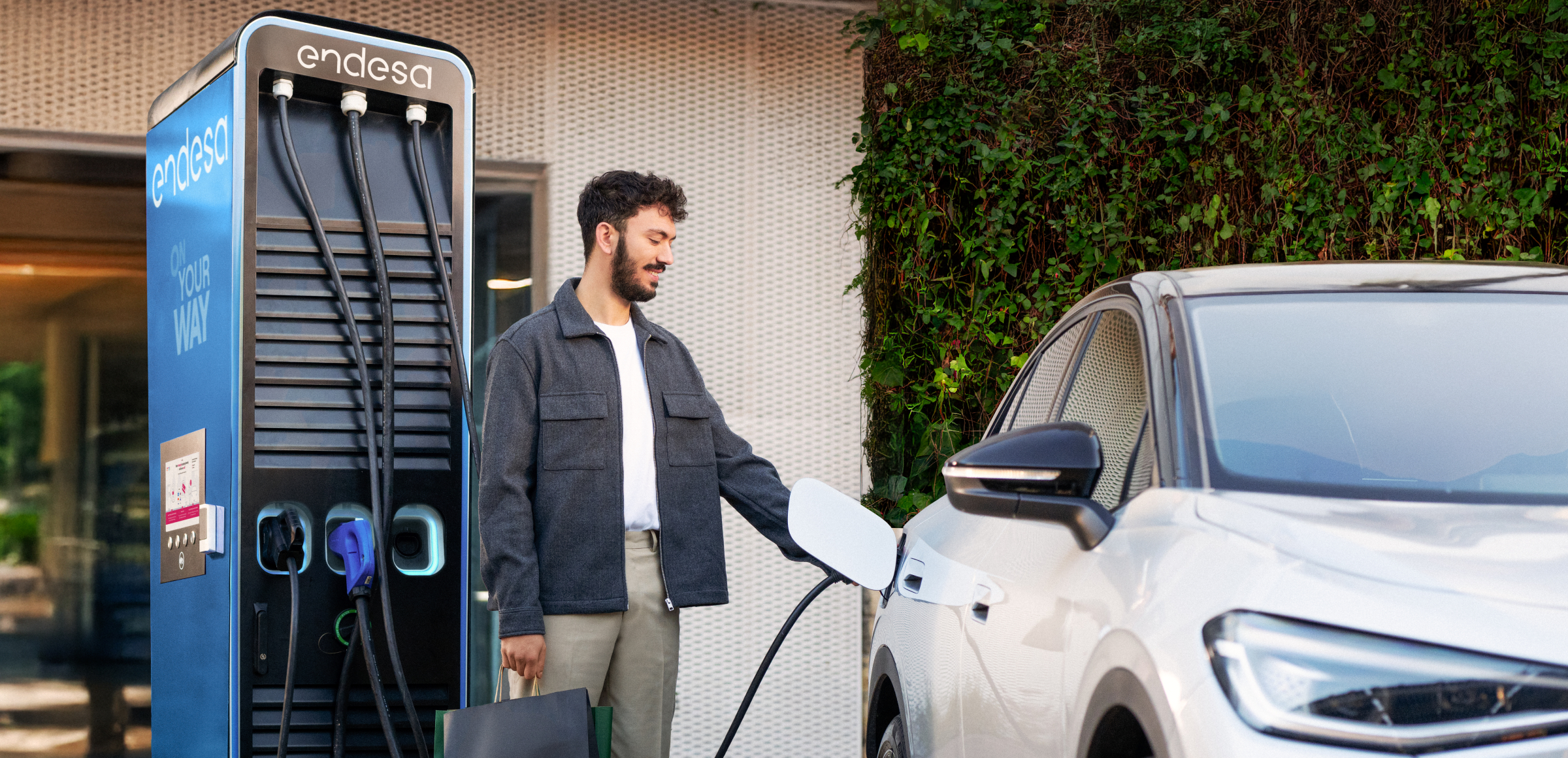
According to information published by the Institute for the Diversification and Saving of Energy (IDAE) and the Ministry for the Ecological Transition and the Demographic Challenge (MITERD), the charging network has expanded compared to previous years. This growth has been driven by the rollout of fast-charging corridors and regulations requiring high-volume service stations to install charging points. As at 2025, there are nearly 40,000 operational charging points, along with official tools like the Reve Map to locate charging points in real time.
If you're heading out for an early holiday adventure this December, plan your energy route with this guide. You’ll find everything you need: charging points, rates, tips, and how to optimise your winter range.
Plan your charging route for the December long weekend
With travel increasing this time of year, charging points can become more crowded. That’s why we recommend installing assistance apps before hitting the road, such as our Endesa On Your Way charging app, which includes a route planner so you can view all our charging stations across Spain. It also provides information on charger power and availability, and even lets you reserve your charging point for the exact time you need it.
These and other platforms allow you to filter and check charger status, charging power levels, real-time availability, compatibility with your vehicle and accepted payment methods. Booking your charging slot when you still have more battery margin than usual (around 20% to 25%) will also help you avoid surprises along the way. Preparation and logistics —that’s the key.
How to choose the right charging point
Selecting the ideal charging point for your vehicle depends on several practical and technical factors. One of the most important is knowing which type of charger you need at each stage of your trip:
Charger types: ultrafast vs. fast vs. semifast
- Ultrafast (150 to 350 kW – DC): best for long trips, motorways, and charging corridors. They can recover a large portion of range —up to 300 km— in 15 to 25 minutes.
- Fast (50 to 100 kW – DC): suitable for 30- to 60-minute stops, they typically charge from 20% to 80%. You’ll find them along national roads and in service areas.
- Semifast (7 to 22 kW – AC): ideal for longer stops (2 to 4 hours) at hotels, restaurants, and urban car parks. Common in shopping centres and public car parks. Not ideal when you're in a hurry, but great for charging while you eat or explore a city.
It’s essential to know the maximum charging power your EV supports to avoid full 0-100 % charges on ultrafast chargers and to help extend your battery’s lifespan.
Charging rates and saving money during your trip
While the National Markets and Competition Commission (CNMC) regulates electric tariffs and charges, each operator sets its own final price. During holiday weekends, rates tend to remain stable. Still, they can vary depending on charger power, connection time, schedule, and location (urban area, road, private parking, etc.).
At public charging points, the average cost ranges from €0.40 to €0.60/kWh, and in some cases up to €0.80/kWh at ultrafast chargers.
At Endesa, we offer 3 charging plans:
- e-Flex: no monthly fee —you only pay for the kWh you charge, i.e., €0.35/kWh for fast and semi-fast charging and €0.55/kWh for ultra-fast charging. Plus, you’ll get 30% off nighttime charging.
- e-Smart: subscription for €2.99/month (no commitment required). It allows access to the full Endesa charging network and grants a 20% discount on all e-Flex prices. It also includes an RFID Waycard to make your charging experience easier.
- e-Smart Plus: for €13.89/month (no commitment required) you can access the entire Endesa charging network with a 50% discount on e-Flex prices. It includes an RFID Waycard to make your charging experience easier, plus roadside charging assistance insurance (if you run out of battery, Endesa will provide on-site charging and, if necessary, tow your car to the nearest charging point). This rate plan enables charging from €0.12/kWh.
Key tips to optimise consumption and range in winter
An electric vehicle’s range typically decreases by 20% to 40% in cold weather. Here are some tips to get the most out of your battery during winter travel:
- Pre-condition your car’s cabin while it’s still connected to the charger.
- Use heated seats, if available, to avoid continuous full-cabin heating.
- Drive smoothly at a moderate speed; avoid sudden acceleration and leverage regenerative braking.
- Check tyre pressure and ensure it meets the recommended level.
- Activate the heat pump, if your car has one, for more efficient climate control.
Steps to take if you can’t find an available charging point
Limited availability is common during this time of year, which is why EV mobility apps are your best option. As mentioned earlier, you can use the Reve map or our Endesa On Your Way mobility app, which allows you to manage all your EV charges: at home with your Endesa X Way home charger, in the city, or on the road.
Apps like PlugShare, ChargeMap, and even Google Maps let you check real-time availability, set up availability alerts, view nearby alternatives, and prioritise locations with multiple chargers —helpful when you need extra margin to reach another station.
If no chargers are available, a good option is to look for semifast chargers in nearby car parks or shopping centres.
What’s the best time of day to charge during the long weekend?
If you're at home or in a private car park with a charging point, take advantage of off-peak hours (00:00–08:00) to plug in. If you’re travelling, avoid charging at service areas during peak times —midday and late afternoon. Generally, usage spikes between 10:00–13:00 and 17:00–20:00.
This is why early-morning or nighttime charging is often faster, cheaper, and more convenient, as you’ll avoid queues and, with some operators, even lower rates. If your route allows for it, make the most of these low-demand hours.
Can I use a public charging point without an app or RFID card?
Yes. Under current regulations from the Ministry for Ecological Transition and Demographic Challenge (MITERD), all new public charging points must support direct payment options —contactless, QR codes, or physical POS terminals— with no need to register.
At charging points below 50 kW, payment can be made by card via virtual POS by scanning a QR code on the screen. At charging points of 50 kW or higher, regulations require a physical POS terminal, which may be located on the charger itself or at a totem serving multiple chargers. All operators are adapting their charging infrastructure to comply, while many stations already offer these options.
Although you can pay without an app, we recommend downloading the operator’s app. It can provide a smoother experience, more control, additional features, and access to promotions and discounts.
What should I do if the charger is occupied or out of service?
Check your preferred navigation app to locate the nearest charging points, contact the operator’s technical support (the phone number must be displayed on the charger), and report the issue. Never depend on a single point —always have a plan B, such as another nearby charging point or alternative solutions offered by the operator.
Remember that with our Endesa On Your Way app, you can reserve your charging point up to 15 minutes in advance. And if you need assistance, you can call us at 0034 800 760 255.
How long does it take to charge 100 km of range in winter?
Cold weather can increase charging times by 10% to 20%. However, charge duration also depends on your vehicle model and the charger’s power.
With an ultrafast charger (150 kW), the charging time for 100 km of range can be between 5 and 10 minutes. If using a fast charger (50 kW), it’ll be 15 to 20 minutes, while a semifast charger (22 kW) will take 40 minutes to 1 hour.
Does cold weather affect charging speed or battery capacity?
Yes. As mentioned earlier, low temperatures increase internal resistance, reducing charging power and overall range. Many EVs limit charging speed until the battery reaches a safe temperature (batteries perform best between 20°C and 30°C). That’s why charging immediately after finishing a drive —while the battery is still warm— helps make the process more efficient.
Travelling across Spain in an electric vehicle is easier than ever —with the right planning. The country’s charging infrastructure has expanded significantly, giving you greater peace of mind on the road knowing that more charging points are available along your route.
This December long weekend, enjoy a safe, smooth, and memorable trip by keeping these recommendations in mind: download the best EV mobility apps (including Endesa On Your Way), choose the right chargers for your vehicle, and remember how winter temperatures can affect your range. By following these steps, your holidays will be safer, more economical, and more sustainable.
Take a minute to find the product that best suits you:
{{firstStep.title}}
Take a minute to find the product that best suits you:
{{title}}
You don't need to adapt to Endesa's tariffs because they adapt to you. If you go to our catalogue you can compare the different tariffs for yourself. Or if you prefer, you can answer a few questions and we will take care of comparing all the different electricity and gas tariffs and then make a customised recommendation.
Take a minute to find the product that best suits you:
{{title}}
You don't need to adapt to Endesa's tariffs because they adapt to you. If you go to our catalogue you can compare the different tariffs for yourself. Or if you prefer, you can answer a few questions and we will take care of comparing all the different electricity and gas tariffs and then make a customised recommendation.
Comparison of Electricity and Gas Tariffs
You don't need to adapt to Endesa's tariffs because they adapt to you. If you go to our catalogue you can compare the different tariffs for yourself. Or if you prefer, you can answer a few questions and we will take care of comparing all the different electricity and gas tariffs and then make a customised recommendation.
Do you want to see all our offers?
Spend a minute to find the product which best adapts to you:
{{firstStep.title}}
Spend a minute to find the product which best adapts to you:
{{title}}
{{content.phone.title}}
{{content.phone.text}}
{{content.phone.phoneText}}
{{content.form.title}}
{{content.form.text}}
{{content.form.success.title}}
Spend a minute to find the product which best adapts to you:
{{title}}
{{content.phone.title}}
{{content.phone.text}}
{{content.phone.phoneText}}
{{content.form.title}}
{{content.form.text}}