


If you prefer to always view the website in English, please click here.
{{content.phone.title}}
{{content.phone.text}}
{{content.phone.phoneText}}
{{content.form.title}}
{{content.form.text}}
{{content.form.success.title}}
Gas detectors: what they are and how they work
Sometimes, when you are at home, you assume everything is fine simply because you don't see or smell anything unusual. But the truth is that some gases can build up in the air without you noticing, and therein lies the danger: A silent natural gas leak or the gradual build-up of carbon monoxide can turn your home into a highly dangerous place at a moment's notice. It is then that your family's peace of mind depends on a device keeping watch while you sleep, capable of detecting what neither sight nor smell can always perceive in time.
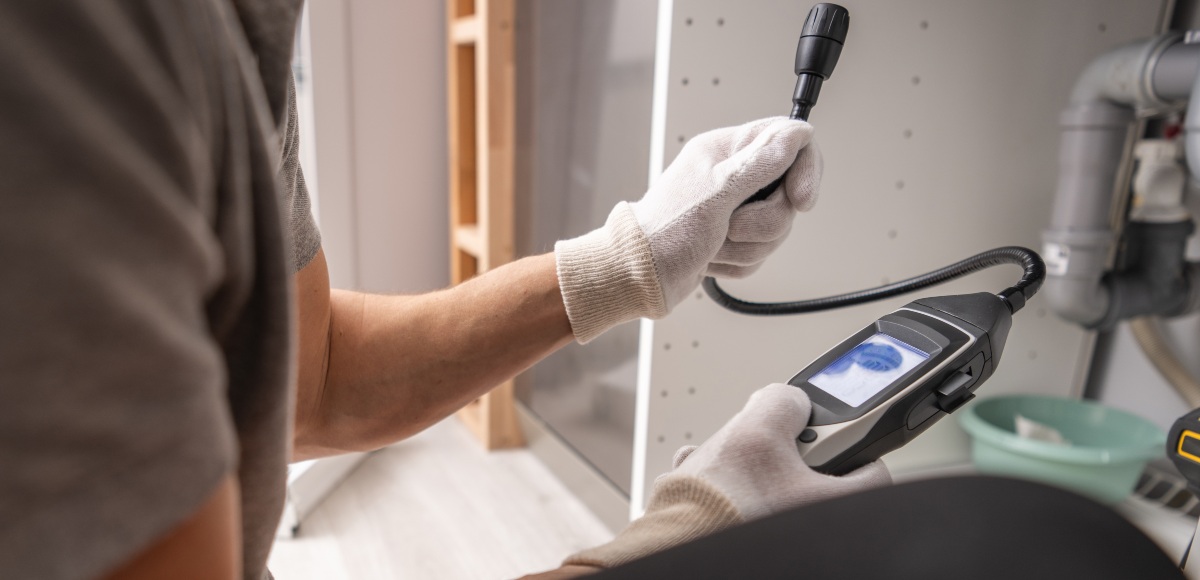
What a gas detector is and what it is for
A gas detector is a safety instrument that analyses the air to identify the presence of combustible or toxic gases; in other words, it is a device that keeps an eye on what you breathe all day long. Its mission is to warn people of a possible leak or poor combustion, acting as a prevention system that allows you to react in time before things escalate. It serves to prevent serious accidents such as fires, explosions, or carbon monoxide poisoning. Above all, it is absolutely essential if you have a natural gas, butane, or propane boiler, cooker, or water heater in your home.
How a gas detector works: a simple explanation
To know if it is really worth installing one at home, you first need to easily understand how a gas detector works. Put simply, the device continuously draws in air from the room and analyses it through an internal sensor over and over again.
Internal sensors (semiconductor, catalytic, or electrochemical)
Sensor technology varies depending on the gas to be detected:
Semiconductor sensors (MOS): These are very common in homes because they are inexpensive and take up very little space. Their operation is based on a metal oxide sensor that, upon coming into contact with the gas, changes its electrical conductivity and triggers the alarm.
Catalytic sensors (Pellistor): Used for combustible gases. They work by burning a small amount of gas on a catalytic sensor, which generates heat; this temperature increase is transformed into an electrical signal that triggers the detection.
Electrochemical sensors: These are the most reliable for detecting carbon monoxide. They detect the gas through a chemical reaction that generates a small electrical current; the higher the gas concentration, the greater the current, which ultimately triggers the alarm.
Infrared sensors (NDIR): These identify gases such as methane or propane by measuring how they absorb infrared light. As they have no parts that wear out easily, they tend to be very stable and can maintain their accuracy for many years.
Safety thresholds
It is important to understand that these devices do not trigger with a small presence of gas, but only when levels begin to become genuinely dangerous. For flammable gases, the reference used is the LEL % (Lower Explosive Limit), which is basically the minimum concentration of gas in the air at which combustion could occur. To better understand it, the detectors used at home are usually set to trigger when the concentration reaches between 10% and 25% of that limit. In other words, they sound the alert with plenty of margin, long before the environment becomes truly dangerous or explosive.
24/7 monitoring
One of its main advantages is that they work continuously. Unless a specific technical inspection is taking place, the detector offers constant vigilance, even when no one is home or during the night, when our senses are not as alert.
Early warning system
When the sensor detects that the gas level has exceeded the safety threshold, the device reacts instantly, setting off an alarm that cannot be ignored. In addition, a red light flashes to ensure the alert is noticed by everyone. This combination of sound and light ensures that wherever you are in the house, you will know something is wrong.
Types of gas detectors according to fuel type
Not all gases behave the same way, which is why there are devices specifically designed to adapt to each type of energy need in the home.
Natural gas (methane) detectors
Natural gas is lighter than air, so when there is a leak, it tends to rise straight up – exactly where we sometimes cannot reach with our sense of smell. Although a distinctive odour (mercaptan) is added so we can smell it, if it builds up near the ceiling, we might still not notice it until it is too late. That is why natural gas detectors are specially calibrated to identify this type of gas precisely in the areas where it usually accumulates.
Butane and propane detectors
Unlike natural gas, butane and propane – known as Liquefied Petroleum Gas or LPG – are heavier than air. In the event of a leak, these gases accumulate in lower areas. For this reason, a butane or propane detector must have a specific sensitivity for these compounds and a different installation logic.
Combined detectors (gas + CO)
There are more comprehensive detectors that feature two sensors in one. They are capable of monitoring both combustible gas leaks (methane/propane) and the presence of carbon monoxide. They are ideal for places like the kitchen, where you have gas burners alongside a boiler or water heater, because you cover all the risks with a single device.
Where to install a gas detector so it works correctly
The effectiveness of these devices fundamentally depends on their location. Knowing where to place a gas detector is essential due to the density of each fuel.
Natural gas, up high
As methane is lighter than air and tends to accumulate higher up, the detector should ideally be placed on the wall, about 30 to 50 centimetres from the ceiling. Note that it must not be placed right next to the cooker or water heater; otherwise, it would go off every time you cook or turn on the heating, without there being a real leak. It is best to leave it about a metre and a half away from the burners, ensuring it only triggers when it truly needs to.
Butane/propane, near the floor
As these are heavier gases than air, the detector must be placed in a low position, about 30 cm from the floor, and away from draughts or doors that could dissipate the gas before it reaches the sensor.
CO, at eye level
Carbon monoxide weighs practically the same as air, although when it comes out of a boiler or heater, it is usually mixed with hot air. The general recommendation for a carbon monoxide detector is to place it at a medium height, roughly at eye level – approximately between 1.5 and 2 metres from the floor, which is exactly where we breathe. And if you can, place it near the bedrooms; that way, if there is a leak at night, there is a better chance the alarm will wake you up in time.
Signs that a gas detector is working properly
To guarantee safety, it is important to check that the detector is working correctly. Most models indicate this with a green power LED and a red LED that flashes periodically to signal that the system is monitoring. A good practice is to use the 'test' button once a month: you press it, and the device should trigger the alarm and lights, confirming that if something really does happen one day, you will definitely notice.
What to do if a gas detector alarm goes off
If the device starts beeping continuously, do not ignore the signal. You must follow a strict protocol to avoid accidents.
Ventilate immediately
If the alarm goes off, the first thing to do is open all doors and windows wide to let in fresh air and disperse the accumulated gas. Creating a through-draught is the most effective way to lower the concentration and move away from that dangerous limit.
Do not switch lights on or off
Any spark, no matter how small (even when turning on a light or an appliance), can ignite the gas-air mixture. Avoid using your mobile phone near the leak area.
Turn off the gas valve if it is safe to do so
If you can access the main gas valve or the cylinder valve without exposing yourself, close it immediately to cut off the supply.
Leave the property
If the smell persists or the alarm does not stop, evacuate all people and pets outside. Do not use the lift.
Call the emergency services or the gas company
Once you are in a safe place away from the leak, call 112 or your supply company's emergency service. Never try to repair the leak on your own.
How to choose the best gas detector for your home
There is a wide range on the market, but for residential use, we must look at certain technical criteria.
By type of gas
Make sure the equipment is suitable for your home's supply. If you have mains gas, you need one for natural gas; if you use gas cylinders, you need one for butane/propane.
By location and property size
In multi-storey houses, it is advisable to install at least one per floor, prioritising the kitchen, areas with boilers, and the corridors leading to bedrooms.
Certified sensors
Always look for products that comply with European regulations. For combustible gases, the reference standard is UNE-EN 50194, and for carbon monoxide, UNE-EN 50291. The presence of the CE mark and the Declaration of Conformity are guarantees that the product is safe.
Lifespan and maintenance alarms
Detectors do not last forever. They usually have a lifespan of between 5 and 10 years due to the chemical wear of the sensors. Choose models that warn you when they reach the end of their operational life or that have a clearly indicated expiry date.
Connected detectors (optional)
Smart or Wi-Fi models allow you to receive alerts directly on your mobile phone. This is especially useful for second homes or to care for elderly people living alone, allowing you to act even if you are not physically present.
Common mistakes when using a gas detector
A common mistake is installing the detector in hidden areas where air does not circulate well, such as enclosed corners or behind curtains, or placing it near extractor fans or ventilators that can disperse the gas before it reaches the sensor. It is also important to keep it clean, as dust can clog the sensor; therefore, it is recommended to vacuum its grilles at least once a year. In any case, the detector is a safety addition, but by no means can it be a replacement, so it does not substitute mandatory installation inspections. It does, however, provide greater peace of mind by warning of potential leaks in the home.
Would you like me to help you identify the best place in your kitchen to install a detector based on the type of gas you use?
SOURCES
- Cómo evitar intoxicaciones en el hogar
- 8 tips to reduce your gas consumption
- Detector de gas analógico - Manual de Instrucciones
- How natural gas reaches our homes
- Detectores CO
- What is an estimated gas bill?
- Guía de seguridad de gases combustibles, explicación del LEL, ubicación del detector y selección del sensor
- How to detect where a gas leak is coming from: a complete guide for your safety
- Mantenimiento Gas Completo
- Normativa de instalaciones de gas
- Por qué es importante tener un detector de gas en casa
Take a minute to find the product that best suits you:
{{firstStep.title}}
Take a minute to find the product that best suits you:
{{title}}
{{content.phone.title}}
{{content.phone.text}}
{{content.phone.phoneText}}
{{content.form.title}}
{{content.form.text}}
{{content.form.success.title}}
You don't need to adapt to Endesa's tariffs because they adapt to you. If you go to our catalogue you can compare the different tariffs for yourself. Or if you prefer, you can answer a few questions and we will take care of comparing all the different electricity and gas tariffs and then make a customised recommendation.
Take a minute to find the product that best suits you:
{{title}}
{{content.phone.title}}
{{content.phone.text}}
{{content.phone.phoneText}}
{{content.form.title}}
{{content.form.text}}
{{content.form.success.title}}
You don't need to adapt to Endesa's tariffs because they adapt to you. If you go to our catalogue you can compare the different tariffs for yourself. Or if you prefer, you can answer a few questions and we will take care of comparing all the different electricity and gas tariffs and then make a customised recommendation.
Comparison of Electricity and Gas Tariffs
You don't need to adapt to Endesa's tariffs because they adapt to you. If you go to our catalogue you can compare the different tariffs for yourself. Or if you prefer, you can answer a few questions and we will take care of comparing all the different electricity and gas tariffs and then make a customised recommendation.
Do you want to see all our offers?
Spend a minute to find the product which best adapts to you:
{{firstStep.title}}
Spend a minute to find the product which best adapts to you:
{{title}}
{{content.phone.title}}
{{content.phone.text}}
{{content.phone.phoneText}}
{{content.form.title}}
{{content.form.text}}
{{content.form.success.title}}
Spend a minute to find the product which best adapts to you:
{{title}}
{{content.phone.title}}
{{content.phone.text}}
{{content.phone.phoneText}}
{{content.form.title}}
{{content.form.text}}