


If you prefer to view the website always in english, click here.
{{content.phone.title}}
{{content.phone.text}}
{{content.phone.phoneText}}
{{content.form.title}}
{{content.form.text}}
{{content.form.success.title}}
{{content.phone.title}}
{{content.phone.text}}
{{content.phone.phoneText}}
{{content.form.title}}
{{content.form.text}}
{{content.form.success.title}}
What happens if it snows on your solar panels: a complete guide to understanding the impact and what to do
Snow may temporarily reduce the production of your solar panels, but it does not pose a risk to their structural integrity. Understanding how snow affects your system and what to do in each scenario will help you keep your installation running efficiently, even in the depths of winter.
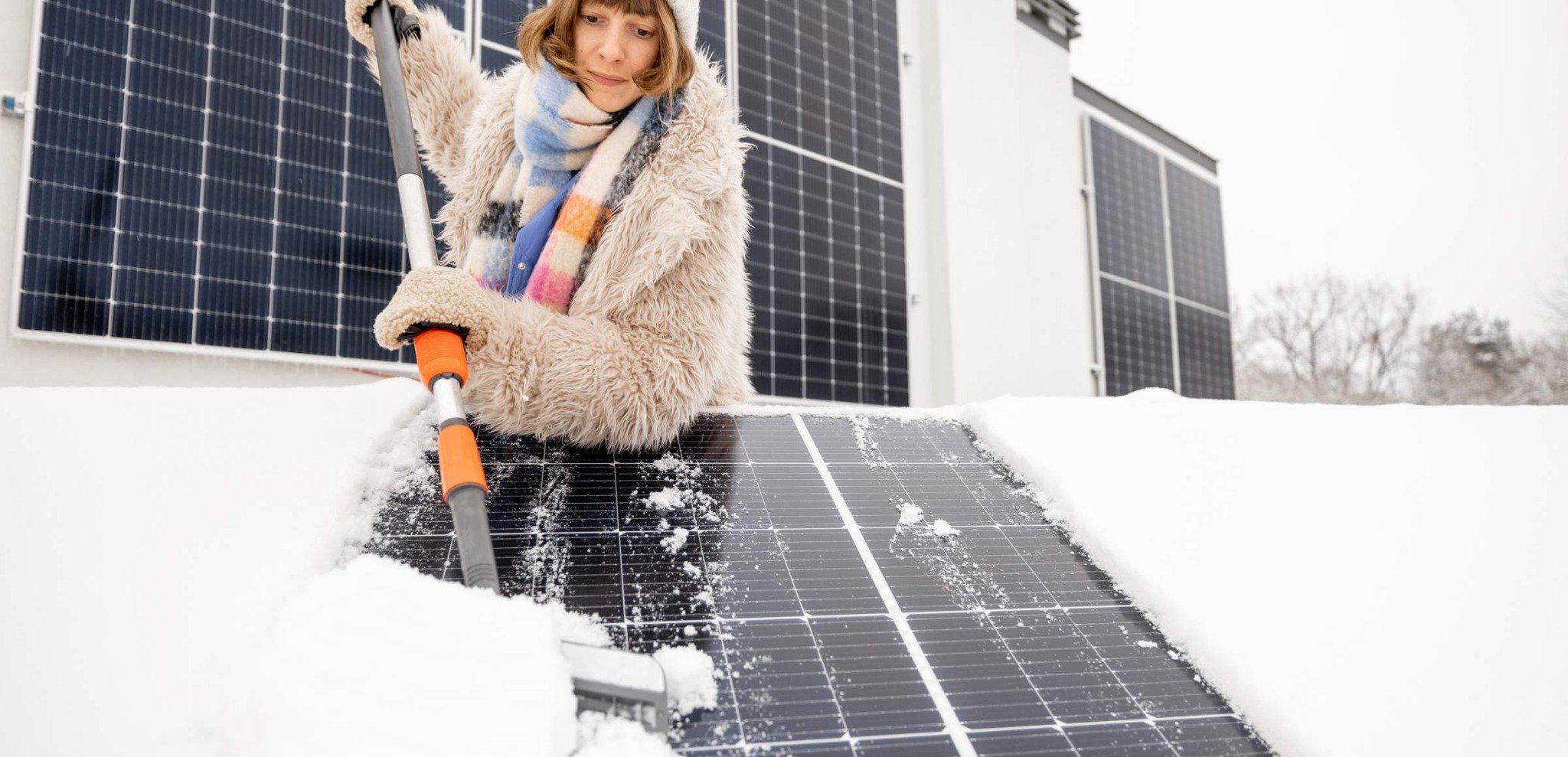
The arrival of winter brings shorter days, low temperatures and, in many areas, snowfall that can completely cover solar panels. It is natural to wonder if this white blanket might damage the installation, reduce production or if it should be manually removed. The good news? Solar panels are designed to withstand adverse weather conditions and, in most cases, snow does not pose a risk to their structural integrity. However, it can temporarily affect their performance.
Does snow affect solar panel performance?
Yes, but only temporarily. When the modules are covered by a layer of snow, it blocks sunlight and reduces electricity production. Consequently, snow can significantly reduce generation or even stop it completely while the surface remains fully covered.
Even so, it is not all bad news. Solar panels continue to work in winter thanks to:
- Diffuse light, which partially penetrates thin layers of snow.
- The tilt angle, which encourages the snow to slide off by itself.
- The temperature effect, since cold weather improves the electrical performance of the modules, increasing their efficiency when they are clear.
In summary, snow may reduce production for a few hours or days, but it does not affect the general long-term operation of the installation.
Can snow damage solar panels?
Solar panels are designed to withstand heavy snow loads. The structures and tempered glass are manufactured to resist significant weight without deforming or breaking, provided the installation complies with current regulations.
Snow rarely causes direct damage, except in extreme cases of very dense accumulation or persistent ice that exceeds the maximum load recommended for the installed model.
In most homes, especially on pitched roofs, the snow slides off naturally when the sun warms the surface of the panel.
Is it worth removing the snow manually?
Experts generally recommend against manual snow removal, except in very specific cases. The reasons are clear:
- There is a risk of damaging the panel surface if unsuitable tools are used.
- Climbing onto a roof in icy or snowy conditions is dangerous.
- In most installations, the snow melts or falls off on its own in a short time thanks to the panel’s residual heat and the pitch of the roof.
Intervention is only advised when:
- The installation is completely flat (in very exceptional cases).
- The snow remains for many days.
- Production is critical (e.g, in off-grid systems with no connection to the utility grid).
In such cases, it is recommended to use specific panel cleaning tools with telescopic handles and soft materials that do not scratch the surface. And before doing so, it is advisable to consult a technician to ensure it is the safest option for your installation.
Why do panels clean themselves when it snows?
As mentioned earlier, solar panels have several characteristics that encourage snow to fall off naturally:
Smooth, non-stick surface
The tempered glass of the modules makes it difficult for snow to stick firmly.
Roof inclination
Most domestic installations are mounted with sufficient tilt so that the snow slides off when it begins to melt.
Residual heat from the panel
Although production may be low, the panels generate a slight heat that accelerates thawing.
'Sliding' effect
When the top layer melts, the snow falls off in a block, clearing the surface in a few minutes.
Can snow improve performance?
Surprisingly, yes. Although it may seem contradictory, solar panels can perform better in winter than in summer under certain conditions. Low temperatures increase the electrical efficiency of the modules. This means that, once cleared, they can produce more energy for every ray of sun received.
Furthermore, snow accumulated on the ground acts as a natural reflector, increasing the amount of diffuse light reaching the panel.
What happens if the snow turns to ice?
Ice is more problematic than snow. A thin layer of ice can:
- Reduce production for a longer time.
- Take longer to melt.
- Be more difficult to remove without damaging the panel.
Even so, the panels are prepared to withstand it. It is strongly recommended not to try to chip the ice away manually, as you could damage the glass.
Tips for managing snow on your solar panels
1. Do not climb on the roof
The risk of falling is high and does not outweigh the small increase in production you might gain.
2. Let the snow melt on its own
In most cases, it will clear in a few hours or days.
3. Install the panels with the correct tilt
Good orientation helps snow, as well as debris like leaves or dust, to slide off more easily. This way, you'll keep the panel surface clear for maximum efficiency.
4. Check the support structure
Ensure the installation is sized to withstand the snow load typical of your area. Installing solar panels in the south, where snowfall is sporadic, is not the same as in the north, where the accumulated weight can be much greater. A technician can guide you on the specific requirements for your region.
5. Consider a monitoring system
This will allow you to check production in real time and detect if snow is affecting it more than usual.
Snow is not a problem for your solar panels
In short, snow may temporarily reduce production, but it does not damage panels nor shorten their useful life. The modules are prepared to withstand the winter and, in most cases, the tilt and residual heat allow them to clean themselves without the need for intervention.
If you live in an area with frequent snowfall, simply ensure that the installation is properly sized and mounted by professionals. Even with snow, solar energy remains a safe bet for enjoying an efficient home all year round.
Take a minute to find the product that best suits you:
{{firstStep.title}}
Take a minute to find the product that best suits you:
{{title}}
You don't need to adapt to Endesa's tariffs because they adapt to you. If you go to our catalogue you can compare the different tariffs for yourself. Or if you prefer, you can answer a few questions and we will take care of comparing all the different electricity and gas tariffs and then make a customised recommendation.
Take a minute to find the product that best suits you:
{{title}}
You don't need to adapt to Endesa's tariffs because they adapt to you. If you go to our catalogue you can compare the different tariffs for yourself. Or if you prefer, you can answer a few questions and we will take care of comparing all the different electricity and gas tariffs and then make a customised recommendation.
Comparison of Electricity and Gas Tariffs
You don't need to adapt to Endesa's tariffs because they adapt to you. If you go to our catalogue you can compare the different tariffs for yourself. Or if you prefer, you can answer a few questions and we will take care of comparing all the different electricity and gas tariffs and then make a customised recommendation.
Do you want to see all our offers?
Spend a minute to find the product which best adapts to you:
{{firstStep.title}}
Spend a minute to find the product which best adapts to you:
{{title}}
{{content.phone.title}}
{{content.phone.text}}
{{content.phone.phoneText}}
{{content.form.title}}
{{content.form.text}}
{{content.form.success.title}}
Spend a minute to find the product which best adapts to you:
{{title}}
{{content.phone.title}}
{{content.phone.text}}
{{content.phone.phoneText}}
{{content.form.title}}
{{content.form.text}}