


If you prefer to view the website always in english, click here.
{{content.phone.title}}
{{content.phone.text}}
{{content.phone.phoneText}}
{{content.form.title}}
{{content.form.text}}
{{content.form.success.title}}
Solar thermal water heaters: what they are, how they work, and how they can benefit your home
Solar thermal water heaters have become an efficient and sustainable solution for reducing electricity consumption at home. By harnessing solar energy, these systems heat water in a clean and economical way, helping the environment and saving on your electricity bill. We explain everything you need to know about this equipment, what it is, how it works, and how it can benefit your home.
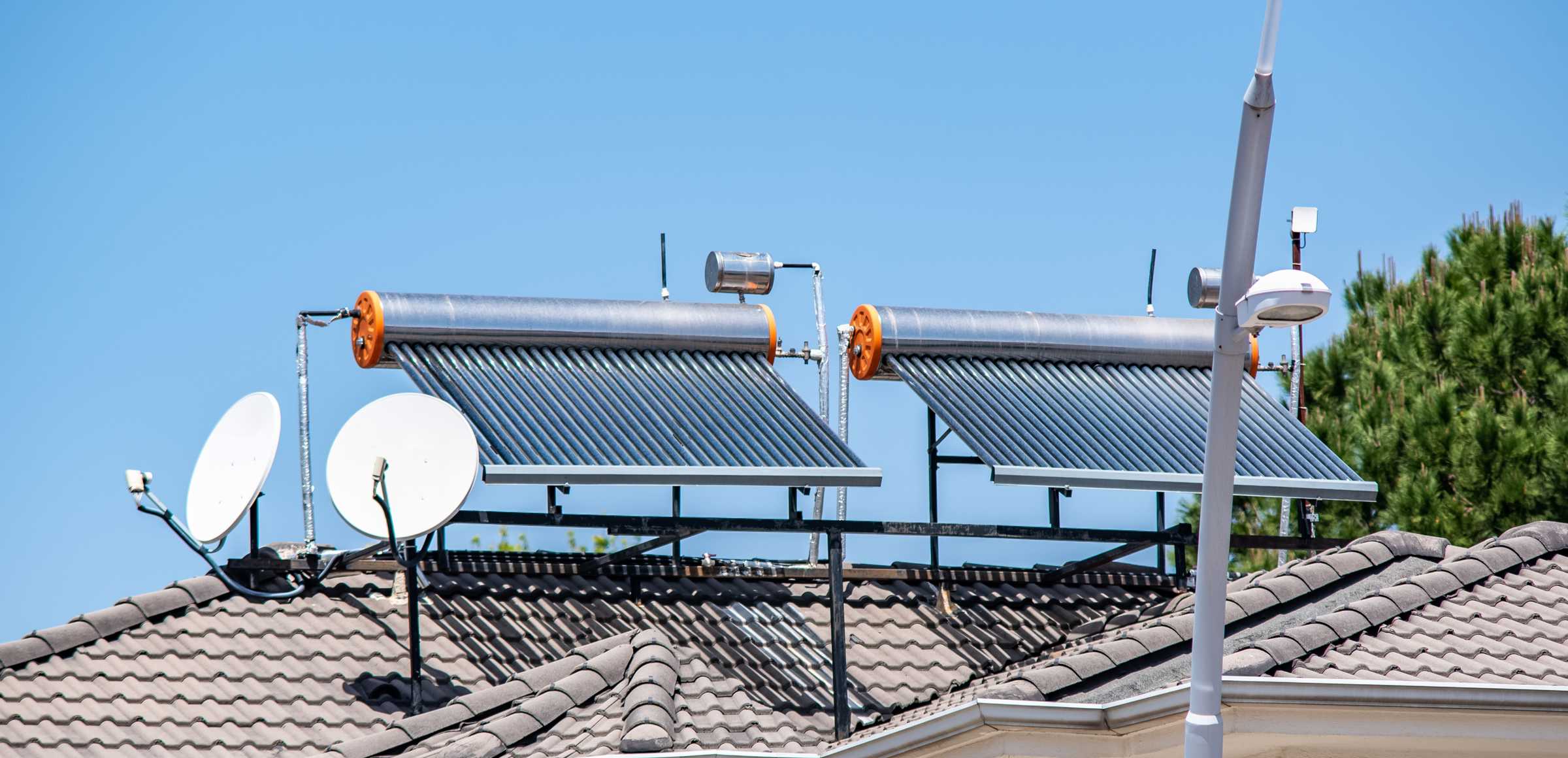
What is a solar thermal water heater?
Also known as a solar thermal energy system or solar system for Domestic Hot Water (DHW), it harnesses the sun's radiation to heat the water you use in showers, sinks, and appliances, and even to support heating systems.
Instead of using electricity, gas, or oil to heat the water you use, a solar thermal water heater transforms sunlight into heat, helping to reduce conventional energy consumption, as well as saving on the bill and cutting the carbon emissions of fossil fuels.
Currently, this type of installation is a key instrument in Spain to promote the use of renewable energies in homes. Under the Technical Building Code (CTE), section HE-4 'Minimum solar contribution for domestic hot water', new and rehabilitated buildings requiring DHW must install solar thermal energy heaters.
How a solar thermal water heater works
It might sound complex, but the principle is simple: capture solar energy, transform it into heat, and transfer it to the water. The process breaks down into four stages:
Capturing solar energy
These systems use solar thermal panels or collectors (flat plate or evacuated tube) installed on the roof, facing south (or in the best possible orientation), and with the appropriate inclination to maximise solar radiation. These collectors contain a dark surface that absorbs heat and transfers it to the water or a heat transfer fluid.
Heat circulation
Water circulates through the collector pipes, carrying heat from the collector to an exchanger or storage tank. In simple systems, this movement occurs via the thermosiphon effect (hot water, being less dense, rises towards the tank). In more advanced systems, a pump drives the flow, improving efficiency in cold climates.
Storage in the tank
The collected heat is transferred to the water destined for your home. This water is stored in a thermally insulated hot water cylinder, where it retains its temperature for hours—even on cloudy days—thanks to diffuse sunlight. This insulation guarantees you have hot water when you need it, even at night or during poor weather.
Distribution to the home
As a final step, the stored hot water is distributed to outlets (taps, showers, washing machine, etc.) via the main plumbing system, just like in any conventional setup. If demand exceeds what the solar heater can provide (for example, many simultaneous uses or very long periods), the conventional system (electric water heater or boiler) kicks in to top up the heat.
Types of solar thermal water heaters
There are several configurations adapted to different needs, depending on the circulation method and the type of collectors:
Thermosiphon system
This is the most common system for houses single-family homes due to its reliability. Water circulates naturally, without the need for pumps, harnessing the natural flow of the liquid due to density differences (hot water rises, cold water falls). It is economical, easy to install and maintain, although less efficient in cold climates.
Forced circulation system
It uses pumps to circulate the water or heat transfer fluid, and ensure heat transfer to the tank. It is usually necessary when more advanced collectors are used, or when the installation requires the cylinder to be far from the collector. It is an ideal system for areas with long winters; it is versatile but requires additional maintenance.
Collectors: flat plate, evacuated tubes
Solar thermal collectors can be of different types according to their design:
- Flat plate collectors: these are the most economical, traditional, and suitable for warm climates. They consist of a flat box with an absorber that captures heat. They are very effective and suit many home styles or designs.
- Evacuated tube collectors: as their name suggests, these collectors use vacuum-sealed tubes to minimise heat loss, greatly improving efficiency in cold or less sunny conditions where high performance is critical.
Choosing the ideal collector type for your home will depend on the orientation of the property, your hot water demand, the space available to install it, and, crucially, your budget.
Advantages of solar thermal water heaters
Investing in a solar thermal system offers diverse benefits:
60% to 80% savings on hot water
According to data from the Institute for Diversification and Saving of Energy (IDAE), a well-sized system can cover up to 80% of a home's annual domestic hot water demand, significantly reducing spending on the gas or electricity bill.
Renewable and free energy
Solar energy is a free, clean, and sustainable source, as it generates no polluting emissions, contributing to European climate objectives and reinforcing the commitment to energy efficiency and sustainability policies promoted by IDAE in Spain. Using it reduces dependence on fossil fuels or grid electricity.
High durability (approx. 20 years)
Solar thermal installations, with basic and proper maintenance, can reach a lifespan of around 20 years, making them a long-term investment.
Low maintenance needs
These systems only require periodic cleaning (especially for forced circulation systems) and a routine inspection of components, typically at a low cost. Maintenance is usually relatively simple: checking the thermal fluid, verifying seals and insulation, checking the tank, etc.
Compatible with existing systems
Solar thermal water heaters can be integrated with your existing boiler, electric water heater, heat pump, or conventional heating system, primarily serving as a pre-heater to reduce the burden on your conventional system. This ease of coexisting with other systems allows them to be retrofitted into existing properties.
Limitations and considerations before installing
Although solar thermal systems have several advantages, there are certain aspects you should carefully evaluate before deciding to install one at home:
- Space and orientation of the property: you need a roof surface facing south, and it must be a sunny area. If your home is covered by shade for many hours of the day, its performance will be limited.
- Consider the climate: in areas with low radiation or cold climates, it is advisable to install conventional backup systems (boiler, electric water heater, etc.), because a solar thermal system may not cover the whole demand.
- Initial investment: while the initial investment is higher than a conventional heater, it is lower compared to many other renewable technologies and can pay for itself quickly.
- Regulations and permits: in Spain, while the installation must comply with the Technical Building Code (CTE), adherence automatically makes you eligible for subsidies from the IDAE and European funds.
- Good maintenance = greater efficiency: Failing to carry out proper cleaning and routine maintenance (checking circuits, thermal fluid, and other components) will cause performance to drop significantly.
Are they suitable for your home?
Perfect for...
- Houses with good solar orientation (roof facing south), without significant shading.
- Households with regular domestic hot water consumption: showers, washing machines, dishwashers, etc.
- Hotels, gyms, and buildings with high DHW demand.
- People or families who want to reduce spending on their electricity bill, and wish to make the switch to sustainable solutions in their daily electricity consumption.
- Homes where energy efficiency is key, and where the solar thermal system can be installed in combination with conventional heaters, without replacing them completely.
Less recommended for...
- Flats without good orientation, in areas with consistently low sunlight, or very shaded, with obstacles to the sun.
- Households where there is very low hot water consumption, such as second homes used occasionally, seasonally, or for holiday stays.
- Homes where it is not possible to install collectors due to inadequate roof inclination, lack of structure, or planning restrictions, among other obstacles.
Comparison of alternatives to reduce energy consumption
Solar thermal energy is just one of the viable and sustainable alternatives for producing DHW. Other options to reduce energy consumption include aerothermal systems, heat pumps, or solar PV (self-consumption) installations with photovoltaic panels.
If your goal is to save on heating or electricity, you can combine solar thermal energy with photovoltaic self-consumption, provided your home allows it. This hybrid solution maximises the use of the sun and reduces dependence on the electricity grid.
For example, there is the option of using solar thermal panels to generate hot water, and photovoltaic panels to power your home's general electricity. Endesa's solar PV tariffs are an ideal complement to your solar thermal system, helping you to cut energy costs and your carbon footprint.
If your home meets the right conditions (sunny roof, regular hot water consumption, space for a tank, etc.), a solar thermal water heater will be a very good investment and an effective, sustainable, and economical solution for producing domestic hot water. And if your goal is to also save on heating or electricity, why not combine solar thermal energy with solar PV.
Comparison of Electricity and Gas Tariffs
You don't need to adapt to Endesa's tariffs because they adapt to you. If you go to our catalogue you can compare the different tariffs for yourself. Or if you prefer, you can answer a few questions and we will take care of comparing all the different electricity and gas tariffs and then make a customised recommendation.
Do you want to see all our offers?
Spend a minute to find the product which best adapts to you:
{{firstStep.title}}
Spend a minute to find the product which best adapts to you:
{{title}}
{{content.phone.title}}
{{content.phone.text}}
{{content.phone.phoneText}}
{{content.form.title}}
{{content.form.text}}
{{content.form.success.title}}
Spend a minute to find the product which best adapts to you:
{{title}}
{{content.phone.title}}
{{content.phone.text}}
{{content.phone.phoneText}}
{{content.form.title}}
{{content.form.text}}