


If you prefer to always view the website in English, please click here.
{{content.phone.title}}
{{content.phone.text}}
{{content.phone.phoneText}}
{{content.form.title}}
{{content.form.text}}
{{content.form.success.title}}
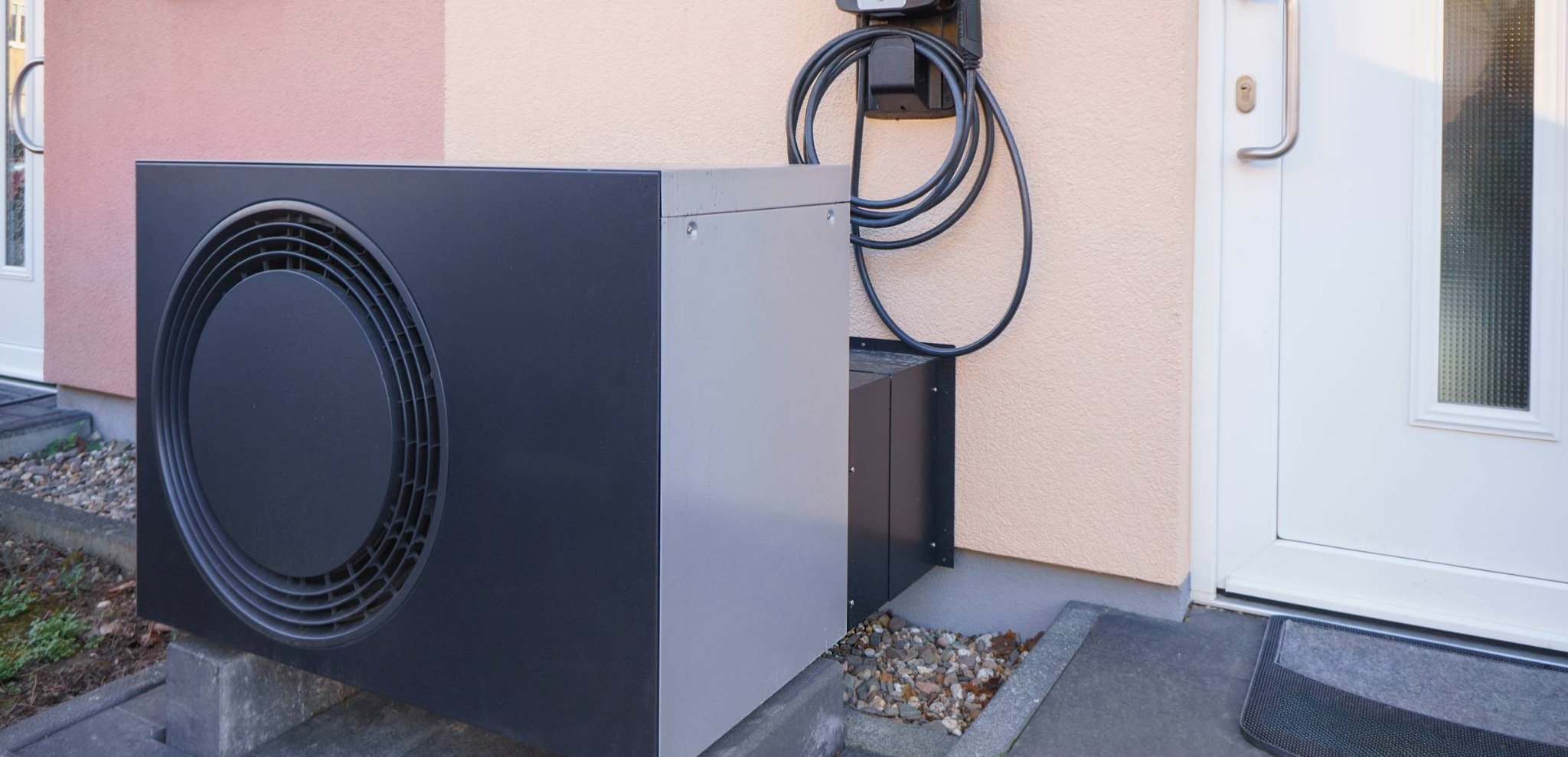
What is a heat pump?
A heat pump is a heating and cooling system that harnesses energy present in the air, water or ground to generate heating, cooling or domestic hot water (DHW). It works via a thermodynamic cycle that transfers heat from one place to another, using very small amounts of electricity. Thanks to this technology, it achieves high energy performance and a lower environmental impact.
How a heat pump works
Extracting heat from the air, water or ground
The heat pump extracts thermal energy from the environment: this can be from the outside air, groundwater or heat stored in the ground.
Compressor and refrigeration cycle
The captured heat is transferred to a refrigerant which, when compressed, increases in temperature. This process is known as the refrigeration cycle.
Distributing heat inside
The accumulated heat is released inside the home through radiators, underfloor heating or indoor units, providing heating and/or hot water.
Reversibility for cooling in summer
One of its great advantages is that the cycle can be reversed: in summer, the heat pump extracts heat from the interior and expels it outside, functioning as air conditioning.
Types of heat pumps
Air-to-air heat pump (air conditioning)
Uses outside air to heat or cool the interior. It is the most common system and is found in many air conditioning units.
Air-to-water heat pump (aerothermal)
Transfers energy from the air to water, which is distributed via radiators, underfloor heating or domestic hot water tanks. It is highly efficient and suitable for whole-house heating.
Geothermal heat pump
Harnesses energy stored underground. Although it requires a more complex installation, it offers very high and stable performance throughout the year.
Hybrid systems
These combine a heat pump with traditional boilers or solar panels, further optimising usage and adapting to the specific needs of the home.
Main benefits of heat pumps
Energy savings (up to 60–70%)
For every kWh of electricity used, a heat pump can generate between 3 and 4 kWh of thermal energy. This represents savings of up to 70% compared to other conventional systems.
Year-round climate control (cooling + heating + hot water)
A single unit covers heating in winter, cooling in summer and domestic hot water all year round.
Renewable energy and low emissions
By harnessing natural resources, it reduces CO₂ emissions and contributes to the energy transition.
Low maintenance
Maintenance is simple and less costly than that of gas or oil boilers.
Compatible with solar panels
Combining it with photovoltaic energy allows you to reduce electricity usage even further and achieve an almost self-sufficient home.
How much energy does a heat pump really use?
Usage depends on the capacity of the equipment and the insulation of the home. On average, an aerothermal heat pump uses between 2,000 and 4,000 kWh per year, which equates to an approximate cost of €300–€600, though this may vary depending on electricity prices. Its efficiency is measured by the COP (Coefficient of Performance), which is usually between 3 and 4, meaning it produces 3–4 times more energy than it consumes.
In which homes is a heat pump most cost-effective?
The cost-effectiveness of a heat pump depends on both the characteristics of the property and the needs of its inhabitants. These are the scenarios where installation proves most efficient:
Homes with good thermal insulation
The better insulated the house, the lower the loss of heat in winter and coolness in summer. This allows the heat pump to work for fewer hours and with less effort, increasing its performance and reducing electricity usage.
Detached houses with space for tanks or underfloor heating
Air-to-water or geothermal heat pumps require space for hot water tanks or to install distribution systems such as underfloor heating. In detached houses, where there is usually more surface area available, installation is simpler and the benefits are greater.
Households looking for comprehensive climate control (heating, cooling and hot water)
A heat pump can cover all climate control needs: heating in winter, cooling in summer and domestic hot water all year round. In homes looking for a single, versatile system, it is the most cost-effective option.
Homes in areas with moderate temperatures
In temperate climates, where winters are not extremely cold, the heat pump reaches its maximum performance. As it does not need to work under extreme conditions, usage remains low and efficiency is very high.
Drawbacks and limitations
Although the heat pump is one of the most efficient technologies for home climate control, there are some aspects to keep in mind:
- High initial investment: Installation can be more expensive than other traditional systems, although this is offset by savings on bills in the medium to long term.
- Lower performance in very cold climates: In areas with extreme winters, the heat pump may need support from electric heating elements to maintain comfort.
- Space required: Certain models, such as aerothermal or geothermal ones, require additional space for hot water tanks or for groundworks/boreholes.
Despite these limitations, its advantages in energy savings, sustainability and versatility make the heat pump a highly recommended solution. With savings of up to 70%, low emissions and compatibility with renewable energies, it has established itself as one of the most efficient technologies for moving towards responsible and economical consumption in the home.
Comparison of Electricity and Gas Tariffs
You don't need to adapt to Endesa's tariffs because they adapt to you. If you go to our catalogue you can compare the different tariffs for yourself. Or if you prefer, you can answer a few questions and we will take care of comparing all the different electricity and gas tariffs and then make a customised recommendation.
Do you want to see all our offers?
Spend a minute to find the product which best adapts to you:
{{firstStep.title}}
Spend a minute to find the product which best adapts to you:
{{title}}
{{content.phone.title}}
{{content.phone.text}}
{{content.phone.phoneText}}
{{content.form.title}}
{{content.form.text}}
{{content.form.success.title}}
Spend a minute to find the product which best adapts to you:
{{title}}
{{content.phone.title}}
{{content.phone.text}}
{{content.phone.phoneText}}
{{content.form.title}}
{{content.form.text}}