


If you prefer to always view the website in English, please click here.
Why and how to clean and service your air conditioning before the summer
An invisible ecosystem has been brewing inside your home over the last few cold months, waiting for the exact moment to take over the air you breathe. When you switch on the appliance after a long period of not using it, that seemingly harmless cooling system can blow out accumulated dust, mites, and germs that have used the winter dampness as a refuge. Servicing the equipment is not simply an aesthetic formality, but the difference between a healthy environment and one saturated with pathogens. Cleaning and servicing your air conditioning improves air quality, helps maintain performance, prevents bad odours, and significantly reduces the risk of breakdowns and excessive electricity use.
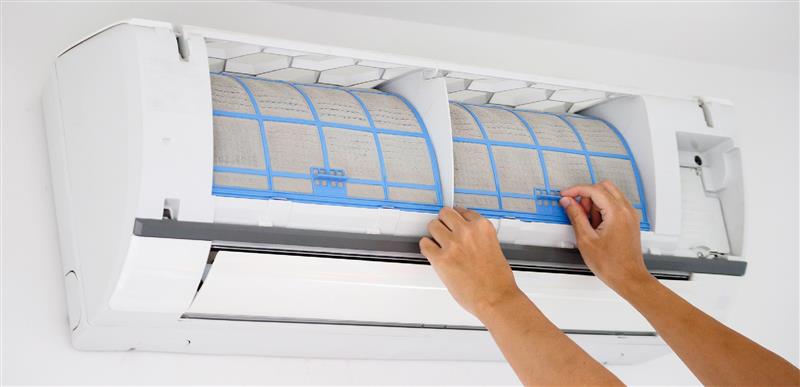
Why it's a good idea to clean and service your air conditioning
Understanding why it is so important to keep your air conditioning system clean is fundamental to achieving true well-being at home. We are not just talking about the device turning on, but about it doing so effectively and safely. Carrying out preventive maintenance tasks is the best investment for anyone with this type of equipment.
Better air quality and less accumulated dirt
The primary mission of the filters is to ensure the quality of the air circulating through the rooms, acting as a shield against mites, bacteria, and viruses. Over time, these particles become trapped in the mesh, creating a layer of dirt that not only blocks the airflow but also becomes a constant source of contamination. Proper cleaning ensures that the air coming out of the unit is much cleaner, which is especially important for those suffering from respiratory ailments.
Lower risk of bad odours and bacteria
A bad odour when turning on the air conditioning is usually a symptom of a biological problem: the proliferation of fungi on the coil or poor drainage that keeps water stagnant. A lack of hygiene in the internal area of the split unit and in the tubes hidden behind the filter favours the appearance of mould. By carrying out maintenance, you will avoid those unpleasant odours that are often the first symptom of bacterial colonisation.
Better performance and less unnecessary energy use
A dirty unit is an inefficient unit. When dust obstructs the heat exchangers, the system must work much harder to reach the desired temperature, which sends electricity use soaring. Keeping the components clean allows thermal exchange to take place without obstacles, meaning you will pay less on your electricity bill.
How often should you clean the air conditioning
The frequency of maintenance is very important to prevent dirt from consolidating and permanently damaging the internal components.
Before and after prolonged use
As a general rule, it is highly recommended to clean your air conditioning unit before and after prolonged use. This means carrying out a service at the beginning of the summer and another at the end. To delve deeper into these routines, you can check out how to maintain your air conditioning this summer.
What changes if you also use it as a heat pump
If your system has a heat pump and you use it to heat your home, the maintenance should be doubled. In these cases, it is necessary to clean and check it also at the beginning and end of the winter, as the equipment works year-round accumulating particles non-stop.
Signs that it needs checking ahead of time
Sometimes the unit will let you know before the scheduled dates. If you notice that the airflow has decreased, that the appliance is making strange noises, or if you detect that electricity use has risen unjustifiably, it is likely that internal dirt is compromising mechanical performance.
How to clean and service your air conditioning step by step
Carrying out a basic service is a simple task that usually takes less than 30 minutes and adds incalculable value to the system.
Don't turn it on if it has been idle for months
There is a fundamental rule: do not turn on your air conditioning if it has been off for months without having cleaned it first. If you do, even for just a few seconds to test it, you will instantly spray the room with all the dirt and bacteria accumulated in the filters during the winter.
How to clean the filters correctly
Open the cover of the split unit, remove the filter holders, and use a vacuum cleaner to remove surface dust. If they are very dirty, you can submerge them in cold water with antibacterial soap. It is crucial not to use hot water, as it could warp the filter fibres. Rinse with plenty of water and let them dry completely in a shaded area before reinstalling them.
How to check the indoor split unit and the grilles
With the filters out, clean the internal area of the split unit and the tubes behind the filter to eliminate bacteria. Use a damp cloth with a little soap to go over the grilles, which are places where dust easily adheres due to condensation. When finished, dry the entire area well with a clean cloth.
What to check on the outdoor unit
Carry out a visual inspection to ensure that the air intakes are not obstructed by leaves or dirt. If you have access, you can clean the heat exchange coil with a soft brush or compressed air to help the unit expel heat efficiently.
How to check drainage and condensation
It is essential to inspect that the drainpipe is not blocked. A blockage in the drain will cause water to accumulate in the internal tray, generating annoying drips on the wall and bad odours from stagnant water.
How to do a test run after cleaning
Once all the components are dry and assembled, turn the unit on. Check that there are no strange mechanical noises and that the air comes out at the right temperature. Leave the split unit open for a while so it can finish drying internally before continuous use.
Which tasks you can do and which must be done by a professional
It is essential to distinguish between domestic hygiene and specialised technical intervention so as not to jeopardise the safety or legality of the installation.
Basic cleaning and visual inspection
Cleaning the filters, hygiene of the split unit, and the visual inspection of the units are tasks that any user can perform safely. These actions are part of basic preventive maintenance.
When to suspect a breakdown
If the air conditioning continues to fail or does not cool after cleaning, there is likely a deep technical problem. In these cases, it is essential to know what to do with air conditioning breakdowns so as not to aggravate the situation.
Why you should not touch the refrigerant gas or the circuit
Maintenance involving the handling of gases is strictly reserved for certified personnel. According to current regulations, if your installation exceeds 5 kW of power, maintenance must be carried out by an authorised professional to comply with the RITE (Regulations on Thermal Installations in Buildings). Do not attempt to tamper with the gas circuit; if you detect leaks, contact an expert.
To ensure that your equipment is always in perfect condition, you can hire an air conditioning maintenance service that resolves any incidents professionally.
Signs that your air conditioning needs a technical inspection
Do not ignore symptoms of malfunction; prevention is always cheaper than buying a new one.
If it smells bad when turned on
Persistent bad odours after cleaning filters indicate the presence of fungi in inaccessible areas of the evaporator that require professional disinfection.
If it doesn't cool like it used to
This is usually a symptom of a refrigerant gas leak or a compressor failure. A technician must locate the leak and seal it before performing any recharge, as gas is not 'used up' by operation.
If it makes noise, drips, or loses performance
Strange noises can indicate faults in the fan motor, while dripping is usually due to faults in the drainage system that require specialised technical intervention.
How to use your air conditioning after servicing it to save money
An excellent service must be accompanied by responsible use to maximise savings and comfort.
Recommended temperature in summer
Maintaining a temperature around 25 degrees is sufficient for comfort. According to independent energy bodies, such as the IDAE, it is recommended to set it at 26ºC, while the usual efficient range is between 24 and 26ºC. Discover more about the ideal air conditioning temperature to keep your bills down.
Ventilate at night and close blinds during the day
Take advantage of the cool early morning hours to ventilate. During the day, reduce the thermal load by lowering blinds. To better manage your energy use, learn how to programme your air conditioning to save money.
Why turning the temperature right down doesn't cool the room faster
Setting the thermostat to 16 degrees only makes the compressor work endlessly, wasting unnecessary energy, as the air comes out at the same temperature regardless of the set point. It is essential to choose carefully which air conditioning mode allows you to save the most.
FAQ
What happens if I don't clean the filters?
The air quality will be worse and the equipment will be forced to work harder, using more electricity and increasing the risk of serious breakdowns.
How often should I clean the air conditioning?
At least twice a year: at the beginning and end of the summer season.
Can I clean the split unit myself?
Yes, surface and filter cleaning is completely safe and highly recommended for the user.
When should I call a technician?
When you detect gas leaks, persistent mechanical noises, or if your system's power exceeds 5 kW.
What is the ideal temperature to avoid sending electricity use soaring?
It is recommended to keep the thermostat between 24 and 26 degrees to balance comfort and energy efficiency.
{{content.phone.title}}
{{content.phone.text}}
{{content.phone.phoneText}}
{{content.form.title}}
{{content.form.text}}
{{content.form.success.title}}
Take a minute to find the product that best suits you:
{{firstStep.title}}
Take a minute to find the product that best suits you:
{{title}}
{{content.phone.title}}
{{content.phone.text}}
{{content.phone.phoneText}}
{{content.form.title}}
{{content.form.text}}
{{content.form.success.title}}
You don't need to adapt to Endesa's tariffs because they adapt to you. If you go to our catalogue you can compare the different tariffs for yourself. Or if you prefer, you can answer a few questions and we will take care of comparing all the different electricity and gas tariffs and then make a customised recommendation.
Take a minute to find the product that best suits you:
{{title}}
{{content.phone.title}}
{{content.phone.text}}
{{content.phone.phoneText}}
{{content.form.title}}
{{content.form.text}}
{{content.form.success.title}}
You don't need to adapt to Endesa's tariffs because they adapt to you. If you go to our catalogue you can compare the different tariffs for yourself. Or if you prefer, you can answer a few questions and we will take care of comparing all the different electricity and gas tariffs and then make a customised recommendation.
Comparison of Electricity and Gas Tariffs
You don't need to adapt to Endesa's tariffs because they adapt to you. If you go to our catalogue you can compare the different tariffs for yourself. Or if you prefer, you can answer a few questions and we will take care of comparing all the different electricity and gas tariffs and then make a customised recommendation.
Do you want to see all our offers?
Spend a minute to find the product which best adapts to you:
{{firstStep.title}}
Spend a minute to find the product which best adapts to you:
{{title}}
{{content.phone.title}}
{{content.phone.text}}
{{content.phone.phoneText}}
{{content.form.title}}
{{content.form.text}}
{{content.form.success.title}}
Spend a minute to find the product which best adapts to you:
{{title}}
{{content.phone.title}}
{{content.phone.text}}
{{content.phone.phoneText}}
{{content.form.title}}
{{content.form.text}}