


If you prefer to always view the website in English, please click here.
{{content.phone.title}}
{{content.phone.text}}
{{content.phone.phoneText}}
{{content.form.title}}
{{content.form.text}}
{{content.form.success.title}}
Charging your electric car at home or at a public charge point: which option is more worthwhile?
Anyone who enjoys the perks of an electric car knows that it requires a change of mindset about how we view charging. Often, the most practical approach is to plug it in at home and start the day with a full battery; at other times, a public charge point fits better with your routine. Both options are part of the same experience, but they do not work in the same way, nor do they meet the same needs.
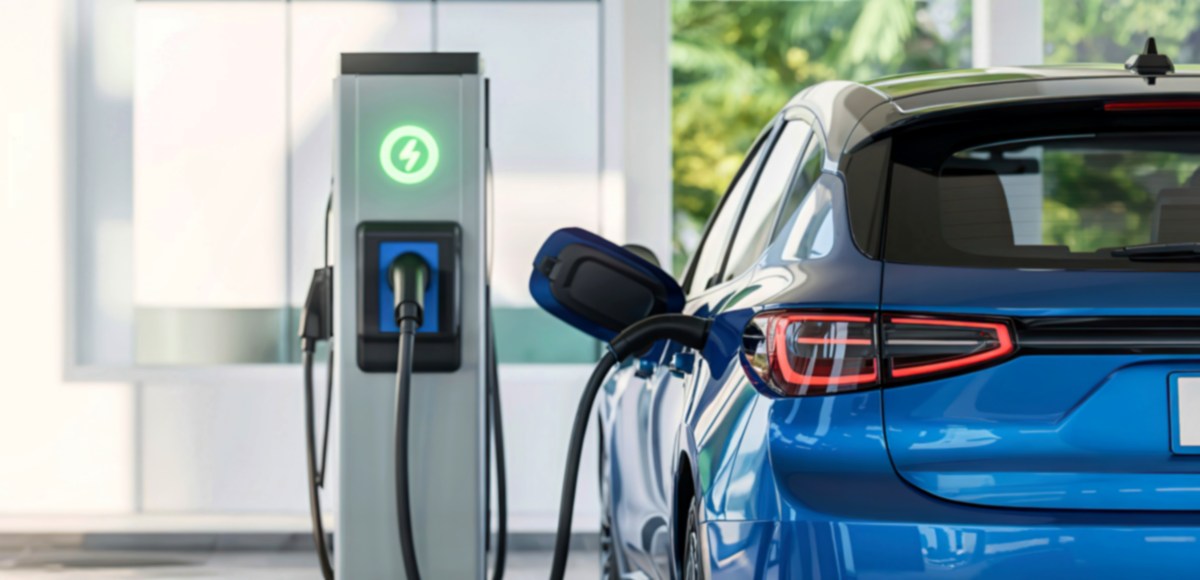
Keep reading this article to understand whether public or home charging is better, discover which suits you best, and learn how to combine them to get the most out of your electric car.
Charging at home or at a public charge point: differences at a glance
First, we are going to compare both alternatives using the same criteria to help you understand which option suits you best depending on how you use your car.
|
Aspect |
Home charging |
Public charging |
|---|---|---|
|
Main use |
Daily routine and short trips. |
Long journeys and unexpected trips. |
|
Cost |
Generally lower (depending on the tariff). |
Variable depending on power and operator. |
|
Speed |
Usually slower (slow/medium charging). |
Can be rapid or ultra-rapid. |
|
Convenience |
Maximum; charges while you sleep. Minimal planning. |
Requires locating and travelling to the charge point. More planning. |
|
Availability |
Your own charger is always available. |
Depends on the network and how busy it is. |
|
Initial investment |
Requires installation. |
Not applicable. |
|
Ideal situation |
You make daily trips and have a garage. |
You are away from home and need to recover range quickly. |
Which is usually cheaper: charging at home or at a public charge point?
Generally speaking, home charging usually costs less per kWh than rapid or ultra-rapid public charging. However, the actual savings will depend directly on your electricity tariff and the type of external charger you use.
Factors affecting the cost of public charging
The final price on your household bill varies depending on your contracted electricity tariff and the energy you consume. Factors such as your charging habits or potential energy losses during the process also play a part.
To maximise savings, it is ideal to have a specific electric vehicle tariff that offers competitive prices during the hours your car is parked.
Factors affecting the price of public charging
Away from home, the price is determined by the charge point operator, the charging power (faster speeds usually mean higher costs), and the location of the station.
The good news is that there are usually pay-as-you-go options or subscription tariffs that offer attractive discounts.
How to properly compare both costs
To compare fairly, always use the same unit: the cost per kilowatt-hour (kWh). The formula is simple:
Cost = kWh charged × effective price per kWh
If you compare the cost of charging the same amount of energy (for example, 40 kWh), you will see that you have much greater control over your spending at home, as you know the price of your contract in advance.
Advantages of charging your electric car at home
Having your own charge point transforms your garage into a private service station that is available 24 hours a day.
You charge while the car is parked
This is the most valued advantage. The car essentially charges itself. You don't need to keep an eye on it; charging happens while you sleep, work, or enjoy your time at home. This eliminates the need to plan specific stops during your day-to-day life.
You have more control over the cost
When charging at home, you know your tariff perfectly and can better adapt to your needs. You know exactly how much each kWh costs you, providing economic predictability that public charging does not always offer.
You don't have to rely on finding an available charge point
This is especially relevant for daily use. You are guaranteed that your charger is free and operational whenever you need it, avoiding the disappointment of arriving at a public charge point only to find it occupied or out of order.
You can manage your charging smartly
Many home chargers allow you to schedule the start and end times, as well as perform load balancing. This system monitors your home's consumption and adjusts the car's charging speed so as not to exceed your contracted limit, preventing the fuse box from tripping if you turn on the oven or the air conditioning.
Advantages of charging your electric car at a public charge point
Public charging stations are a necessary complement for any electric vehicle in various scenarios.
It allows you to charge when you are away from home
This is essential for those days when your journeys exceed your usual range, or unforeseen events force you to travel more kilometres than planned.
You can recover range more quickly
Public charge points usually offer higher power capacities than domestic ones. While home charging is slow or medium, on the go you can recover a significant portion of your battery in the time it takes to have a coffee.
It is essential for long-distance trips
Without the public charging network, long-distance journeys would be impossible. Rapid and ultra-rapid chargers located on major roads allow you to cross the country by making short, strategic stops.
It is an alternative if you don't have a home charger
Not having a parking space does not stop you from enjoying an electric car. In this scenario, public charge points near your home, work, or shopping centres become your regular allies, although you need to carefully assess their availability and cost within your routine.
Which option takes less time to charge the car?
The short answer is rapid or ultra-rapid charging at public stations. For example, while our 7.4 kW domestic Waybox charger usually takes between 6 and 10 hours to complete a charge, a rapid public charger (50–150 kW) can recover 80% of the battery in about 20–40 minutes.
However, overusing these types of rapid charges can accelerate battery wear. Furthermore, the speed will depend on the maximum power the vehicle accepts and its condition.
When is it worth charging at home?
Charging at home is the logical choice if you use the car for your daily commute and the vehicle is parked in your garage for several hours. It is the most efficient way to control your monthly spending and integrate electric mobility into your life without altering your schedule.
When is it better to use a public charge point?
Using the public network is a priority during long journeys, when you need to recover range quickly, or when you can take advantage of the time you spend at a shopping centre, restaurant, or work. It is also the necessary solution if you do not have your own charge point.
What if I can't install a charger at home?
This is a common situation, as only 1 in 3 homes in Spain has a parking space. This means that many electric vehicle drivers exclusively use the public network.
At Endesa, we have launched a map that allows you to locate all our charge points, check their availability, and compare prices.
It is a lifestyle that requires a bit more planning, but it remains perfectly viable and sustainable.
The best option is usually to combine domestic and public charging
As with load balancing, the trick is finding the perfect balance. If charging at home is the most practical and economical solution for your day-to-day life, public charging can be more attractive for trips or unexpected events.
The ideal strategy is always to leave home with a 100% battery and plan your stops along the route (if you need them) using rapid chargers to minimise waiting times.
Rather than having to stick to one of the two options, electric mobility allows you to adapt to the context of any given moment:
- Daily commutes: Home.
- Regular or overnight charging: Home.
- Unexpected trip: Public (if needed).
- Long journey or holidays: 100% at home before leaving + public en route.
- Need for speed: Rapid or ultra-rapid public charging.
- No private garage: Public (charging stations, workplace, etc.).
How to save by combining charging at home and away
Managing your energy smartly can mean drastic savings at the end of the month:
- Prioritise regular charging at home when you can: Doing the bulk of your charging at home with a suitable tariff is the first step to reducing your cost per kilometre.
- Choose the public charge point based on need, not just power: You don't always need the most powerful and expensive charger. If you are going to stop for an hour to eat, a standard rapid charger can be sufficient and cheaper than an ultra-rapid one.
- Check the price and availability before you travel: Using mobile apps, such as On Your Way, allows you to avoid unnecessary trips to occupied charge points and know the price in advance to avoid surprises.
- Take advantage of the benefits of your mobility tariff or service: Now, by signing up for the Waybox charger and Endesa's Recarga en Casa Tariff, you can drive up to 15,000 km a year for less than €22 a month. Plus, you get a 20% discount for 1 year on our public charging network.
Frequently asked questions about charging at home or at public charge points
Is it cheaper to charge an electric car at home or on the go?
It is generally cheaper at home, especially with specific electric car tariffs or those that incentivise overnight charging.
Is it faster to charge at home or at a public charge point?
It is much faster at rapid or ultra-rapid public charge points, which are designed to minimise waiting times.
Can I have an electric car without a home charger?
Yes, by relying on the public network and charge points available at your workplace or regular destinations.
How much does it cost to charge an electric car at home?
With the Recarga en Casa Tariff, for example, you can drive up to 1,250 km a month for less than €22.
How much does it cost to charge an electric car at a public charge point?
The price varies greatly depending on the operator and the power, and can reach up to €0.79 per kWh.
Is it better to always charge the car at home?
It is highly recommended for economy and convenience for daily use. However, depending on the context, we recommend using the public network or a combination of both.
Is rapid charging more expensive than home charging?
Yes, due to the infrastructure required to offer high power capacities in a short time.
Can I use any public charge point?
Yes, as long as the connector is compatible and you follow the operator's payment method or app.
Do I need an app to charge away from home?
With Endesa, you simply need to have the On Your Way app on your mobile device.
Which option is best for travelling?
A combination of leaving home with a full charge and using rapid public chargers for stops along the route.
Take a minute to find the product that best suits you:
{{firstStep.title}}
Take a minute to find the product that best suits you:
{{title}}
{{content.phone.title}}
{{content.phone.text}}
{{content.phone.phoneText}}
{{content.form.title}}
{{content.form.text}}
{{content.form.success.title}}
You don't need to adapt to Endesa's tariffs because they adapt to you. If you go to our catalogue you can compare the different tariffs for yourself. Or if you prefer, you can answer a few questions and we will take care of comparing all the different electricity and gas tariffs and then make a customised recommendation.
Take a minute to find the product that best suits you:
{{title}}
{{content.phone.title}}
{{content.phone.text}}
{{content.phone.phoneText}}
{{content.form.title}}
{{content.form.text}}
{{content.form.success.title}}
You don't need to adapt to Endesa's tariffs because they adapt to you. If you go to our catalogue you can compare the different tariffs for yourself. Or if you prefer, you can answer a few questions and we will take care of comparing all the different electricity and gas tariffs and then make a customised recommendation.
Comparison of Electricity and Gas Tariffs
You don't need to adapt to Endesa's tariffs because they adapt to you. If you go to our catalogue you can compare the different tariffs for yourself. Or if you prefer, you can answer a few questions and we will take care of comparing all the different electricity and gas tariffs and then make a customised recommendation.
Do you want to see all our offers?
Spend a minute to find the product which best adapts to you:
{{firstStep.title}}
Spend a minute to find the product which best adapts to you:
{{title}}
{{content.phone.title}}
{{content.phone.text}}
{{content.phone.phoneText}}
{{content.form.title}}
{{content.form.text}}
{{content.form.success.title}}
Spend a minute to find the product which best adapts to you:
{{title}}
{{content.phone.title}}
{{content.phone.text}}
{{content.phone.phoneText}}
{{content.form.title}}
{{content.form.text}}