


If you prefer to always view the website in English, please click here.
12 tips to watch the 2026 World Cup without your electricity bill skyrocketing
The match begins, the tension builds, and your electricity consumption also rises without you even noticing. Watching a 2026 World Cup match on a 65-inch TV involves an electricity cost that may be reflected in your next electricity bill. Although the impact is moderate, it adds up with every match and could mean an approximate increase of between €3 and €8 by the end of the tournament.
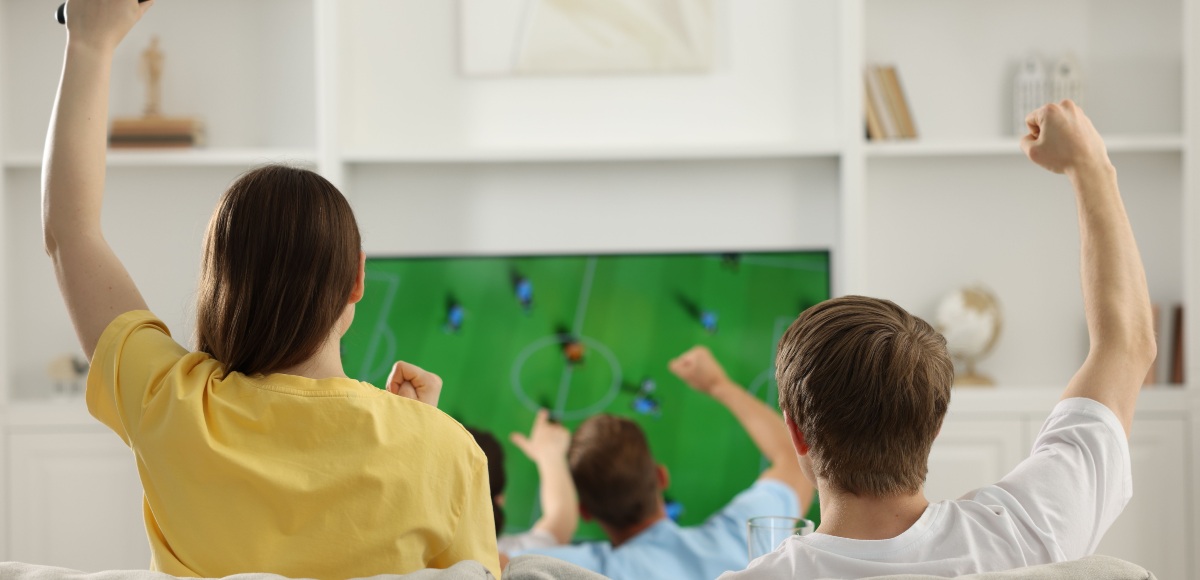
However, the biggest impact doesn't always come from the television. In many homes, the energy used by the air conditioning during matches can easily exceed that of the screen. Let's look at the bigger picture so you can watch the 2026 World Cup without sending your bill through the roof or ending up paying too much for your electricity.
How much your TV consumes during a match: the real data
To optimise costs, the first step is knowing the actual impact of the screen. Modern LED TVs use up to 25% less energy than LCDs, making them your best bet. The size and technology of the panel will also directly influence the power required.
Here is the estimated cost per 90-minute match, based on data from a manufacturer of QLED TVs and an electricity price of €0.11/kWh:
| TV size | Potencia (W) | Coste por partido (90 min) |
|---|---|---|
| 55 inches | 79 - 114 W | €0,013 - €0,019 |
| 65 inches | 106 - 180 W | €0,017 - €0,030 |
| 75 inches | 135 - 220 W | €0,022 - €0,036 |
It is vital to remember that, in an average home, the TV accounts for 12% of appliance energy consumption; a figure we can reduce by correctly adjusting the picture settings.
The most important tip that nobody mentions: air conditioning during matches
Many users obsess over TV consumption, but the appliance that can have the biggest impact on your costs during the 2026 World Cup is your air conditioning. For example, a 1,500 W air conditioning unit left on for the 90 minutes of a match will consume 2.25 kWh. Taking the previous reference of €0.11/kWh, you would pay €0.247 in total. In contrast, a 55-inch TV would only cost €0.013 over the same period.
This means that cooling the living room to watch the football uses significantly more energy than the screen itself. Therefore, the real savings during the tournament will come from how you manage your thermostat while enjoying the match.
The 12 tips ordered from highest to lowest impact on your bill
Not all habits affect electricity consumption equally when watching TV. Some changes are barely noticeable, while others can significantly reduce your monthly costs without sacrificing comfort or picture quality.
Tip 1: Choose match times that fit your time-of-use tariff (impact: very high)
Matches in the US, Canada, and Mexico are broadcast in Spain primarily at night or in the early hours of the morning. For instance, the Uruguay vs. Spain match will be at 02:00. Late-night matches coincide with the off-peak hours of the tariff (between 00:00 and 08:00), which is the cheapest period. Therefore, if you have a time-of-use tariff, late-night matches will be cheaper to watch.
Tip 2: Turn the air conditioning up by 2 or 3 degrees during the match (impact: very high)
It is recommended to set the air conditioning to 27ºC, as every degree you lower the air con increases consumption by 8%. If you decide to combine a fan and air con to use less energy during matches, the fan will help distribute the cold air, allowing you to turn up the thermostat without losing comfort.
Tip 3: Adjust the screen brightness (impact: high)
It is the simplest and most effective method: reducing the screen brightness will help you save energy. TVs come with maximum brightness set from the factory to grab attention, but lowering it to 50% or 60% is enough for a perfect viewing experience and noticeably reduces your bill. Plus, your eyes will thank you too.
Tip 4: Take advantage of the joint Orange and Endesa offer
Orange TV customers who have signed up for the all-football package will be able to enjoy all 104 World Cup matches at no extra cost on top of their tariff. Furthermore, by signing up for these services, you can save up to €6 a month on your electricity or gas bills with Endesa.
Tip 5: Activate energy-saving mode
Most modern televisions include an ECO mode that automatically reduces brightness and electricity consumption.
Tip 6: Use cinema mode instead of sports mode
Cinema mode reduces backlighting to adapt to dark rooms, using less energy than sports mode, which maximises brightness.
Tip 7: Use the TV's built-in speakers
Foregoing a soundbar or peripherals, such as external speakers, helps to limit the system's total electricity consumption.
Tip 8: Turn off features you don't use
Bluetooth, voice assistants, AirPlay, or automatic searches might remain active, consuming energy.
Tip 9: Avoid vampire power (standby)
Never leave the TV on standby. Turning it off completely will stop you paying for energy you aren't using.
Tip 10: Clean your air conditioning filters
Keeping the filters clean allows the unit to run more efficiently and puts less strain on the motor.
Tip 11: Don't put hot food in the fridge
If you prepare hot snacks for the match, avoid putting them in the fridge. This forces the motor to work harder, increasing its consumption, which already accounts for 30.6% of the household total.
Tip 12: Choose the right screen size for your living room
If you're looking for a new TV for the 2026 World Cup, bear in mind the size of your living room. The bigger the TV, the higher the electricity consumption tends to be. It is also important to prioritise LED, OLED, or QLED models.
Is it worth buying a new, more efficient TV for the World Cup?
If your TV is more than 8 or 10 years old and uses plasma technology, switching to an efficient LED model can generate significant savings. However, if you already own an LED TV that is less than 5 years old, the gain in efficiency won't justify the financial investment based solely on consumption during the World Cup.
FAQ
How much does it cost in electricity to watch all the World Cup matches?
If we take a 65" TV consuming 106 W, a 1,500 W air conditioning unit, an electricity price of €0.11/kWh, and assume that each match lasts 90 minutes.
Does the TV's sports mode use more energy than cinema mode?
Yes, as sports mode tends to push brightness and contrast to the maximum, whereas cinema mode aims for more natural and efficient lighting.
What time are the 2026 World Cup matches in Spain?
Most will be broadcast between 18:00 and 06:00. The late-night matches are ideal for saving if you have a time-of-use tariff.
Is a soundbar worth it to watch the World Cup?
It adds extra consumption. If you are looking for maximum savings, the TV's built-in speakers are the most efficient option to avoid adding to your costs.
Take a minute to find the product that best suits you:
{{firstStep.title}}
Take a minute to find the product that best suits you:
{{title}}
{{content.phone.title}}
{{content.phone.text}}
{{content.phone.phoneText}}
{{content.form.title}}
{{content.form.text}}
{{content.form.success.title}}
You don't need to adapt to Endesa's tariffs because they adapt to you. If you go to our catalogue you can compare the different tariffs for yourself. Or if you prefer, you can answer a few questions and we will take care of comparing all the different electricity and gas tariffs and then make a customised recommendation.
Take a minute to find the product that best suits you:
{{title}}
{{content.phone.title}}
{{content.phone.text}}
{{content.phone.phoneText}}
{{content.form.title}}
{{content.form.text}}
{{content.form.success.title}}
You don't need to adapt to Endesa's tariffs because they adapt to you. If you go to our catalogue you can compare the different tariffs for yourself. Or if you prefer, you can answer a few questions and we will take care of comparing all the different electricity and gas tariffs and then make a customised recommendation.
Comparison of Electricity and Gas Tariffs
You don't need to adapt to Endesa's tariffs because they adapt to you. If you go to our catalogue you can compare the different tariffs for yourself. Or if you prefer, you can answer a few questions and we will take care of comparing all the different electricity and gas tariffs and then make a customised recommendation.
Do you want to see all our offers?
Spend a minute to find the product which best adapts to you:
{{firstStep.title}}
Spend a minute to find the product which best adapts to you:
{{title}}
{{content.phone.title}}
{{content.phone.text}}
{{content.phone.phoneText}}
{{content.form.title}}
{{content.form.text}}
{{content.form.success.title}}
Spend a minute to find the product which best adapts to you:
{{title}}
{{content.phone.title}}
{{content.phone.text}}
{{content.phone.phoneText}}
{{content.form.title}}
{{content.form.text}}