


If you prefer to always view the website in English, please click here.
How much energy an electric oven uses: power, kW and cost
How much energy does an electric oven actually use every time you turn it on? There is no single answer: consumption depends on the model, the programme, the temperature, and the cooking time.
If you want to know how much energy your oven uses, start by checking the kWh per cycle on its energy label or spec sheet. For domestic ovens sold in the European Union, this figure is given for the conventional mode and, where applicable, for the fan-forced mode.
From there, working out how much it costs to run is very straightforward.
In summary
Power → kW: the electrical capacity of the appliance.
Consumption → kWh: the energy used over a period or cycle.
Cost → €: kWh consumed × price of electricity.
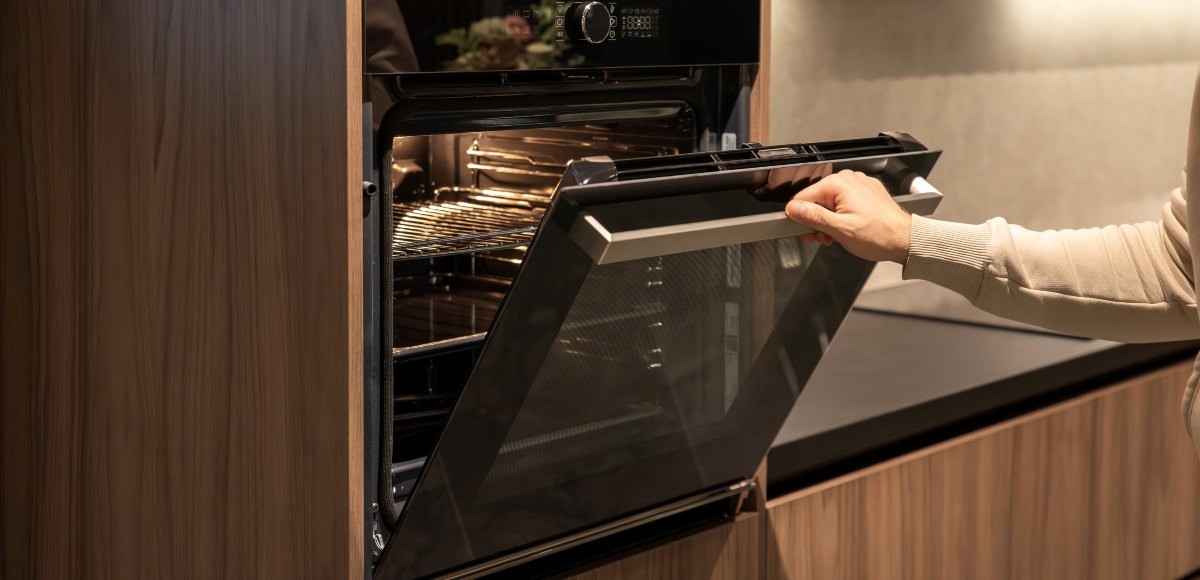
How many kWh does an electric oven use?
There is no single consumption figure that applies to all electric ovens.
The energy used in a single session depends on the model and how you use it: temperature, duration, programme, preheating, fan usage, volume, and insulation.
That is why, if you want to know how much a specific oven uses, you should look at its consumption in kWh per cycle.
Consumption per cycle: the most useful figure for comparing ovens
Consumption per cycle is the amount of energy the oven uses during a standardised test cycle. It is expressed in kWh and allows you to compare different models under uniform conditions.
For example, if your oven's label says 0.90 kWh/cycle, that is the figure you can use as a benchmark to calculate its energy use.
Of course, this doesn't mean that every recipe you cook at home will use exactly 0.90 kWh. The actual consumption will depend on how you use the oven.
Where to check how much energy your oven actually uses
If you want to find out the consumption of a specific model, there's no need to rely on general averages. There are several places where you can find this information.
Check the energy label
This is the first place you should look.
On an oven's energy label, you will find details such as:
- its energy efficiency class
- the oven's volume
- its energy consumption per cycle in conventional mode
- its energy consumption per cycle in fan-forced mode, where available
In addition, the QR code on the label gives you access to the product information registered in the European EPREL database.
Check the manufacturer's spec sheet
If you haven't kept the label or want to check the specifications in more detail, search for the exact oven model on the manufacturer's website.
The spec sheet usually lists the appliance's power, its consumption per cycle, and its different operating modes.
Search for your model on EPREL
EPREL is the European product database for energy labelling. It allows you to look up the registered energy information for specific models sold in the European Union.
If you can't find the consumption per cycle, use its power output as an estimate
If you don't have the kWh/cycle figure, you can estimate it using the oven's power and its running time.
For example, a 2.5 kW oven running continuously for one hour would have a theoretical consumption of:
2.5 kW × 1 hour = 2.5 kWh
But note: this is an estimate, not a measure of its actual energy consumption.
Oven power and consumption: why kW and kWh are not the same
Although they are related, kW and kWh do not measure the same thing.
What power in W or kW means
Power indicates the electrical capacity of the appliance and is expressed in watts or kilowatts.
For example: 2,500 W = 2.5 kW
However, just because an oven has a power output of 2.5 kW doesn't automatically mean it uses 2.5 kWh every hour.
What consumption in kWh means
kWh indicates the amount of energy used over a given period.
To make a simple estimate, you can use the following calculation:
Consumption (kWh) = power (kW) × time (h)
So, a 2.5 kW oven used for one hour would have a theoretical consumption of 2.5 kWh.
In practice, the actual consumption may be lower because the heating elements do not necessarily run continuously at maximum power: they turn on and off to maintain the selected temperature.
That is why, if you have the kWh/cycle figure, it is better to use that.
How to calculate the cost of turning on your oven
Once you know the consumption, calculating the cost is simple:
Cost (€) = consumption (kWh) × price of electricity (€/kWh)
The key is to use the price that applies to your contract.
If you know the kWh per cycle
This is the most direct way to calculate the cost of a single use.
For example, if your oven uses 0.90 kWh/cycle and we use a purely illustrative price of €0.20/kWh: 0.90 × 0.20 = €0.18
In this scenario, using the oven would have an energy cost of €0.18 per cycle.
The price per kWh depends on the tariff you are on. If you want to check which option might best suit your usage habits, you can compare Endesa's electricity tariffs.
If you only know the oven's power output
You can use the previous formula to get an estimate.
For a 2.5 kW oven used for one hour: 2.5 × 1 = 2.5 kWh
Then, multiply the estimated kWh by your electricity price. Remember that the result will only be a guide, not a measurement of actual consumption.
How much it costs to use your oven once, per month and per year
To put things into perspective, imagine an oven with a consumption of 0.90 kWh per use, used three times a week, with an electricity price of €0.20/kWh (as an example only).
|
Period |
Consumption |
Cost |
|---|---|---|
|
One use |
0.90 kWh |
€0.18 |
|
One week |
2.70 kWh |
€0.54 |
|
One month** |
11.69 kWh |
€2.34 |
|
One year |
140.40 kWh |
€28.08 |
*Estimate based on 52 weeks a year.
Your figures will be different if you use the oven more or less often, if its consumption per cycle is different, or if the price per kWh changes.
Calculate how much energy your electric oven uses
You now have the most reliable figure: the kWh per cycle. Now all you have to do is apply it to how you cook.
You need to know:
- kWh/cycle: the figure from your model's energy label or spec sheet.
- Uses per week: how many times you use the oven.
Then, calculate:
Weekly consumption = kWh/cycle × uses per week
Annual consumption = kWh/cycle × uses per week × 52
For example:
0.90 kWh/cycle × 3 uses = 2.70 kWh/week
2.70 × 52 = 140.40 kWh/year
Your calculation
___ kWh/cycle × ___ uses per week × 52 = ___ kWh/year
This way, you can find out the approximate consumption of your own oven, rather than relying on a general average.
Does an oven use more energy at 200°C than at 180°C?
It can use more, but there is no fixed percentage that applies to all ovens.
Temperature plays a role, but so do cooking time, the programme used, insulation, oven size, and the food you are cooking.
Does preheating increase energy consumption?
Yes. The time it takes to reach the selected temperature also forms part of the session's overall energy use.
Therefore, if you want to calculate how much it costs to cook a dish, you need to factor in both the preheating and the cooking time.
Does an oven use less energy with the fan on?
It depends on the model and the programme.
Fan-forced mode can alter cooking conditions, but it is incorrect to state that all ovens will use a specific percentage less energy when using it.
The best benchmark is to compare the kWh/cycle for conventional mode against fan-forced mode on the energy label, where both are listed.
What factors make an oven use more electricity?
The energy used in a single session doesn't just depend on the appliance's maximum power output. Here are some of the main factors that can influence it:
Cooking time
The longer the oven takes to cook food, the more energy is generally used during that session.
Temperature
A higher temperature may require more energy, although there is no fixed rule that applies to all ovens and recipes.
Preheating
Heating the oven before cooking also adds to the session's total energy consumption.
Opening the door during cooking
Every time you open the door, some of the built-up heat is lost, and the oven has to use energy to recover it.
The programme used
Using conventional mode is not the same as using the fan, the grill, or other programmes available on your specific model.
Size and insulation
The volume of the oven cavity and its ability to retain heat also affect its energy performance.
The amount of food
Cooking several compatible dishes at the same time can improve the energy efficiency per dish.
Examples of oven consumption by type of use
Not all dishes require the same cooking time or use the oven in the same way:
| Type of use |
What can influence consumption the most |
|---|---|
|
Short cooking time |
The relative impact of preheating |
|
Medium cooking time |
Temperature and duration |
|
Long cooking time |
Running time and heat maintenance |
|
Grill |
Power of the heating element and duration |
|
Multiple dishes |
Making the most of a single session |
The exact figure will always depend on the oven and the usage conditions.
Does an old oven use more energy than an efficient one?
There is no universal percentage to define exactly how much more an old oven consumes.
Energy performance depends on features such as insulation, temperature control, volume, the technology used, and the condition of components like the door seals.
An oven with a higher maximum power output does not necessarily use more energy over a complete cycle.
How to compare two ovens before buying
If you are comparing models, don't just look at the W or kW. Also check:
- kWh/cycle
- volume
- energy class
- consumption in conventional mode
- consumption in fan-forced mode, where available
This allows you to compare the energy used during standardised cycles, rather than just the appliance's maximum power output.
Does your electricity tariff affect how much it costs to use your oven?
Yes. The price you pay for electricity makes up part of the final cost of using the oven.
Depending on the tariff you are on, your price per kWh might be fixed or it might vary depending on the time of use.
That is why, to calculate how much it actually costs you to use the oven, you must use the price that applies to your specific contract.
If you are thinking of switching tariffs, you can view and compare Endesa's electricity tariffs to find one that suits your needs and usage habits.
Do you need a higher contracted power capacity to use an electric oven?
Not necessarily.
What matters is considering what other appliances you are running at the same time. For instance, the oven might be on at the same time as your ceramic hob, washing machine, dishwasher, or air conditioning.
If you want to find out what power capacity your home might need, you can use Endesa's power calculator to estimate your requirements before considering a change.
How to reduce your oven's energy consumption without changing what you cook
You don't have to stop using your oven to save money. A few simple habits can help:
Avoid preheating when it isn't necessary
If the recipe doesn't require it, you can skip this extra energy use.
Don't open the door unnecessarily
Every time you open the door, heat escapes, and the oven has to work harder to recover it.
Maximise each use
If you are preparing multiple compatible dishes, you can make the most of the same heating cycle and running time.
Make use of residual heat
For certain dishes, you can turn the oven off a few minutes early and let the remaining heat finish the cooking process.
Choose the right mode
Use the programme best suited to each dish and follow the manufacturer's recommendations.
Check the seals and closure
A worn seal or a door that doesn't close properly can lead to heat loss. Keeping these parts in good condition helps the oven run efficiently.
The most common mistakes when calculating an oven's energy consumption
Confusing kW with kWh
kW indicates power. kWh indicates energy consumed.
Confusing maximum power with actual consumption
Maximum power × usage time serves as a theoretical estimate, but it does not necessarily reflect the appliance's actual energy consumption.
Forgetting about preheating
If you want to calculate the total energy used to cook a dish, you must also include this time.
Using the wrong price per kWh
Your calculation should use the exact price set out in your tariff.
Comparing ovens purely by power output
W or kW alone do not tell you which model will use less energy over a full cycle.
Using an average when you can check your own model
If you have your oven's energy label or spec sheet, that figure is much more useful than a general average.
FAQs about electric oven energy consumption
How many kWh does an oven use in an hour?
It depends on the model and how it runs during that hour. Multiplying the power in kW by the time gives you an estimate, but actual consumption may be lower if the heating elements aren't running continuously at maximum power.
How much does it cost to have the oven on for an hour?
It depends on the consumption during that session and the price per kWh on your tariff.
Cost = consumption (kWh) × price (€/kWh)
How many watts does an electric oven have?
It depends on the model. You can find the power output on its rating plate, spec sheet, or manufacturer's documentation.
What is the difference between W, kW and kWh in an oven?
W (watts) and kW (kilowatts) express power. kWh (kilowatt-hours) express energy consumed.
Where can I see how many kWh my oven uses?
On its energy label, the manufacturer's spec sheet, or the European EPREL database.
What does kWh per cycle mean?
It is the energy consumed during a standardised test cycle. It serves as a benchmark for comparing the consumption of different models.
Does an oven use less energy with the fan on?
It depends on the model and the programme. If the label provides both figures, compare the consumption in kWh/cycle between conventional mode and fan-forced mode.
Does it use more energy the higher the temperature?
Consumption can increase, but there is no fixed percentage that applies to all ovens.
How much energy does preheating use?
It forms part of the session's overall consumption. Its impact will depend on the oven, the temperature, and the time needed to reach it.
Does a 3,000 W oven use 3 kWh every hour?
Not always. 3,000 W equals 3 kW of power, but the oven does not run continuously at maximum power. Therefore, its actual consumption may be lower.
Do I need a higher contracted power capacity to use the oven?
It depends on what you use at the same time. The key is ensuring your contracted power is sufficient to handle the oven and the other appliances running simultaneously.
Take a minute to find the product that best suits you:
{{firstStep.title}}
Take a minute to find the product that best suits you:
{{title}}
{{content.phone.title}}
{{content.phone.text}}
{{content.phone.phoneText}}
{{content.form.title}}
{{content.form.text}}
{{content.form.success.title}}
You don't need to adapt to Endesa's tariffs because they adapt to you. If you go to our catalogue you can compare the different tariffs for yourself. Or if you prefer, you can answer a few questions and we will take care of comparing all the different electricity and gas tariffs and then make a customised recommendation.
Take a minute to find the product that best suits you:
{{title}}
{{content.phone.title}}
{{content.phone.text}}
{{content.phone.phoneText}}
{{content.form.title}}
{{content.form.text}}
{{content.form.success.title}}
You don't need to adapt to Endesa's tariffs because they adapt to you. If you go to our catalogue you can compare the different tariffs for yourself. Or if you prefer, you can answer a few questions and we will take care of comparing all the different electricity and gas tariffs and then make a customised recommendation.
Comparison of Electricity and Gas Tariffs
You don't need to adapt to Endesa's tariffs because they adapt to you. If you go to our catalogue you can compare the different tariffs for yourself. Or if you prefer, you can answer a few questions and we will take care of comparing all the different electricity and gas tariffs and then make a customised recommendation.
Do you want to see all our offers?
Spend a minute to find the product which best adapts to you:
{{firstStep.title}}
Spend a minute to find the product which best adapts to you:
{{title}}
{{content.phone.title}}
{{content.phone.text}}
{{content.phone.phoneText}}
{{content.form.title}}
{{content.form.text}}
{{content.form.success.title}}
Spend a minute to find the product which best adapts to you:
{{title}}
{{content.phone.title}}
{{content.phone.text}}
{{content.phone.phoneText}}
{{content.form.title}}
{{content.form.text}}