


If you prefer to always view the website in English, please click here.
How much electricity does a fridge use? Power, kW and cost
While a fridge remains on 24 hours a day, that doesn't mean it uses the same amount of electricity throughout that time. The most useful figure for finding out how much electricity your model uses is on its energy label, which shows its annual consumption in kWh.
You can use this figure to calculate the average daily and monthly consumption and, if you know the price per kWh under your tariff, estimate the cost in euros.
For example, if your fridge's consumption amounts to 250 kWh/year:
- Per day: 250 ÷ 365 = 0.68 kWh.
- Per month: 250 ÷ 12 = 20.8 kWh.
- Per year: 250 kWh.
Assuming an electricity cost of €0.15/kWh, the annual cost would be around €37.50.
This is an estimate: the actual cost will depend on how much you pay per kWh and how much electricity the appliance uses under your home's actual conditions.
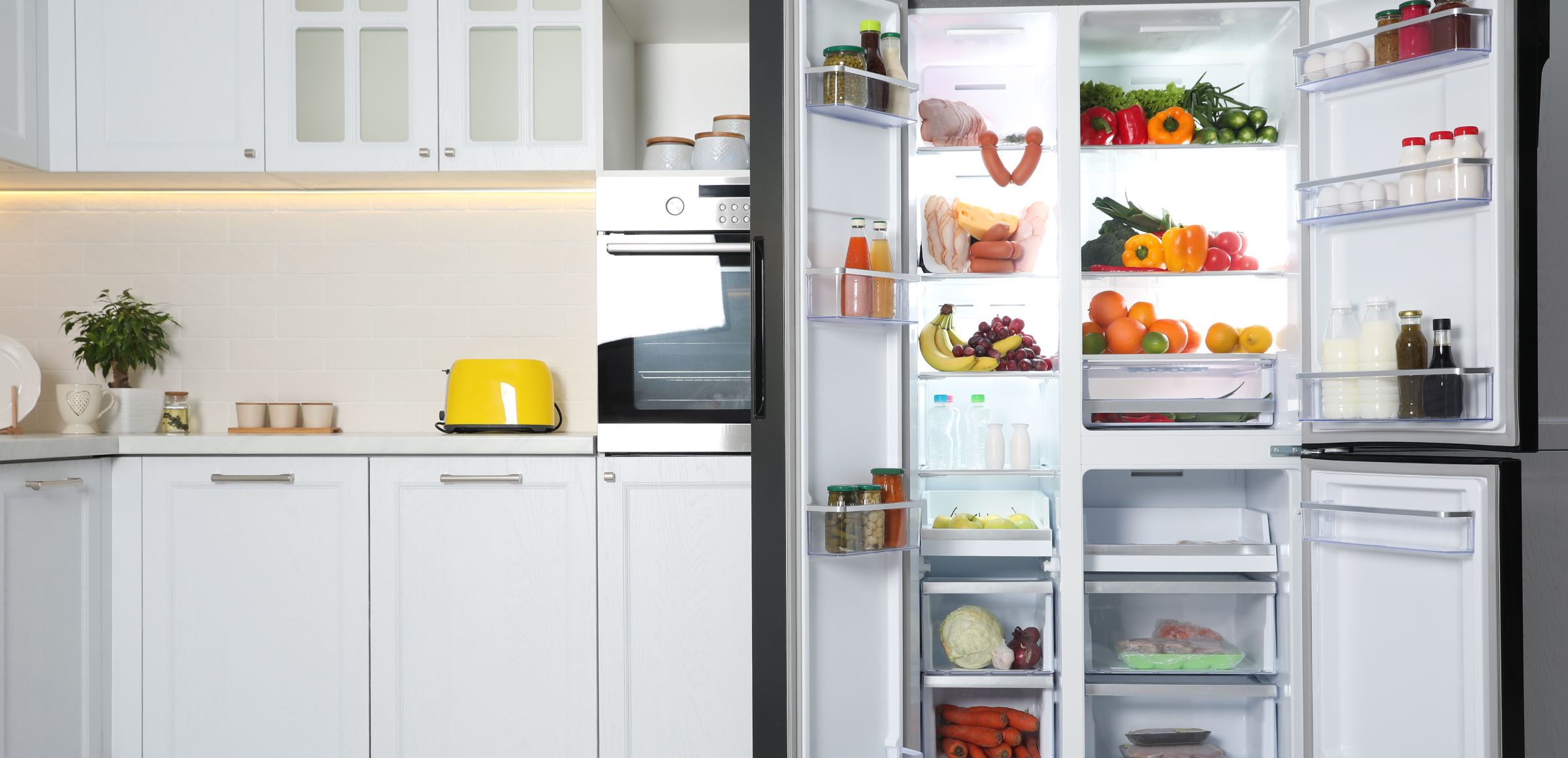
How many kWh does a fridge use per year?
The answer can be found on the energy label for each model. Not all fridges use the same amount of electricity, even if they remain plugged in all day.
The label shows annual energy consumption, expressed as kWh/year. This is the figure you should use as a starting point to calculate how much electricity your fridge uses.
For example, a model rated at 150 kWh/year will have a different stated annual consumption from one rated at 300 kWh/year.
Capacity, energy efficiency and the appliance's features also affect consumption. So, if you want to know how much electricity a particular fridge uses, the most reliable approach is to check the figure on its own energy label.
How many watts does a fridge use, and why isn't that enough to calculate its consumption?
A fridge's power rating is expressed in watts (W). However, this figure alone doesn't tell you how much electricity it will use over a day, a month or a year.
There is an important difference between power rating and energy consumption.
The compressor doesn't run continuously at the same power level. It starts up when cooling is needed, stops when the required temperature is reached and, depending on the model, may adjust its operation. Usage conditions and room temperature also have an impact.
That's why looking at kilowatt-hours (kWh) is more useful for finding out how much energy the appliance uses over a given period.
Why a 200 W fridge doesn't use 4.8 kWh every day
The calculation may seem straightforward: 200 W × 24 hours = 4,800 Wh = 4.8 kWh
The problem isn't the calculation itself, but the assumption that the fridge uses 200 W for all 24 hours.
That's not how it works. The 200 W figure represents a power rating, but the compressor doesn't necessarily run at that power level all the time. The appliance adjusts its operation to maintain the internal temperature.
That's why you shouldn't calculate annual consumption by multiplying the wattage by 24 hours and then by 365 days, as if the fridge were continuously using that amount of power.
To find out your model's expected consumption, use the kWh/year figure on its energy label. And if you want to check how much electricity it actually uses in your home, you can measure it directly.
How to find out exactly how much electricity your fridge uses
There are several ways to find out. The energy label indicates the model's annual consumption, but if you want to check how the appliance performs in your home, you can use an electricity consumption meter.
Check the energy label
This is the first place to look.
The label shows the energy efficiency class and annual consumption in kWh, along with other information about the appliance.
If you no longer have the label, you can look up the model number in the manufacturer's documentation or check the information available in EPREL.
Search EPREL
You can also look up your fridge in EPREL, the European database of products covered by energy labelling requirements.
The QR code on the energy label takes you to information about the model. EPREL also allows you to search for and compare products, which can be useful if you're thinking about replacing your fridge.
Use an electricity consumption meter
If you want to find out how much electricity your fridge uses under your home's actual conditions, you can use an electricity consumption meter.
It plugs in between the socket and the appliance, and records the electricity used, usually in kWh. If you leave it plugged in for several days, you'll get an indication of actual consumption that you can compare with the figure on the energy label.
Find out how electricity consumption meters work with Endesa.
Check the manufacturer's spec sheet
Another option is to check the fridge's technical specifications on the manufacturer's website.
You'll usually need the model number or appliance reference to find them. Make sure the specifications correspond to your exact fridge, especially if there are several versions with different capacities or features.
How to read a fridge's energy label
The current energy label for fridges uses a scale from A to G, with A representing the highest efficiency and G the lowest. It also shows annual energy consumption in kWh, the volume of the compartments and airborne noise emissions, among other details.
Specifically, you'll find:
- Annual energy consumption, expressed in kWh.
- Compartment volume, expressed in litres.
- Noise emission class and level.
- Information about freezer compartments, where applicable.
- A QR code providing access to additional information about the model in EPREL.
If you want to know how much electricity a fridge uses, there's one figure you should pay particular attention to: kWh/year.
The letter indicates its energy efficiency class on the scale. The kWh/year figure tells you the model's stated annual energy consumption.
What happened to the old A+++, A++ and A+ ratings?
If your fridge is a few years old, its energy label may still show one of the old A+, A++ or A+++ ratings.
The labelling system changed in 2021, and fridges moved to a scale from A to G.
There is no direct equivalence between the old and current categories. So, if you're comparing an older fridge with a new one, it's more useful to look at their annual consumption in kWh than to try to convert a rating from one scale to the other.
Does a class A fridge always use less electricity than a class C model?
Not necessarily. A fridge's energy efficiency class alone doesn't tell you its absolute energy consumption.
Efficiency matters, but so do the appliance's size, capacity and features.
For example, a large class A fridge may have a higher annual energy consumption than a smaller class C model.
If you're comparing two models, consider their respective energy efficiency class, the kWh/year, capacity and features.
How to compare fridges in EPREL
If you're looking for a new fridge, EPREL can help you compare data for different models.
Start with the kWh/year and capacity. Then look at other factors, such as compartment volumes, noise levels and the features you need.
That way, you won't have to base your decision solely on the letter shown on the energy label. You'll be able to check how much electricity each model uses and assess that figure in relation to its size and features.
How much does it cost to run a fridge all year?
To calculate how much your fridge costs to run, start with the annual consumption figure on its energy label.
The calculation is straightforward:
kWh/year × price per kWh = annual energy cost
For example, if your fridge uses 250 kWh/year and you pay €0.15/kWh:
250 × 0.15 = €37.50 per year
The result represents the cost of the electricity consumed by the fridge. It isn't the total amount on your electricity bill, which includes other charges.
To explore the options available, take a look at Endesa's electricity tariffs.
Can you save money by running your fridge during off-peak hours?
A fridge needs to keep food at a stable temperature, so unlike a washing machine or dishwasher, you can't simply choose to run it during off-peak hours.
If you have a time-of-use tariff, such as Conecta 3 Periodos, the price of electricity can vary depending on the time period. Even so, switching your fridge off to try to make it use electricity only during the cheapest periods isn't recommended.
If you want to reduce its energy consumption, it's better to focus on other measures: maintaining the right temperature, avoiding opening the door more often than necessary and checking that the appliance is installed correctly and working properly.
How to calculate your fridge's daily energy consumption
If you know the annual consumption shown on the energy label, you can calculate the daily average:
kWh/year ÷ 365 = kWh/day
For example: 250 kWh/year ÷ 365 = 0.68 kWh/day
This is an approximate average. Your fridge won't necessarily use exactly this amount every day, as operating conditions can vary.
How to calculate its monthly energy consumption
To calculate the monthly average, divide the annual consumption by 12:
kWh/year ÷ 12 = kWh/month
Using the example above: 250 kWh/year ÷ 12 = 20.8 kWh/month
To convert this consumption into euros, multiply the monthly kWh figure by the price per kWh under your tariff.
What makes a fridge use more electricity?
Energy consumption depends on more than just the energy efficiency class. The conditions in which the appliance operates and certain usage habits also play a part.
Room temperature
When the room temperature rises, the fridge may need to work harder to keep the inside cool.
That's why the appliance's location and the conditions in the room can also affect its energy consumption.
Thermostat setting
The thermostat allows you to adjust the temperature inside the fridge. Setting it correctly helps prevent the appliance from working harder than necessary.
The thermostat dial doesn't always correspond directly to a specific temperature. To find out which setting the manufacturer recommends, check the manual and, if possible, measure the actual temperature inside the fridge.
Opening the door
Every time you open the door, warm air from outside enters and the temperature inside changes. The fridge then has to work to bring the temperature back to the set level.
Opening the door only when necessary helps avoid this extra work.
Hot food
Putting freshly cooked food in the fridge can raise the internal temperature, forcing the appliance to work harder to bring the temperature back down.
Door seals
The door seal must be in good condition to ensure the door closes properly.
If the seal is damaged or the door doesn't close tightly, check its condition and follow the manufacturer's maintenance recommendations.
Ventilation
The fridge needs adequate ventilation to operate correctly.
Follow the installation clearances and recommendations specified by the manufacturer.
Frost
In models that require manual defrosting, excessive ice build-up can affect performance.
If this applies to your fridge, follow the manufacturer's instructions for defrosting and maintenance.
Size
Capacity also affects energy consumption. A large fridge may use more electricity than a small one, although size alone doesn't tell you which will use more.
When comparing models, always look at the kWh/year alongside capacity.
Age
A fridge's age alone isn't enough to determine how much electricity it uses.
If you want to check whether an older appliance is using more electricity than expected, look up the model's specifications or measure its consumption directly.
What temperature should you set your fridge at to avoid wasting electricity?
Keep your fridge between 1°C and 4°C, the temperature range recommended by the Regional Government of Madrid (Comunidad de Madrid) for storing food safely.
There's no need to cool it more than necessary. Setting the temperature too low can increase energy consumption without providing any additional benefit for food preservation.
If your fridge allows you to adjust different zones or compartments separately, check the manufacturer's specific instructions.
Does a fridge use more electricity in summer?
Yes, energy consumption can increase in summer.
When the room temperature rises, the fridge has to work under more demanding conditions to keep the inside cool.
Other factors can also play a part, such as the temperature setting, how often you open the door and how much food you put inside.
How to tell if your old fridge is using too much electricity
Just because a fridge is old doesn't automatically mean it's using too much electricity.
To check, you can measure its actual consumption over several days and use the result as a benchmark.
You can also consult the model's documentation and compare its consumption with that of other fridges with similar features.
This will give you concrete data to assess its performance rather than relying solely on its age.
How to work out whether replacing an old fridge is worth it
If you're thinking about replacing your fridge, compare several factors before making a decision:
- The annual energy consumption of your current fridge.
- The annual energy consumption of the new model.
- The purchase price.
- The price you pay per kWh.
- How many years you expect to use the new fridge.
The difference between the two consumption figures allows you to estimate how much energy you would save each year. You can then multiply the result by the price per kWh to calculate the difference in euros.
This allows you to assess whether replacing your fridge is the right option based on your own consumption figures and costs, rather than energy efficiency class alone.
Calculate how much electricity your fridge uses and how much it costs
To work this out for your own fridge, you only need three pieces of information:
1. Find the kWh/year figure.
Look for the annual consumption figure on the energy label or in the model's documentation.
2. Calculate daily or monthly consumption.
Divide the kWh/year by 365 to get the daily average or by 12 to get the monthly average.
3. Calculate the cost.
Multiply the amount of kWh consumed by the price per kWh under your tariff.
For example, for a fridge rated at 250 kWh/year and a hypothetical electricity price of €0.15/kWh:
- Average daily consumption: 0.68 kWh.
- Average monthly consumption: 20.8 kWh.
- Annual energy cost: €37.50.
Remember that these are estimates based on the model's stated annual consumption and an electricity price used purely as an example.
If you want to check and manage your electricity supply, you can do so through Endesa's Customer Area.
Is your fridge using too much electricity?
Before you reach that conclusion, check these three figures:
- The kWh/year figure on the energy label. This gives you a benchmark for the appliance's expected consumption.
- Actual consumption at home. You can measure it over several days with an electricity consumption meter to find out how much electricity the appliance is actually using.
- The price you pay per kWh. This is the figure you need to calculate how much that consumption costs on your electricity bill.
If you're an Endesa customer, you can also check InfoEnergía to see how your electricity consumption is broken down and receive personalised recommendations to improve your home's energy efficiency.
If, after checking these figures, you find that consumption is significantly higher than expected or notice a malfunction, contact the manufacturer or a service technician.
Why actual consumption may differ from the figure on the energy label
The figure on the energy label provides a benchmark for comparing models under specific conditions. Your fridge at home may use a different amount of electricity.
Room temperature, how often you open the door, the amount of food inside, the appliance's settings and other usage conditions can all affect consumption.
So, if you need to know how much electricity your fridge uses in your home, an electricity consumption meter allows you to measure it directly.
The energy label helps you understand and compare a model's stated annual consumption, while a meter shows you how that particular appliance performs under your actual usage conditions.
Does a large fridge use more electricity?
A larger fridge doesn't necessarily use more electricity.
Capacity affects consumption, but it isn't enough to determine it on its own. A large fridge may have lower annual consumption than a smaller one if their features and energy efficiency differ.
When comparing two models, check the respective kWh/year, capacity and energy efficiency class, and try to compare models with similar features.
Does a No Frost fridge use more electricity?
No Frost technology alone doesn't determine how much electricity a fridge uses.
Consumption depends on the appliance's overall characteristics, including its design, capacity and energy efficiency.
So, if you're comparing a No Frost model with another fridge, check the kWh/year figure on their energy labels and consider their capacities and features too.
FAQs about fridge energy consumption
How much electricity does a fridge use per day?
It depends on the model. To calculate an approximate daily average, divide the kWh/year figure on the energy label by 365.
For example, a fridge rated at 250 kWh/year uses an average of around 0.68 kWh per day.
How much electricity does a fridge use per month?
Divide the kWh/year figure on the energy label by 12.
For a fridge rated at 250 kWh/year, the average would be around 20.8 kWh per month.
How much does a fridge cost to run per year?
It depends on the fridge's annual consumption and the price per kWh under your electricity tariff.
The calculation is: kWh/year × price per kWh = annual energy cost
Assuming a consumption of 250 kWh/year and an electricity price of €0.15/kWh, the cost would be €37.50 per year.
How many watts does a fridge use?
There is no single figure for all fridges.
Watts (W) indicate power, but this doesn't mean the appliance uses that amount of power continuously. To find out its actual consumption, check the kWh/year figure on the energy label or use a consumption meter.
Why doesn't 200 W mean 200 W for 24 hours a day?
Because the fridge doesn't run continuously at that power level.
The compressor starts when cooling is needed, stops when the required temperature is reached and starts again when necessary. That's why multiplying 200 W by 24 hours a day doesn't tell you its actual energy consumption.
Where can I find my fridge's energy consumption?
The figure appears on the energy label, expressed in kWh/year.
If you no longer have the label, you can check the manufacturer's documentation or look up the model in EPREL.
What does kWh/year mean?
It is the fridge's annual electricity consumption, expressed in kilowatt-hours (kWh) under the reference conditions used for energy labelling.
You can use this figure to calculate average daily or monthly consumption and estimate the cost.
Which energy efficiency class uses the least electricity?
On the current energy label scale, class A is the most efficient, while class G is the least efficient.
However, the letter alone doesn't tell you the appliance's absolute energy consumption. When comparing fridges, also look at the kWh/year and capacity.
Does the A+++ label still exist?
No. Since 2021, fridge energy labels have used a scale from A to G.
The old A+, A++ and A+++ classes belonged to the previous system and cannot be converted directly to the new classes.
Does a fridge use more electricity in summer?
It can. When the room temperature rises, the fridge may need to work harder to keep the inside cool.
Other factors also play a part, such as the temperature setting and how often the door is opened.
Does an old fridge use much more electricity?
You can't tell from its age alone.
To find out, you can measure your fridge's energy consumption at home or compare it with that of other models with similar features.
Does a No Frost fridge use more electricity?
No Frost technology alone doesn't determine energy consumption.
If you're comparing a No Frost fridge with another model, look at the respective kWh/year as well as their energy efficiency classes, capacities and features.
Is it better to switch a fridge off at night?
No. A fridge is designed to maintain a stable temperature and run continuously.
Switching it off every night isn't a recommended way to reduce energy consumption. It's better to maintain the right temperature, avoid opening the door more often than necessary and check that the appliance is installed correctly and working properly.
Take a minute to find the product that best suits you:
{{firstStep.title}}
Take a minute to find the product that best suits you:
{{title}}
{{content.phone.title}}
{{content.phone.text}}
{{content.phone.phoneText}}
{{content.form.title}}
{{content.form.text}}
{{content.form.success.title}}
You don't need to adapt to Endesa's tariffs because they adapt to you. If you go to our catalogue you can compare the different tariffs for yourself. Or if you prefer, you can answer a few questions and we will take care of comparing all the different electricity and gas tariffs and then make a customised recommendation.
Comparison of Electricity and Gas Tariffs
You don't need to adapt to Endesa's tariffs because they adapt to you. If you go to our catalogue you can compare the different tariffs for yourself. Or if you prefer, you can answer a few questions and we will take care of comparing all the different electricity and gas tariffs and then make a customised recommendation.
Do you want to see all our offers?
Spend a minute to find the product which best adapts to you:
{{firstStep.title}}
Spend a minute to find the product which best adapts to you:
{{title}}
{{content.phone.title}}
{{content.phone.text}}
{{content.phone.phoneText}}
{{content.form.title}}
{{content.form.text}}
{{content.form.success.title}}
Spend a minute to find the product which best adapts to you:
{{title}}
{{content.phone.title}}
{{content.phone.text}}
{{content.phone.phoneText}}
{{content.form.title}}
{{content.form.text}}