


If you prefer to always view the website in English, please click here.
What is a humidifier used for and how much does it cost to run?
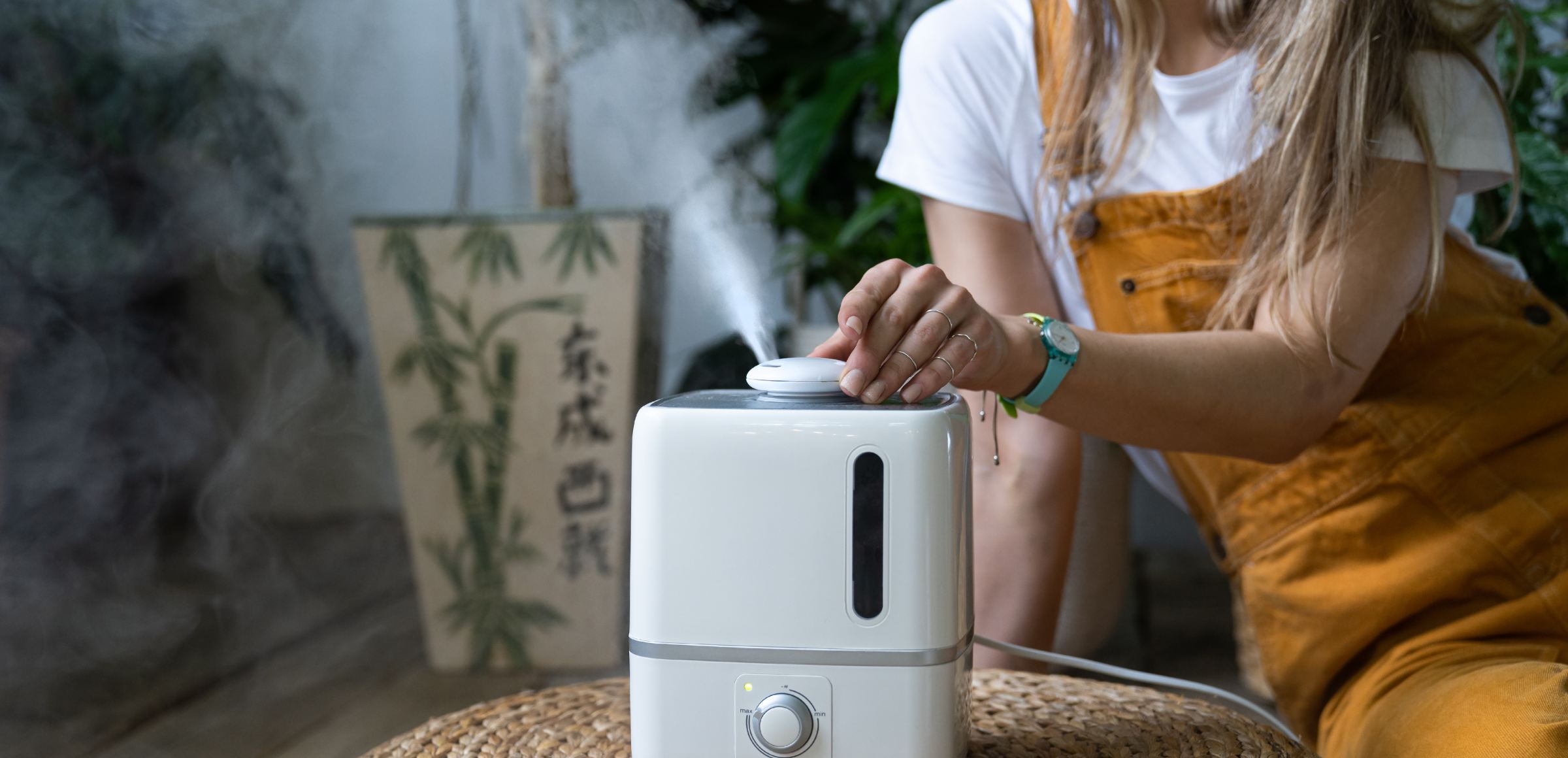
The indoor humidity of your home plays a major role in your comfort and, in many cases, your health. Humidifiers are used to raise this humidity when the air is too dry. Knowing how to use them and understanding their different technologies will help you maintain the ideal environment at home while saving energy.
What is the recommended indoor humidity level for your home?
The indoor humidity percentages established by the Spanish Regulation on Thermal Installations in Buildings (RITE), which align with the recommendations of the World Health Organization, are as follows:
|
Season: |
Relative humidity: |
|---|---|
|
Summer |
45% to 60% |
|
Winter |
40% to 50% |
However, as with everything, the exact levels for your home depend mainly on your personal preferences. These will be influenced by factors such as the type of activities you do at home, the number of people living together, their ages, and even any respiratory conditions, for which a specific indoor humidity level may be beneficial.
What can happen if the indoor humidity is not right?
In our day-to-day lives, it is not unusual to get used to the humidity level of the air in our homes. However, that level is not always what we actually need to feel comfortable, or to ensure it does not affect our health in the long term.
When the level falls below 40% or 45%, keeping it that low for a prolonged period can lead to dry skin or irritation of the respiratory tract.
Conversely, consistently high humidity can create the ideal breeding ground for mould, fungi, and bacteria. This can affect both your health and the walls, fabrics, and furniture in your home.
Relative humidity is therefore an indoor climate factor that deserves just as much attention as your heating or air conditioning temperature.
How to know if you really need a humidifier: the hygrometer
Finding out whether you need a humidifier starts with checking whether your indoor humidity is at the right level. This is measured using a hygrometer.
The simplest domestic hygrometers are available from just €2, and the same device very often measures the room temperature as well.
However, you may not even need to buy one: newer thermostats for heating and cooling systems usually include a built-in hygrometer, giving you all the information about your home's 'climate' at a glance.
A hygrometer lets you check the humidity in each room of your home, as well as how it fluctuates throughout the year. If the relative humidity falls below the minimum recommended levels, using a humidifier to balance it out can be a sensible decision.
Do humidifiers clean the air?
To a certain extent, humidifiers can mitigate the harmful effects of airborne impurities by maintaining a humidity level that prevents them from thriving. However, they do not purify the air.
If you want to rid the air of harmful particles such as dust mites, dust, pollen, and other allergens, what you need is an air purifier.
Purifiers draw in the air from the room, pass it through specialist filters, and release it back free of harmful agents. Humidifiers, on the other hand, simply release water particles that mix with the surrounding air to raise its relative humidity.
How does a domestic humidifier work and how much electricity does it use?
Essentially, a humidifier's job is to add moisture to the air in a room. The device has a tank from which it draws water and, depending on the technology used, releases it into the room as steam or a fine mist.
These different technologies also entail varying levels of electricity consumption when running:
Ultrasonic humidifiers: what they are and how much energy they use
Ultrasonic models feature a ceramic diaphragm that vibrates at a very high frequency, breaking the water down into microscopic droplets that are released into the room as a fine mist.
This is currently the most energy-efficient technology available. An ultrasonic humidifier typically has a power rating of between 20 W and 40 W, suitable for rooms of up to 40 m2.
Evaporative humidifiers: cool mist and slightly higher consumption
Humidifiers that produce cool mist work by drawing in air from the room and passing it through a damp wick filter. After being forced through this filter at high pressure, the air is released back into the room mixed with water particles from the filter.
Their energy consumption is noticeably higher than that of ultrasonic models, with power ratings ranging between 30 W and 60 W.
Warm mist humidifiers: the cost of heat evaporation
In the case of steam humidifiers that use heat, the system works differently. And so does the energy consumption. Because they work by boiling water using a heating element, they require considerably more power than cool mist or ultrasonic models: from 200 W to 400 W, and even more in models designed to humidify very large spaces.
How to calculate how much it costs to run your humidifier
Based on your humidifier's power rating, you can calculate how much energy it uses by applying the following formula:
- Divide the power rating (W) by 1,000 to find out its hourly consumption (kWh).
- Multiply this figure by the number of hours you use the appliance.
- Finally, multiply the result by the price (€/kWh) you pay on your electricity tariff.
This will give you a rough idea of how much it costs to humidify your home, although you can get a more accurate figure by plugging the device into an energy monitor.
By way of example, this table gives an estimate of how much it would cost per month to run a humidifier depending on its technology and how many hours a day you leave it on, based on Endesa's Luz 24h Online tariff:
|
Type of humidifier: |
Cost for 4 hours a day: |
Cost for 8 hours a day: |
|---|---|---|
|
30 W ultrasonic |
€0.46 |
€0.93 |
|
50 W cool mist |
€0.77 |
€1.54 |
|
300 W warm mist |
€4.63 |
€9.26 |
Calculation based on a 30-day month and an energy price of €0.128561/kWh (Luz 24h Online tariff at 5 October 2026).
What to look out for when buying a humidifier
Aside from the power rating, there are a few other aspects worth comparing when choosing the right humidifier for your home:
- The size of the rooms where you plan to use it, as larger spaces require more power.
- The water tank capacity, depending on the technology, as there is also a direct link between the volume in litres and the size of the space to be treated.
- The control options, timer settings, and other features on the device.
- How easy the appliance is to maintain, including cleaning the filters and internal components.
- The noise level it produces, as the appliance is typically left running for long stretches during the day or night.
- Other specific needs in your home, such as avoiding the risks of hot steam if you have children, or the space available for placing and storing the humidifier.
Can you leave a humidifier on all night?
Humidifiers are designed to run continuously for many hours at a time, so you will have no problem leaving yours plugged in overnight. However, it is advisable to take a few precautions when doing so:
- If it is a warm mist appliance, take the necessary safety measures to prevent any accidental burns.
- Try not to set the humidifier to a very high output, as releasing mist or steam for several hours could end up making the room overly humid.
Humidifiers with a humidistat: do they help reduce energy consumption?
One way to enjoy peace of mind when leaving your humidifier on for long periods is to choose a device with a built-in humidistat.
A humidistat works for indoor humidity in the same way a thermostat works for temperature in heating and cooling systems: when the room exceeds the maximum recommended humidity, the humidifier switches off. And if the humidity drops below the preset level, the appliance starts up again.
In this way, a humidistat helps keep the room environment stable and can also save energy by preventing the humidifier from running unnecessarily.
Is it a good idea to put the humidifier on when you turn on the heating?
Using a humidifier alongside your heating is usually a good idea – especially on cold, dry days – because heating dries out the air. Although radiators circulate hot water inside, they emit dry heat, causing ambient moisture to evaporate.
Furthermore, maintaining a higher level of humidity makes the room feel warmer when the heating is on. This is because the water particles in the air trap heat and retain it for longer. This can help you save on heating at a minimal cost, as the perceived level of comfort is similar to turning your thermostat up by one or two degrees.
Our recommendation: only run your humidifier when needed
Whether day or night, for a few hours or several, on a higher or lower setting, how you use your humidifier should be tailored to how comfortable you want your home to feel at any given time.
Ideally, you should switch it on when the relative humidity falls below 40% or 45%, depending on the season, and switch it off once it reaches the maximum recommended level.
Alternatively, you can opt for a device with a built-in smart humidistat, which will maintain your chosen humidity level throughout the day without you having to worry about switching it on and off manually.
Tips for using your humidifier properly
Using and maintaining your humidifier properly will help extend its lifespan, create a healthier, more comfortable environment at home, and save energy on heating and cooling. Here are a few simple tips to achieve this:
- Change the water in the tank frequently to prevent tank corrosion and the build-up of mould and bacteria.
- Clean the unit regularly, paying particular attention to any limescale build-up in the tank, ducts, and vents.
- Replace the filters in line with the manufacturer's instructions and recommended timeframes.
- Do not place it right up against walls or furniture, as the water particles it releases could cause damp and damage your furnishings and decor.
- Likewise, keep it away from cables, sockets, and electrical appliances. Direct moisture can damage them or stop them from working properly.
- Check the appliance regularly for any damage or water leaks.
- Prevent indoor condensation by ventilating your home daily to let fresh air circulate.
- Only use the humidifier when needed to raise the indoor humidity to its optimum level, without overusing it.
The right type of water for your humidifier
When choosing which water to fill your humidifier with, bear in mind that you will be breathing in whatever that water contains. If it is heavy in minerals or limescale, all of that will end up in your system. It will also settle around the room and on your furniture as fine white dust, as well as inside the appliance itself, damaging its components.
Therefore, unless the manufacturer's instructions state otherwise, the most recommended types of water are generally:
- Distilled water.
- Demineralised water.
- Tap water purified using reverse osmosis filters.
Is it safe to put essential oils in a humidifier?
It is not advisable to add essential oils directly to the water tank, as their composition and thickness can damage the humidifier. If you want to combine humidification with home fragrance, there are two options that will help protect your device:
- Use water-soluble fragrances, which dissolve in the water without leaving an oily residue.
- Choose a humidifier with a separate essential oil tray, which prevents the oils from coming into contact with the internal mechanism.
Humidifier vs dehumidifier: when should you use each one?
Excess moisture in the air can be just as harmful as an overly dry environment. In such cases, a dehumidifier helps prevent mould from forming on walls and furniture, creates a healthier and more pleasant home environment, and even helps laundry dry faster on rainy days.
There are various options available, including having two separate appliances to use depending on the day, or opting for a hybrid unit that combines both functions.
Either way, the choice between humidifying and dehumidifying the air comes down to what your hygrometer tells you: if the reading is below 40% or 45%, it makes sense to use a humidifier to raise it; if it exceeds 50% or 60%, it is best to switch on the dehumidifier to achieve the opposite effect.
Frequently asked questions about humidifiers and electricity consumption
What does a humidifier do?
A humidifier releases microscopic water particles into the air, thereby increasing the relative humidity in your home.
How much electricity do humidifiers use?
It depends on the humidifier's power rating. You can work out its hourly electricity consumption (kWh) by dividing its power rating (W) by 1,000.
How much does it cost to leave a humidifier on every night?
Multiply its hourly consumption (kWh) by 8 hours, and then multiply the result by the price in €/kWh on your electricity tariff.
Does an ultrasonic humidifier use a lot of electricity?
Ultrasonic humidifiers typically use the least energy, as their power rating can be up to 10 times lower than that of warm mist devices.
Which type of humidifier uses the least energy?
Ultrasonic technology uses the least energy, followed by cool mist (evaporative) humidifiers and, with considerably higher consumption, warm mist (steam) models.
How many hours should you leave a humidifier on for?
For as long as needed, depending on how dry the air is and how long the humidifier takes to reach the recommended relative humidity level.
What humidity level should a humidifier reach?
Between 40% and 50% relative humidity in winter, and between 45% and 60% in summer.
Do you have to fill a humidifier with distilled water?
It is advisable to do so to prevent microscopic limescale or mineral particles from building up inside the system and settling in the room. You can also use demineralised water or tap water filtered by reverse osmosis.
Can you put aromatic oils in a humidifier?
It is not advisable to put essential oils into the water tank, as they damage the humidifier's internal mechanism. Some models feature a separate compartment so you can use them as both an air freshener and a humidifier.
Do a humidifier and an air purifier do the same thing?
No. Humidifiers release a fine mist or steam into the room to raise the relative humidity of the air. Air purifiers, on the other hand, filter the air in the room and release it back clean without altering its humidity.
Does a humidifier save money on heating?
Yes, indirectly. Maintaining the right relative humidity makes the room feel slightly warmer when the heating is on, allowing you to turn the thermostat down and, consequently, reduce your energy consumption.
Take a minute to find the product that best suits you:
{{firstStep.title}}
Take a minute to find the product that best suits you:
{{title}}
{{content.phone.title}}
{{content.phone.text}}
{{content.phone.phoneText}}
{{content.form.title}}
{{content.form.text}}
{{content.form.success.title}}
You don't need to adapt to Endesa's tariffs because they adapt to you. If you go to our catalogue you can compare the different tariffs for yourself. Or if you prefer, you can answer a few questions and we will take care of comparing all the different electricity and gas tariffs and then make a customised recommendation.
Comparison of Electricity and Gas Tariffs
You don't need to adapt to Endesa's tariffs because they adapt to you. If you go to our catalogue you can compare the different tariffs for yourself. Or if you prefer, you can answer a few questions and we will take care of comparing all the different electricity and gas tariffs and then make a customised recommendation.
Do you want to see all our offers?
Spend a minute to find the product which best adapts to you:
{{firstStep.title}}
Spend a minute to find the product which best adapts to you:
{{title}}
{{content.phone.title}}
{{content.phone.text}}
{{content.phone.phoneText}}
{{content.form.title}}
{{content.form.text}}
{{content.form.success.title}}
Spend a minute to find the product which best adapts to you:
{{title}}
{{content.phone.title}}
{{content.phone.text}}
{{content.phone.phoneText}}
{{content.form.title}}
{{content.form.text}}