


If you prefer to always view the website in English, please click here.
Basic smart home automation to save energy in summer: what devices to install for under €50
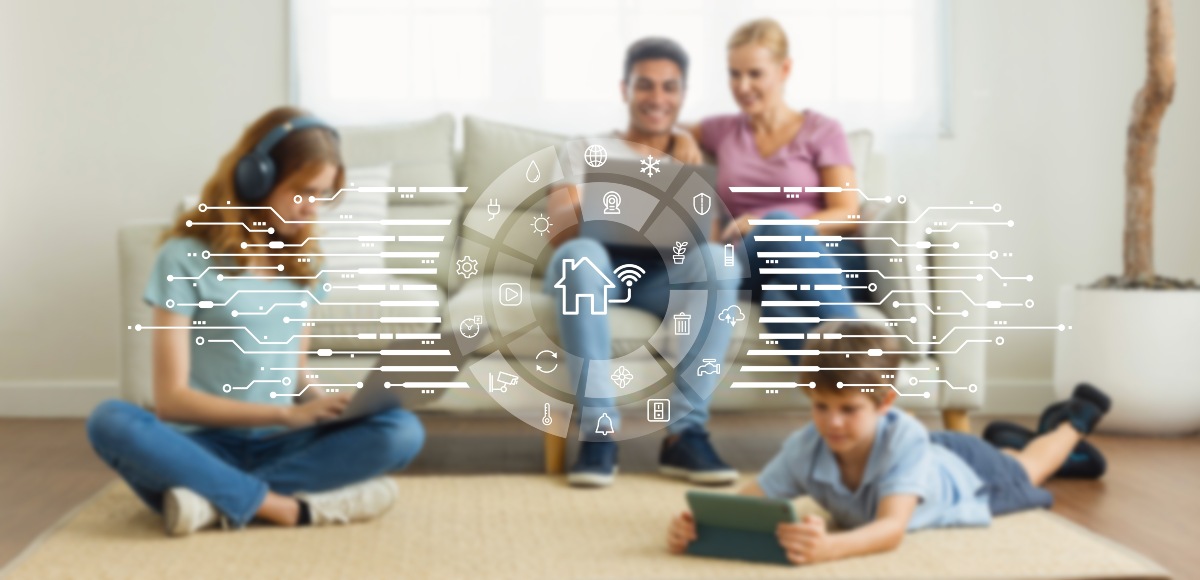
The summer holidays are a great time to take stock of the electricity we have consumed throughout the year and, for very little money, install some smart home devices to help us save on our electricity bill. But how do you go about it with a clear plan in mind?
{{content.phone.title}}
{{content.phone.text}}
{{content.phone.phoneText}}
{{content.form.title}}
{{content.form.text}}
{{content.form.success.title}}
According to the latest report by the Institute for the Diversification and Saving of Energy (IDAE), we lose almost as much electricity leaving appliances on standby as we use running washing machines. The approximate consumption of a million homes a year, no less.
To avoid this kind of situation, an increasing number of families are installing basic smart home solutions in their properties. And they are achieving average energy savings of up to 30% through tackling vampire power, using smart climate control, and adjusting lighting.
Now that we are spending more time at home or in our second homes, we can take the opportunity to apply some simple energy-saving measures without major installations or renovations. And without having to set up a complete or overly sophisticated smart home system. Because it is often enough to automate the basics, with solutions that can cost under €50. Here are a few of them.
Saving shouldn't be expensive: what smart home devices to buy for under €50
Saving starts with taking care of the little details. That light left on when no one is in the room, the reluctance to get out of bed to turn off the AC on a tropical night, or the time you nip out to the shops while leaving the TV on.
These are details that force us to constantly pay attention. Smart home automation is precisely about installing simple devices that take care of these details for us. They make our lives easier and, for very little money, help us save electricity. Here are some of them:
|
Smart plugs |
From €9 |
|---|---|
|
Smart extension leads |
From €25 |
|
Energy monitors |
From €10 |
|
Timers |
From €5 |
|
Temperature and humidity sensors |
From €18 |
|
Smart bulbs |
From €10 |
|
Remote controllers |
From €10 |
How smart plugs and extension leads save electricity
When you turn off the TV with the remote control, you will have noticed that a tiny light stays on. That light indicates the appliance has gone into standby, ready to be turned back on conveniently next time.
But convenience comes at a price: your TV continues to consume around 5% of the energy it uses when switched on. This means that if you only watched 1 hour of TV a day and left it on standby for the other 23 hours, you would be spending more with the TV off than while watching it.
This also happens with games consoles, PC monitors, microwaves, coffee machines, and many other appliances. The combined total makes it highly worthwhile to connect your appliances to smart plugs and extension leads.
These basic smart home devices allow you to completely cut off the power supply to your appliances. And you can do this via a mobile app, so you don't lose out on convenience. In many models, you can also schedule when they turn on and off, or select which sockets on the extension lead to activate or deactivate at any given time, depending on what devices you are going to use.
Energy monitors: discover where to save the most this summer
How much is your air conditioning really consuming? Is your fridge using more energy than it should? Do you spend more when you turn on a portable AC unit or a ceiling fan? Aside from what each appliance's instruction manual says, knowing exactly how much electricity each one uses while running is difficult.
That's why an increasing number of people are installing simple energy monitors which, when plugged into the socket of their appliances, provide real-time data on the electricity being used.
With these, you can identify how much each appliance affects your total consumption by cross-referencing the monitor data with your contracted electricity tariff and, if your plan has time-of-use pricing, the price of energy during off-peak, shoulder, or peak hours.
Timers that cool the house before you arrive
Imagine the feeling of walking into your house after a day in the sun, and the temperature is perfect. Instead of having to turn the air conditioning on at maximum power, with the resulting surge in consumption, the living room is already waiting for you like an oasis of cool air. This is the result of smart home tech working while you're away: timers.
Timers allow you, for a very affordable price, to schedule the switching on and off of fans, lights, routers, air conditioning units, or even your electric vehicle charger.
Without needing to keep an eye on an app, these devices let you automate what time the AC switches on at the optimal setting so the house is cool when you arrive, turn off the internet when you're not using it, or take advantage of charging batteries when electricity is cheapest.
You can also use timers to turn on a small living room light every night while you are on holiday, simulating that the house is occupied. All this makes this highly affordable smart home solution a favourite for combining comfort, security, and savings.
Temperature and humidity sensors to save on air conditioning
If it isn't already included in your climate control thermostat, installing a temperature and humidity sensor can help you quickly improve the comfort level in your home while consuming less electricity.
This is a basic smart home device used to determine when you should turn on the air conditioning, when a fan is sufficient, or when to freshen the air in the house by opening the windows.
For example, an ambient humidity of between 40% and 60% is perfect for cooling the living room faster and reducing the air conditioning's energy consumption. Bearing in mind that every degree below 24°C can require up to 8% more electricity, maintaining the ideal humidity translates to significant savings throughout the summer.
On the other hand, if the room temperature is higher than it is outside, it may be better to open the windows and ventilate the room before turning on the AC, and even speed up the air circulation with the help of fans.
Sensors are therefore an excellent guide to saving money through the combined use of different systems, always prioritising natural ventilation and the use of fans, as these can consume up to 90% less electricity than air conditioning.
Remote controllers and smart lighting: the little allies of low consumption
Sometimes, a small change ends up generating significant energy savings in the long run. This is what happens when you introduce simple lighting control models, combining the innovation of smart bulbs with their activation and scheduling from a mobile phone.
Smart lamps add to the savings generated by their LED technology with a wide range of options that, without needing to replace the bulbs, allow you to modify the intensity, brightness, and even colour to adapt the lighting to how you use your home at any given moment.
With their advanced connectivity systems, you can also control them remotely via your smartphone, smart home apps, and voice assistants. It's a convenient way to manage your home's lighting, creating more refreshing atmospheres in summer with a range of cool tones and saving on electricity thanks to their long lifespan.
Innovative smart tech and traditional habits: the perfect combination for this summer
You have probably heard it many times: they don't build houses like they used to. We long for those homes with thick stone walls, which retained the heat in winter and the cold in summer. Or those that maintained an orientation and spatial layout that encouraged the formation of cool air currents inside.
But, although building methods have changed, we can still practise some traditional habits that remain just as effective today. Combining these routines with simple, affordable, and easy-to-install smart home technology can make your summer very different. And your electricity bill, too:
- Use awnings, blinds, or curtains, preferably in light colours, to act as a barrier against direct sunlight.
- Take the opportunity to ventilate the house during the first and last hours of the day, refreshing the indoor air before the heat sets in.
- While using the air conditioning, ensure that the doors and windows of the house are tightly closed.
- Multiply the effect of the air conditioning with suitable ambient humidity and the help of fans.
Frequently asked questions about basic smart home automation
Can basic smart home automation save electricity?
Yes. Depending on the devices you install, the type of appliances you have at home, and how you normally use them, smart home automation can provide savings of between 15% and 40% on power consumption.
Which smart device should I buy first to start saving?
Smart plugs and extension leads, which when combined with remote control apps are the most common smart devices for starting to save.
Does a smart plug reduce consumption?
Yes. Smart plugs are your best ally, especially for reducing vampire power – a hidden cost that can account for 7% to 11% of your home's electricity expense.
What can I automate in summer for under €50?
If you spend the day out, a good idea is to automate the air conditioning so the house starts cooling down before you arrive. If you go on holiday, timers allow you to schedule the switching on and off of certain lights, or raise and lower blinds depending on the time of day, to make the house look occupied.
Is it worth buying a temperature and humidity sensor?
Yes. It will help you optimise the effect of the air conditioning, which is one of the appliances that consumes the most energy in summer.
Do smart bulbs save electricity?
Yes. In addition to the savings provided by their LED technology, you can adjust the brightness of these types of bulbs according to your needs, thereby reducing your energy consumption.
Does basic smart home automation replace a good electricity tariff?
No, but it enhances your savings. Smart home automation helps you save, regardless of the electricity tariff you have contracted. The ideal scenario, therefore, is to combine both decisions.
Take a minute to find the product that best suits you:
{{firstStep.title}}
Take a minute to find the product that best suits you:
{{title}}
{{content.phone.title}}
{{content.phone.text}}
{{content.phone.phoneText}}
{{content.form.title}}
{{content.form.text}}
{{content.form.success.title}}
You don't need to adapt to Endesa's tariffs because they adapt to you. If you go to our catalogue you can compare the different tariffs for yourself. Or if you prefer, you can answer a few questions and we will take care of comparing all the different electricity and gas tariffs and then make a customised recommendation.
Take a minute to find the product that best suits you:
{{title}}
{{content.phone.title}}
{{content.phone.text}}
{{content.phone.phoneText}}
{{content.form.title}}
{{content.form.text}}
{{content.form.success.title}}
You don't need to adapt to Endesa's tariffs because they adapt to you. If you go to our catalogue you can compare the different tariffs for yourself. Or if you prefer, you can answer a few questions and we will take care of comparing all the different electricity and gas tariffs and then make a customised recommendation.
Comparison of Electricity and Gas Tariffs
You don't need to adapt to Endesa's tariffs because they adapt to you. If you go to our catalogue you can compare the different tariffs for yourself. Or if you prefer, you can answer a few questions and we will take care of comparing all the different electricity and gas tariffs and then make a customised recommendation.
Do you want to see all our offers?
Spend a minute to find the product which best adapts to you:
{{firstStep.title}}
Spend a minute to find the product which best adapts to you:
{{title}}
{{content.phone.title}}
{{content.phone.text}}
{{content.phone.phoneText}}
{{content.form.title}}
{{content.form.text}}
{{content.form.success.title}}
Spend a minute to find the product which best adapts to you:
{{title}}
{{content.phone.title}}
{{content.phone.text}}
{{content.phone.phoneText}}
{{content.form.title}}
{{content.form.text}}