


If you prefer to always view the website in English, please click here.
{{content.phone.title}}
{{content.phone.text}}
{{content.phone.phoneText}}
{{content.form.title}}
{{content.form.text}}
{{content.form.success.title}}
Dog Day: how to keep your home cool for your pet without driving up your bill
Many pet owners return from work to discover that their home has transformed into a miniature oven for their four-legged friend. Despite leaving a window ajar, indoor temperatures can reach dangerous levels for their wellbeing. Today, we are celebrating Dog Day by ensuring their safety during the hottest months of the year.
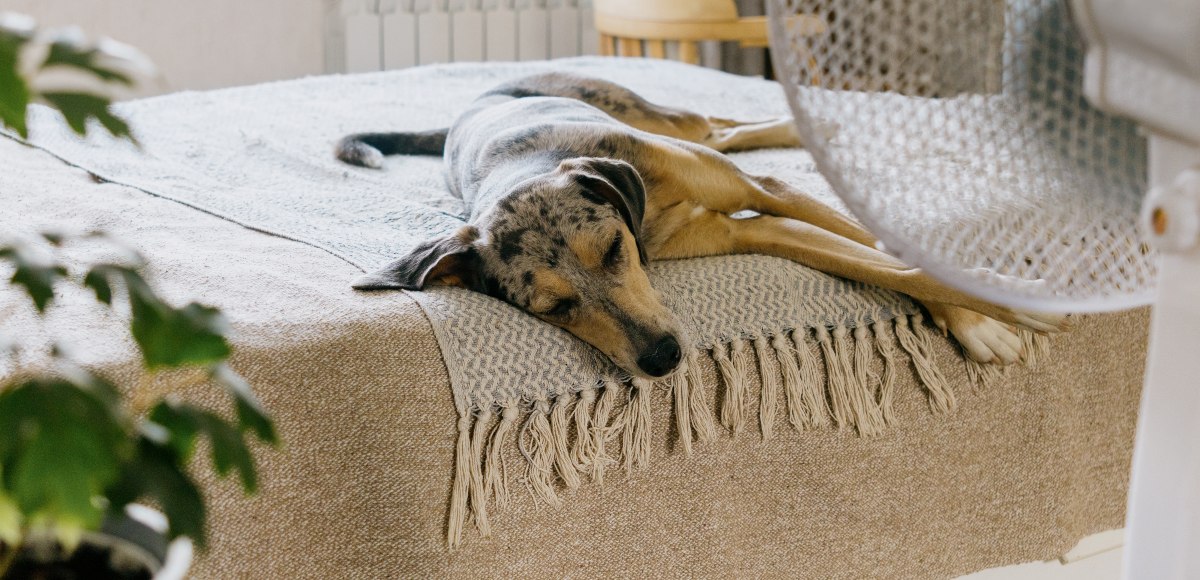
By following the tips in this article, you will find the perfect balance between maintaining a cool, safe haven for your pet and looking after your household budget. This way, your best friend is protected from the heat while you enjoy a more relaxing summer, safe in the knowledge that your energy consumption is under control.
Why a hot house also affects your dog
Unlike us, dogs have a much more limited cooling system. While humans sweat over almost our entire skin surface, canines only sweat minimally through the sweat glands located in their paw pads.
Their main tool for combating high temperatures is panting; by moving air rapidly over the moist surfaces of their mouth and tongue, they manage to evaporate water and dissipate heat. This mechanism is effective, but it has its limits, and when the ambient temperature is very high, it is much harder for them to lower their body temperature.
Furthermore, factors such as age (puppies and senior dogs), being overweight, or their coat type influence their resilience. This is especially true for brachycephalic breeds (such as Bulldogs, Pugs, or Boxers), whose shorter airways make air exchange significantly more difficult, leaving them far more vulnerable to serious heat-related issues.
The basic rule: a cool house, not a freezing one
The key to creating a cool refuge for your dog without it hitting your pocket is keeping the house comfortably chilled. The goal is not to turn the living room into a fridge, but to maintain a constant, sensible temperature. What is more, sudden temperature changes can be harmful to their health and send your consumption through the roof.
Below, we explain a very simple strategy to prioritise your pet's wellbeing while still saving money:
|
Action |
What it does for your dog |
What it does for your bill |
|---|---|---|
|
Lowering blinds |
Reduces direct heat and solar radiation. |
Reduces the need for air conditioning by limiting the heat load. |
|
Night-time ventilation |
Brings in fresh air and cools the fabric of the house. |
Takes advantage of cooler hours to avoid straining the air conditioning during the day. |
|
Fan |
Improves thermal comfort by moving the air. |
Consumes significantly less than air conditioning. |
|
Air conditioning at 24–26°C |
Maintains comfort during critical hours without excessively drying out the air. |
Avoids excessive consumption (every degree below this temperature increases your bill by 8%). |
|
Fresh water and a shaded area |
Helps naturally prevent internal overheating. |
Uses no electricity. |
|
Alfombra refrescante o suelo fresco |
Provides an effective resting spot to dissipate heat through contact. |
Uses no electricity. |
Blinds, awnings, and curtains: the first air conditioner uses no electricity
The cheapest way to protect your dog from the heat at home is to stop it from getting inside in the first place. Using blinds, awnings, and thermal curtains during the middle of the day can drastically reduce heat build-up inside your home.
A common mistake is leaving the blinds up so the dog can 'look out at the street', but if the sun beats directly on the glass, it creates a greenhouse effect that sends the room temperature soaring.
Lowering the blinds in rooms that receive direct sunlight allows the air conditioning to work with less effort, which also extends the lifespan of your units by preventing overloading.
Ventilating properly: when to open and close windows
Ventilation is key, but it needs to be strategic. The recommendation is to open windows only at night or first thing in the morning, when the outside air is genuinely cooler than the air inside. As soon as the outside temperature starts to rise, it is vital to close everything to trap the night-time coolness inside the property.
If you are at home, you can create cross-ventilation by opening windows on opposite sides of the house; this generates a natural draught that improves your pet's comfort without needing to switch on any appliances.
Air conditioning and pets: recommended temperature and common mistakes
Many people wonder if air conditioning is bad for dogs. The answer is no, but with certain caveats. It is an excellent ally in preventing heatstroke, especially during intense heatwaves. However, two serious mistakes must be avoided:
- Direct blasts of air: Cold air should not blow directly onto the dog's resting area.
- Extreme temperatures: Do not set the air conditioning to 18°C thinking it will cool the house down faster; you will only force the compressor to work at maximum capacity without cooling any quicker, sending your energy usage soaring.
The recommended temperature for pets is between 24 and 26°C. In this range, the dog feels comfortable, and you avoid the huge spike in consumption that lowering the thermostat to 18°C would cause.
Furthermore, if your unit has an Eco or Fan mode, you can activate it once the temperature is already pleasant.
Fans: when they help and when they are not enough
A fan is the most energy-efficient appliance, with a very low monthly cost compared to air conditioning. However, you should be aware that a fan does not cool the air; it only improves thermal comfort by moving it.
Its effectiveness drops significantly when the indoor temperature exceeds 27–28°C. In these cases, the fan simply blows hot air around and may not be enough to provide relief for your dog, especially if they belong to a sensitive breed.
A top tip for saving electricity is to combine both: use the air conditioning to lower the temperature to 26°C and rely on the fan to distribute that cool air. This allows you to raise the air conditioning thermostat by 2 or 3 degrees, saving on your bill.
Water, shade, and cool areas: the basic kit for your dog
These should be the absolute basics. When it comes to cooling your dog down at home without using a lot of electricity, nothing beats hydration and the smart use of surfaces.
- Hydration: Place several bowls of fresh water (you can add ice cubes) around the house and change it frequently.
- Resting areas: Put away your winter rugs. Dogs will instinctively seek out marble, terrazzo, or ceramic floors, which help dissipate their body heat through contact.
- Cooling mats: These are an excellent investment. They work on contact, do not require cables, and can lower the animal's temperature by up to 5 degrees for several hours.
What to do if your dog is left alone at home in summer
If you are going out and your companion has to stay home for a few hours, the most important thing is to make sure their wait is comfortable and very cool. A good idea is to give them access to rooms with ceramic or marble floors, such as the kitchen or bathroom, which are their favourite retreats for dissipating body heat through contact.
Do not forget to refresh their water bowl before you leave the house and, if possible, set the air conditioning or a fan on a timer so the air does not become stagnant.
Crucially, never leave your dog inside the car, not even for a couple of minutes to pop to the shops. On a hot day, the interior of a vehicle can heat up by 10 degrees in just 10 minutes, becoming a death trap for your pet.
It is worth remembering that the Animal Welfare Law (Law 7/2023) states that we must not leave our dogs alone for more than 24 consecutive hours, or 3 days for other animals. Furthermore, for their own safety, the law prohibits them from permanently living on terraces, balconies, patios, or in vehicles.
Warning signs: when the heat can be dangerous for your pet
Detecting heatstroke in time saves lives. Pay attention to these warning signs:
- Very intense, rapid, and constant panting.
- Difficulty walking, weakness, or dizziness.
- Bright red or even purple tongue and gums.
- Vomiting or diarrhoea in more severe cases.
If you suspect your dog is suffering from heatstroke, move them to a cool place immediately and contact a vet.
How to save electricity without risking your dog's wellbeing
Adding to the table at the beginning of this article, here are some final tips to reduce the impact of air conditioning on your electricity bill while ensuring total comfort for your pet:
- Smart programming: Set the unit to turn on during the hottest hours if the dog is home alone.
- Maintenance: An air conditioner with dirty filters consumes much more energy and provides less cooling.
- Stable-price tariff: If your pet spends a lot of time at home, it is worth looking into tariffs like Endesa's Conecta Luz. It offers a stable price 24 hours a day, making it ideal for running the air conditioning or fans when your pet is home alone, without having to worry about time bands.
FAQs
Which consumes more, a fan or air conditioning?
Air conditioning consumes significantly more. While a fan costs just a few pence per hour, air conditioning can send costs soaring if not used efficiently.
Is it better to leave the air conditioning on or just use it occasionally?
It is more efficient to maintain a constant temperature of 26°C using a timer than to constantly turn the unit on and off to cool the house down.
Can I leave the fan on for my dog if I am not home?
Yes, it is safe and helps circulate the air. However, remember that if the house gets above 28°C, the fan alone might not be enough, especially when dealing with at-risk breeds.
Which appliances cause the biggest spike in summer bills?
Without a doubt, air conditioning is responsible for the biggest peaks in consumption. However, it is poorly maintained climate control systems, or those set to very low temperatures (18–20°C), that really cause spending to skyrocket.
Take a minute to find the product that best suits you:
{{firstStep.title}}
Take a minute to find the product that best suits you:
{{title}}
{{content.phone.title}}
{{content.phone.text}}
{{content.phone.phoneText}}
{{content.form.title}}
{{content.form.text}}
{{content.form.success.title}}
You don't need to adapt to Endesa's tariffs because they adapt to you. If you go to our catalogue you can compare the different tariffs for yourself. Or if you prefer, you can answer a few questions and we will take care of comparing all the different electricity and gas tariffs and then make a customised recommendation.
Take a minute to find the product that best suits you:
{{title}}
{{content.phone.title}}
{{content.phone.text}}
{{content.phone.phoneText}}
{{content.form.title}}
{{content.form.text}}
{{content.form.success.title}}
You don't need to adapt to Endesa's tariffs because they adapt to you. If you go to our catalogue you can compare the different tariffs for yourself. Or if you prefer, you can answer a few questions and we will take care of comparing all the different electricity and gas tariffs and then make a customised recommendation.
Comparison of Electricity and Gas Tariffs
You don't need to adapt to Endesa's tariffs because they adapt to you. If you go to our catalogue you can compare the different tariffs for yourself. Or if you prefer, you can answer a few questions and we will take care of comparing all the different electricity and gas tariffs and then make a customised recommendation.
Do you want to see all our offers?
Spend a minute to find the product which best adapts to you:
{{firstStep.title}}
Spend a minute to find the product which best adapts to you:
{{title}}
{{content.phone.title}}
{{content.phone.text}}
{{content.phone.phoneText}}
{{content.form.title}}
{{content.form.text}}
{{content.form.success.title}}
Spend a minute to find the product which best adapts to you:
{{title}}
{{content.phone.title}}
{{content.phone.text}}
{{content.phone.phoneText}}
{{content.form.title}}
{{content.form.text}}